Napoleon’s Expedition to Egypt, L’Institut d’Egypte, Description de L’Egypte
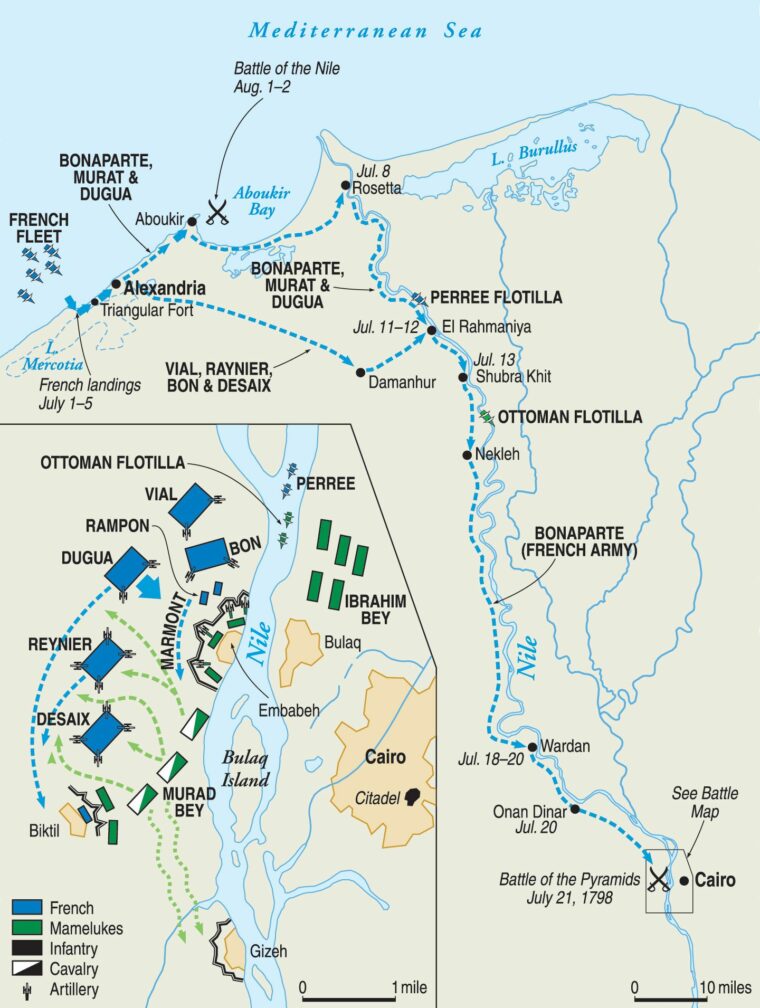
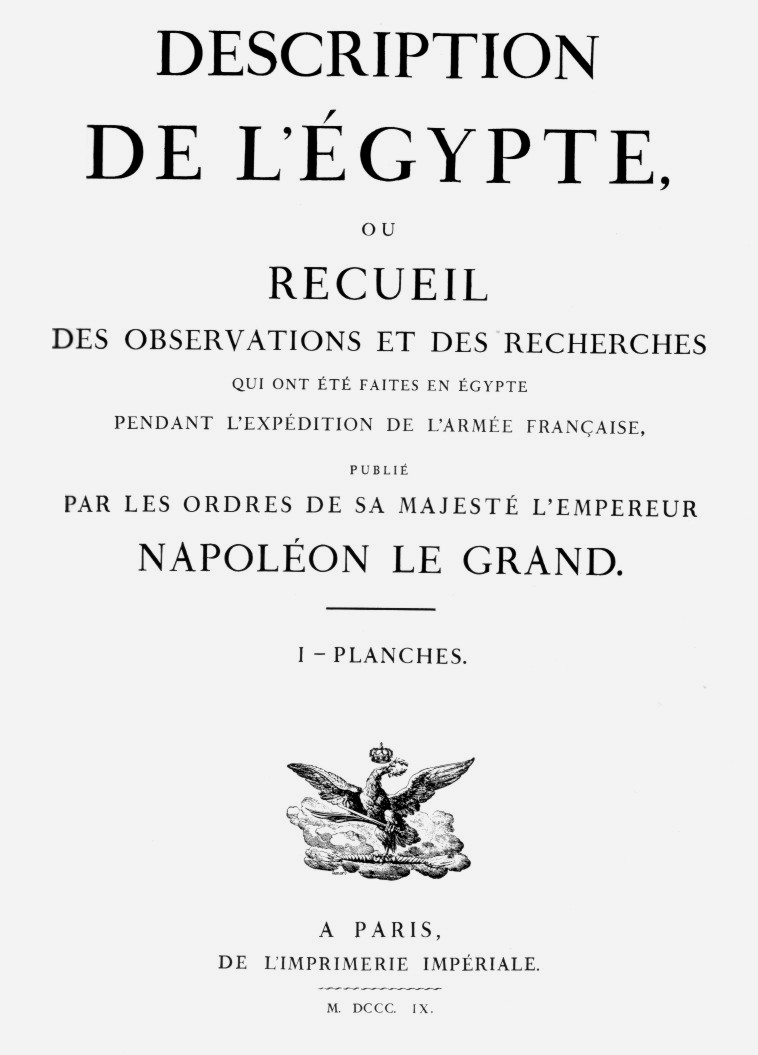
This cover page comes from the first edition of the Description. Published in 1809, this edition still paid tribute to Napoleon as the Emperor. The Second Edition, published between 1820-1829, would pay tribute to the King after Louis XVIII restored the monarchy in 1814.

(2nd Edition) – Antiquités
Frontispiece
Two months after landing at Alexandria, Napoleon Bonaparte established the Institut d’Égypte in Cairo in August of 1798. Along with his military forces, Napoleon had brought more than 150 scholars and scientists to Egypt to establish this academy. L’Institut d’Égypte was tasked with producing, “the research, study and publication of physical, industrial and historical facts about Egypt.” The eventual Description was split into 2 main sections: texts and plates. Naturally, the plates volumes are much more accessible than the dense texts, and thus will make up the bulk of this paper. The eleven volumes are broken into three sections: Antiquities, Natural History and Modern History. There are approximately 3,000 drawings, more than half of which are found in the Antiquities section, the Description’s richest section because of the French fascination with Ancient Egypt, a fascination modeled by Napoleon himself.
In the body of the frontispiece, many of Egypt’s famed monuments and structures are depicted in the foreground, though all seem to have been taken out of context. Missing from the image are any depictions of Egyptians, modern settlements or anything affiliated with Islamic culture.
Example Plates
These are four prime examples of the type of drawings one could find in the Description.

Pyramides de Memphis Pl.11, Vue de La Sphinx et La Grande Pyramide, Prise de sud-est, Volume 5 – 1823

Thebès Pl.51, Élévation Perspective de la Porte du Sud, Volume 3 – 1822

Edfoù Pl.49, Vue du Grand Temple, Volume 1 – 1820

Edfoù Pl.50, Plan et Coupe Générale du Grand Temple, Détails des Constructions Intérieurs, Volume 1 – 1820
Napoleon’s “savants” as they were called, would start with the topography of the place, then the panoramic view, perspective views, plans and elevations, and finally ending with details.
Note the similarity between La Porte du Sud (2nd image) and the Arc de Triomphe.
French often included themselves in their own depictions. Firstly, to provide a reference point for relative scale, but also possibly to signal and preserve their presence in the historic record. Egyptians are sometimes shown as well, but there is never any interaction between the two.
Fun Facts
Large Format Folios
Some editions of the Description were printed in elephant folio size (roughly one meter tall!). These are impressive collector’s items.
Multidisciplinary ‘Savants’
The scientists and scholars worked in highly-specialized fields, ranging from engineering and linguistics, to botany and zoology, to architecture.
Flora and Fauna
The Natural History Volumes introduced Europeans to many “new” species of plants and animals.
Buying and Selling the Description
Though much of the Description is available for free online, full original sets can sell for upwards $500,000.
Maps, and mapping were tools for imperialism in Egypt, insofar as they undermined and subverted the realities of modern-day Egypt. Plans were made for a canal through the Isthmus of Suez, as well as for re-building of existing canals and the construction of barrages.
These plans to remake the physical geography of Egypt, though never actually realized by French forces, are indicative of the literal and ideological reshaping of Egypt that was undertaken by the French, and is made manifest in the Description.
Further reading
- Godlewska, Anne. “Map, Text and Image. The Mentality of Enlightened Conquerors: A New Look at the Description de l’Egypte.” Transactions of the Institute of British Geographers 20, no. 1 (1995): 5–28. https://doi.org/10.2307/622722.
- Haddad, George A. “A Project for the Independence of Egypt, 1801. ” Journal of the American Oriental. Society 90, no. 2 (1970): 169–83. https://doi.org/10.2307/598134.
- Prochaska, David. “Art of Colonialism, Colonialism of Art: The ‘Description de l’Égypte’ (1809-1828).” L’Esprit Créateur 34, no. 2 (1994): 69–91. http://www.jstor.org/stable/26287498.
- Also Edward Said’s Orientalism
- Said, Edward W. Orientalism. Pantheon Books, 1978.
- Said, Edward W. Orientalism. Pantheon Books, 1978.
