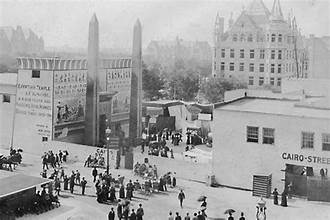
Paris 1867 & 1889, Chicago 1893, and St. Louis 1904
The World’s Fairs were designed to bring people from all over the world to one place and experience the culture and technological advancements of modern times. They were typically held in Europe and the United States and featured exhibits from many other c0untries.
Paris (1876 & 1889) – Exposition Universelle
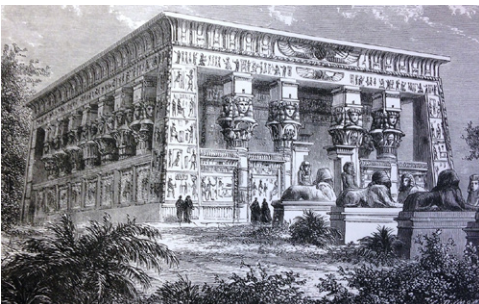
France, in attempt to one up Great Britain’s World’s Fair a few years prior, put on a grand exposition named Exposition Universelle that featured many different countries from around the world. Parc égyptien was designed placed in the oriental section of the fair and featured three buildings that took visitors through the history of ancient, medieval, and modern Egypt. The temple (left sketch) represented ancient Egypt and contained symbols, hieroglyphs, and architecture from the time period.
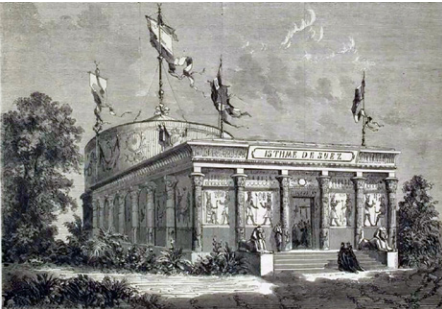
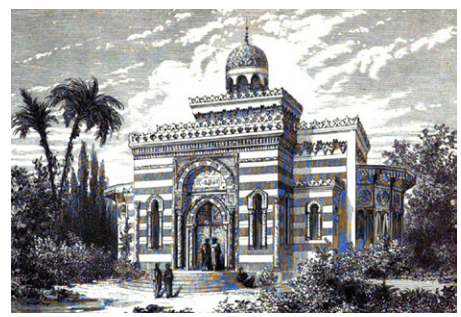
The Caravansary – a hotel for travelers common in the Middle Eastern area – (pictured on the right) represented medieval Egypt and a selamlik – a portion of an Ottoman palace – represented modern Egypt. The Suez Pavilion (pictured on the left) was the other major exhibit that was put on display in the Exposition Universelle that got a lot of attention and visitors and was revered for it’s realistic design. It showed off the construction that was taking place at the time in Egypt on the Suez Canal. France had a major role in this work and the pavilion worked to show off the good France was doing
In 1889, the Exposition Universelle came back to France in celebration of the 100th year anniversary of the French revolution. This was the first year that The Streets of Cairo – Rue du Caire – was featured (pictured to the right). Baron Alphonse Delort de Gélon was one of the main investors of the Streets of Cairo and the project manager. Gélon spent many years living in Egypt and studying the country and used his knowledge to bring a sense of authenticity to the exhibit; despite this however, there were still many elements that had been designed in a western interpretation of the Egyptian style. Timothy Mitchell in his book Colonizing Egypt mentions accounts of native Egyptians who visited Rue Du Caire and spoke about how westernized a lot of the Egyptian style used in the mosque and other buildings along the street was.

Chicago 1893 & St. Louis 1904
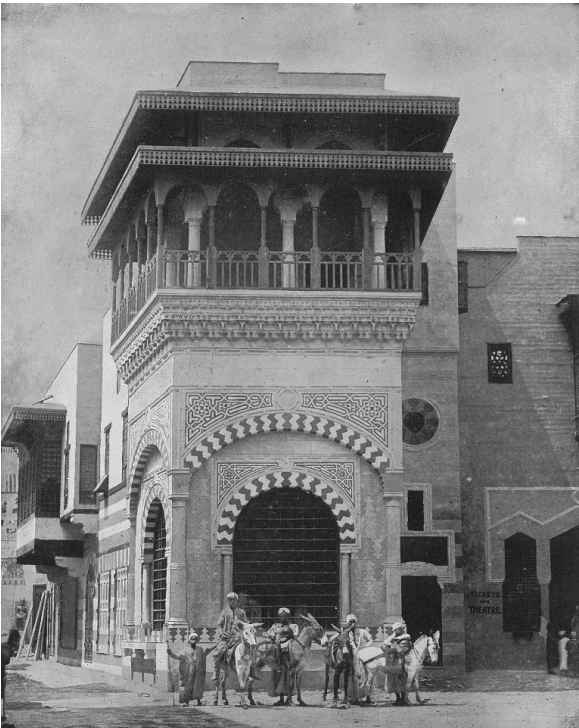
In 1893, Chicago’s World’s Colombian Exposition contained a large international sector called The Midway Palace, which housed Cairo Street. Henry Cobb and Max Hertz were the main designers/architects in charge of the street. They chose to take a romanticism approach, and created a street that would transport visitors to another world. Similar to that which was featured in Paris, Cairo Street was a long narrow road with high building walls on each side which disconnected the street from the rest of the world, making visitors forget the country they were in and feel as though they had stepped foot in Egypt.
The Streets of Cairo in Paris, Chicago, and St. Louis utilized the element of chaos to create the “authentic” feeling. There were many animals imported from Egypt including camels and donkeys, as well and people native to Egypt who were brought over to Paris and the Americas to work as vendors, animal caretakes, and different forms of entertainment. All these people, animals, and visitors on one narrow street created quite a crowd and made people feel like they were actually walking down the street in Egypt.
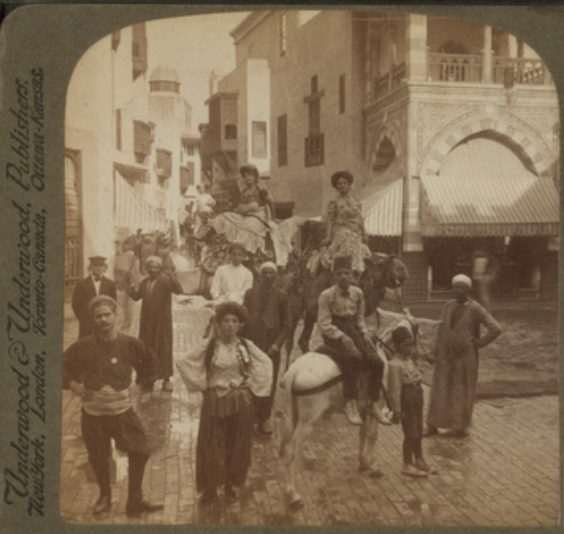
There was always something going on on Cairo Street. Fake birthday parties and weddings were put on to entertain visitors as well as constant performances from jugglers, fortunetellers, dancers, and more. Europeans and Americans who made up the majority of the visiting population were not use to being around this culture and style and many people describe the exhibition as being quite shocking and atrocious; however, it was also quite an exciting and interesting experience for visitors because it was so new and exotic to the western eye. The Streets of Cairo quickly became one of the most popular and most visited attraction.
The imperial gaze
The Egyptian government never officially participated in any of these fairs due to lack funds to be able to take on the entire project. They did however send some money to the host countries to support the creation of Egyptian exhibits and encouraged Egyptian civilians to participate in and work the fairs. This was because Egypt knew it was important to be represented; the attention and political connections gained from the fairs were beneficial to the country. That being said, Egypt did not care how they were represented, only that they were. This fact also meant that the main investors of Parc égyptien and The Streets of Cairo had major influence over their design. Egyptian style and Egyptian people were often caricaturized and made in the orientalist view. Newspapers and advertisements for the World’s Fair often emphasize the exoticness of the architecture and people within the exhibit, tapping into Western Egyptomania, making people excited to come visit. The more people that went to the fair, the more money the investors would make, so designers utilized what they could to draw attention to the exhibit.
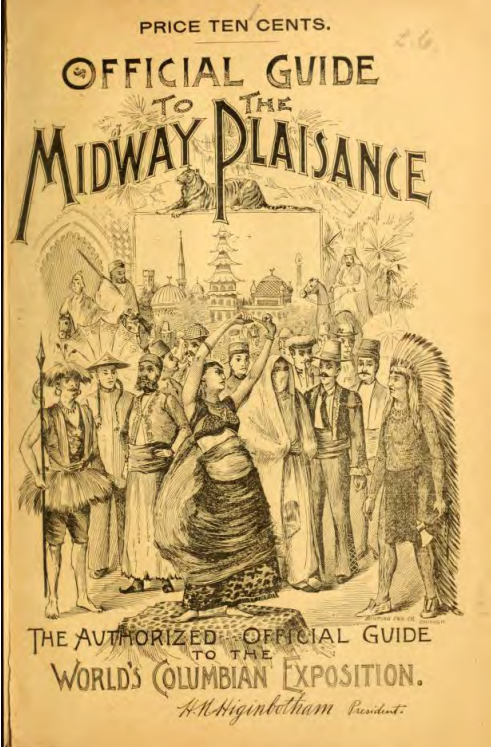

Left Image: Cover page of the guide to the Midway Place in the Chicago World’s Fair Right Image: French caricature of English visitors at the 1867 World’s Fair in Paris captioned “Oh! Shocking! Oh! Beautiful!”
This caricaturizing depiction of Egyptian culture created a superiority complex between the host country and the oriental countries. The World’s Fairs were a chance for the host country to show off their power, the colonies they controlled, their access to resources, and to promote faith in the country and the technological advancements being made. Most international exhibits were made for the imperialist gaze and designed to show off the host country’s superiority. As said before, architecture, style, and decor of Egypt was displayed as foreign and exotic. White European and American visitors bought from the vendors, putting native Egyptians working there in an inferior position. Entertainment was for the people who were able to pay to go see it, automatically putting them in a higher class than those who were working. The belly dancers who performed in the theatre on Cairo Street in Chicago and St. Louis were seen as scandalous for the way they moved and dressed which was a very different style than what western society is used to. Spectators would leave the exhibition with the idea that Egyptian culture was inferior due to there lack of western morals which built civilian confidence around their own country’s social and technological advancements.
Want to Learn more? Here are some sources to check out!
- Paris:
- St. Louis:
- Chicago:
- Book – Colonizing Egypt by Timothy Mitchell
- Book – Cairo in Chicago: Cairo Street at the World’s Columbian Exposition of 1893 by István Ormos
- https://arabist.hu/wp-content/uploads/articles/volume-37/Istvan-Ormos-2016.pdf
- World’s Fairs in general:
