• Skip to main content
  • Skip to footer

Deliberative Citizenship Initiative

Building Democracy One Conversation at a Time

  • The Initiative
    • Programs
      • Deliberation Across the Curriculum
      • Deliberation on Campus
      • Deliberation in the Community
      • Research on Deliberation
    • Motivations
      • Why Deliberative Citizenship?
      • Why Davidson? Why Now?
    • Who’s Involved?
      • DCI Fellows Cohorts
        • 2025-2026 Fellows
        • 2024-2025 Fellows
        • 2023-2024 Fellows
        • 2022-2023 Fellows
        • 2021-2022 Fellows
        • 2020-2021 Fellows
      • DeeP Collaborative Cohorts
        • 2024-2025 DeeP Collaborative Faculty
        • 2023-2024 DeeP Collaborative Faculty
      • Advisory Council
    • History
      • What Sparked the Initiative?
    • Key Deliberative Dispositions
    • Frequently Asked Questions (FAQ)
    • Annual Report
  • Get Involved!
    • Participate in a Forum
    • Join a D Team
    • Become a Fellow
    • Take Courses
    • Get Training
    • Come to Guest Lectures
  • Events
    • Upcoming Events
      • 250th Anniversary Deliberative Forum Series on American Values
    • Past Events
  • Connections
    • The Deliberative Citizen: The DCI’s Monthly Newsletter
    • Efforts on Campus
    • Efforts in the Community
    • Efforts Elsewhere
    • Readings and Resources
      • DCI-Published Guides
      • DCI Guide to One-on-One Conversations
      • How to Disagree
      • Demonstration of Facilitation Styles
      • Deliberative Pedagogy Mini-Course
    • How We Can Help: DCI’s LET’S DELIBERATE! Partnership Opportunities
    • DCI in the News
  • DCI Blog Posts
    • Recent Blog Posts
    • All Blog Posts

The DCI Blog

Deliberation and Role-Play as Tools to Foster Engagement, Civility, and Thought (in Spanish!)

January 16, 2026 by Jose Batista

The Deliberative Pedagogy (DeeP) Faculty Collaborative consists of faculty from Davidson College and other higher education institutions who are committed to learning and implementing new ways to improve and deepen the quality of their class discussions. These faculty come from a wide array of disciplines and backgrounds to study and discuss deliberative pedagogy methods, share their ideas and questions with one another, and work to embed deliberation in their classrooms. In this special blog series, members of the Collaborative describe and reflect on their experiences developing and teaching their deliberation-involved courses.

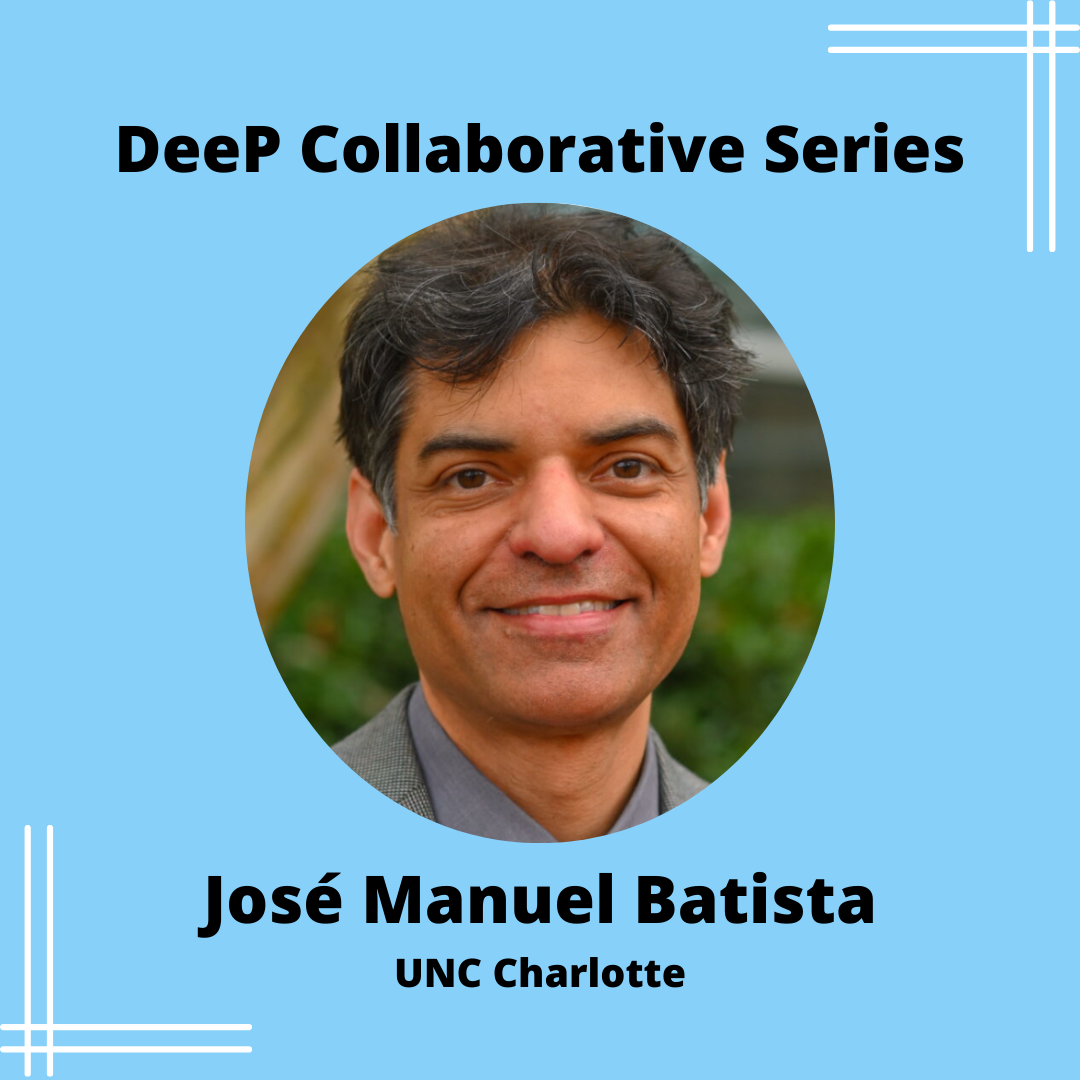
By José Manuel Batista (2024-25 Deliberative Pedagogy Collaborative Faculty Fellow)

Before the first Deliberative Pedagogy (DeeP) meeting, I wanted to get a better idea of what deliberative pedagogy was all about; so, I read through all the DCI Blogs and found the reports from college professors very instructive. Even though I was not versed in the practice or theory of deliberative pedagogy, the DCI blogs did provide a helpful window into what the DeeP collaborators actually did and what would be expected of participants.

Of all the blogs, I found the work of one professor, the classics historian Dr. Vander Poppen from Rollins College, most intriguing and relatable in terms of how I could use a deliberative approach in my course on “Spanish American Civilization and Culture.” After watching his video, I began to think about adopting role-playing to motivate students to engage with historical events, controversies and documents by drawing up a list of major controversies and historical events to consider for the course.

As I came to fully understand deliberative pedagogy under Dr. Graham Bullock’s direction, and its connection with our democratic ideals as documented by Carcasson, Drury, Hess and McAvoy, and others, I realized that I had to radically transform the course and not just add an extended role-play activity to deepen comprehension of the material. I had to embrace a more humanistic pedagogy that fosters empathy and understanding, and not just critical thinking; a pedagogy that revolves around collaborative learning. The epiphany was important because, for this project, I was able to set aside my fixation on inquiry-based learning and the Socratic method.

The readings, different types of meetings, and the participants were instrumental in the process of developing the course. After reading the “DCI Guide to Different Forms of Discourse,” for example, I decided to include at least one of each type of discourse (conversation, discussion, dialogue, debate, and deliberation) so that students could gain a better understanding of a deliberation by way of contrast.

The initial Deliberation Facilitator Training Program Sessions in which DeeP faculty interacted with Davidson Wildcats was one of the highlights of the entire experience. Dr. Graham Bullock and Willow Paul organized micro-deliberations as well as mini deliberations for us to experience. I personally found these events memorable and meaningful. For example, I decided to use micro-deliberations as a skills development tool from this experience. In this manner, I thought, I could dedicate a particular warm-up session to a basic aspect of deliberation whether its deliberative dispositions, facilitation styles, ground rules, etc.

The DeeP Collaborative Cohort meetings were also helpful. In the second such meeting, I remember the biologist Dr. Kate LeCroy sharing her course plans and I was struck by her emphasis on the debrief and reflective component of the deliberations. Up until then, I had not really considered the value of the debrief or reflection, and, as a result, I made sure to leave ample room for this important step of the deliberation. More importantly, she really seemed to grasp the humanistic element of the deliberation; something that I had not yet fully assimilated.

The Faculty Partner Meetings were also great; I was fortunate to be paired with Dr. Abril Jiménez, a professor of Spanish at Davidison College. As language professors, our discussions helped me better adapt the deliberative approach to my Spanish language content course. Dr. Jiménez also showed me the value of broaching current affairs topics in class. In fact, we now share an ever-growing discipline-specific list of deliberation topics to use in our Spanish-language classroom. As a side note, we may be the first DeeP partners to conduct all of our meetings in a foreign language!

The course I worked on is titled, “Spanish American Civilization and Culture: A Deliberative Approach,” and it’s an advanced undergraduate Spanish level content course. The first two weeks we read a selection from Grant and the first three chapters from Aikens and Talisse. Student wrote brief summaries of the reading assignments. They also thoroughly enjoyed the discussions and found Grant, in particular, incredibly helpful in their own personal lives.

Initially, students were to complete a dozen or more micro-deliberations as a class warm-up. Instead, however, since the aim was to use the micro-deliberation for skills development, the activity ended-up taking nearly the entire 75-minute class session. As a consequence, the number of micro-deliberations were reduced from 15 to five.

Students found these sessions helpful in terms of understanding what deliberations entail, practicing the deliberative rules or dispositions, and, most importantly, managing their emotional response to contrary views. All deliberation topics were contentious current affair topics and given the diversity of the classroom (36% white, 36% latino,18% African American, and 9% Asian) the deliberations were lively and, for some, challenging.

Dr. Graham Bullock’s modeling and the readings from Hess and McAvoy were helpful in handling certain situations. After the micro-deliberations, the course then shifted to two multi-day deliberations. The deliberations were simulated, that is, students adopted a historical persona to deliberate on whether to accept or reject a newly founded republic’s constitution.

Originally, the first deliberation was a role-play and the second would have tackled a current affair. However, after the first simulation, and the wonderful student feedback, I decided to repeat the simulation in order to improve upon it. The students agreed because they felt somewhat unprepared to discuss the first constitution and found it difficult to stay in character.

Given these observations, in the second deliberation on a different constitution, we spent an additional day analyzing the constitution, rehearsed roles with a prop, mask or costume the day prior to the deliberation, and came to class in character for the deliberation. Students stayed in character and saw others as characters. I made an effort to balance political leanings of characters as well as assigning characters opposite to the student’s own political leanings. The students had a blast and the quality of the deliberation was excellent.

I look forward to continuing to improve the course, expanding the use of deliberation in other courses, like an Honors section of a Critical Thinking and Communication course, and perhaps, if time allows, develop yet another course on the Fundamentals of Democracy. I also intend to continue participating in Deliberative Forums hosted by Davidson College. I participated in a couple during the Fall of 2024 to gain more experience with deliberations. At UNC Charlotte, Dr. Andrew Keener and Dr. Mindy Adnot, both DeeP Collaborative alumni, got wind of my involvement with the DeeP Collaborative and kindly invited me to participate in a Faculty Workshop on deliberation that took place on March 17th, 2025. Even though I was still reading and working on the course, I presented my initial work with micro-deliberations as a skills-development tool. The reception to our workshop was positive and we plan on doing a follow-up next academic year.

Selected Readings

  1. Akin, S., and R.B. Talisse. Why We Argue (And How We Should), Routledge, 2018.
  2. Bullock, Graham, and Kyle Braxton. “DCI Guide to Different Forms of Discourse”
  3. Hess, Diana E., and Paula McAvoy. The Political Classroom, Routledge, 2015.
  4. Grant, Adam. “Actions for Impact.” Think Again. The Power of Knowing What You Don’t Know. Viking, 2021, pp. 253-259.
Filed Under: Faculty Posts

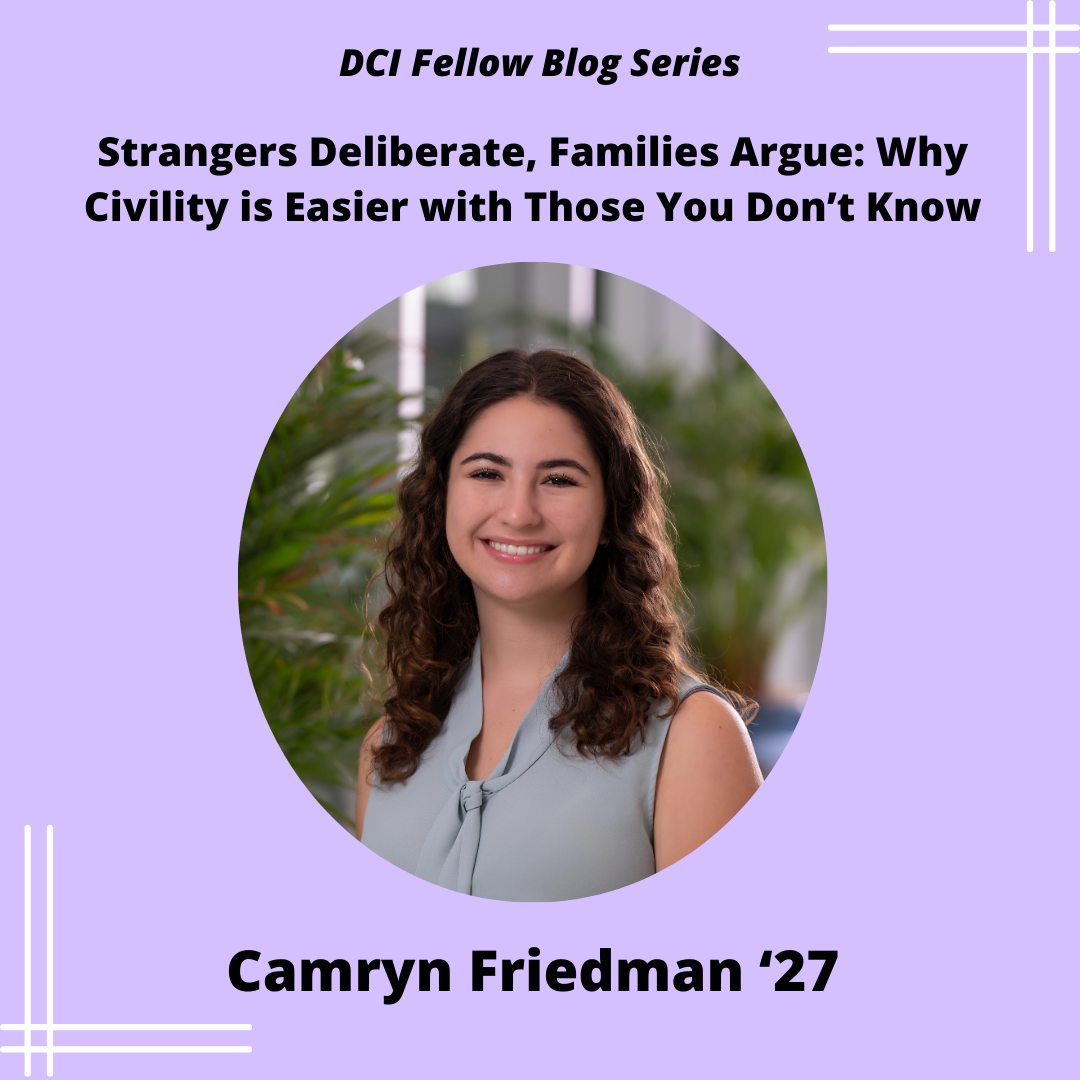
Strangers Deliberate, Families Argue: Why Civility is Easier with Those You Don’t Know

January 12, 2026 by Camryn Friedman

By Camryn Friedman ’27 (DCI Fellow)

During a lively conversation with family and friends, our loud demeanor suddenly shifted into hushed tones when the discussion transitioned to politics. Knowing that some of the people there had strong political views that are very different from our own, we were careful that they would not overhear what we had to say in order to avoid an argument.

This stood out to me because this aversion to discussing politics with those that disagree with me is paradoxical to everything I do with the DCI. I am a strong proponent of having these difficult conversations with people that have varying opinions from my own, so why is it so difficult for me to practice this with those I am close with?

The DCI brings together people from many different backgrounds and places them into groups to have these deliberations. The people in D Teams do not previously know each other – they come into the conversation as strangers. Without the pressure of maintaining a relationship with these people, it can feel easier to honestly share your opinions and not judge others for their views.

With family and friends, people often feel compelled to hold the same beliefs. We inherently want to have things in common with those we are close to, and since politics is such a personal thing that many feel passionate about, we tend to prioritize it as something we want to have in common with those around us.

In Robert B. Talisse and Scott Aikin’s book Why We Argue, they write how arguing is a display of respect and care for one another. When we have a belief that is challenged by someone we are close with, we feel compelled to argue with them because we believe we are right and do not want them to be wrong. We can even feel embarrassed or concerned about people that disagree with us because of how strongly connected we are to our own political beliefs.

Therefore, our emotions when discussing politics with those we are close with can be much more intense than when we talk with strangers. This makes deliberation easier and more effective with people who you did not previously know. I think this allows the DCI to have highly productive conversations.

The goal of deliberation is not necessarily to come to an agreement, it is to find common ground and open your mind to why people who disagree with you hold those views. In our relationships – family, friends, neighbors, etc. – we should work to approach our discussions with this same mindset. Arguing with those we care about is inherent in human nature, but we can strive to use deliberative values to have these conversations rather than acting overly defensive.

Next time the subject of politics arises when I am around people who hold different beliefs from my own, I hope to have an open-minded and productive conversation with them rather than speaking quietly or changing the subject to avoid an argument. I know that I do not need to be in agreement with everything my friends and family believe. While we feel compelled to argue because we care about them, having productive conversations rather than forming a hostile environment is necessary. We must respectfully deliberate with them to find what we have in common and understand their perspective.

Filed Under: Fellow Posts

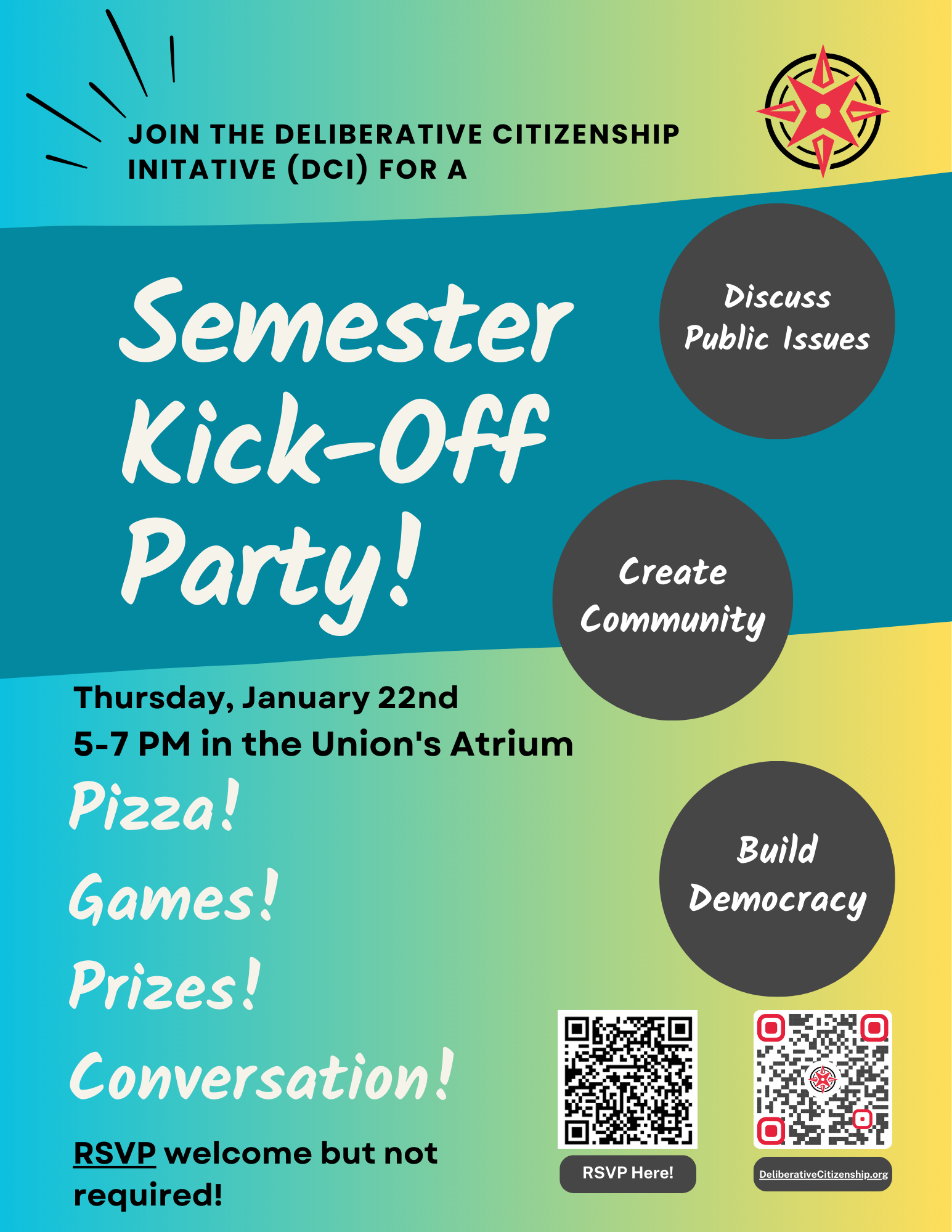
Join us for our Spring 2026 Semester Kickoff Party!

January 8, 2026 by Graham Bullock

On Thursday, January 22nd from 5-7 pm, the DCI is hosting a Spring 2026 Kickoff Party! We will be in the Alvarez-Brown Atrium at the Alvarez College Union, and we welcome you to join us for an evening of connection, deliberation, and fun! We’ll have pizza, prizes, and some engaging deliberative activities in which you’ll be able to engage with members of our Davidson community on both local and national topics of interest. It’s a great way to kick off the new year and connect with others who are interested in building community and improving our public discourse.

This event is intended to bring together those who have already been involved with the DCI in some way with people who may not have had an opportunity yet to engage in our programming or would like to learn more about us. If you completed our Deliberation Facilitator Training in the past, have taken part in any of our Deliberative Forums or D Teams, we would love for you to join us and help show others what the DCI is all about.

If you’ve never been to a DCI event or want to participate more but don’t know how to get involved, this is a perfect opportunity to learn more from the DCI community. Students, staff, faculty, community members, alums and family members are all welcome! We’ll share a bit about our plans for the upcoming semester – we’ve got some great events and activities on the calendar for 2026!

We hope you’ll decide to join us for our Kickoff Party! Feel free to drop in any time, bring a friend, and enjoy some free pizza! Registration is not required but an RSVP is appreciated for our planning purposes.

Filed Under: Announcements

Upcoming Expert Roundtable on Liberty and General Welfare: The Case of Social Safety Nets

January 8, 2026 by Graham Bullock

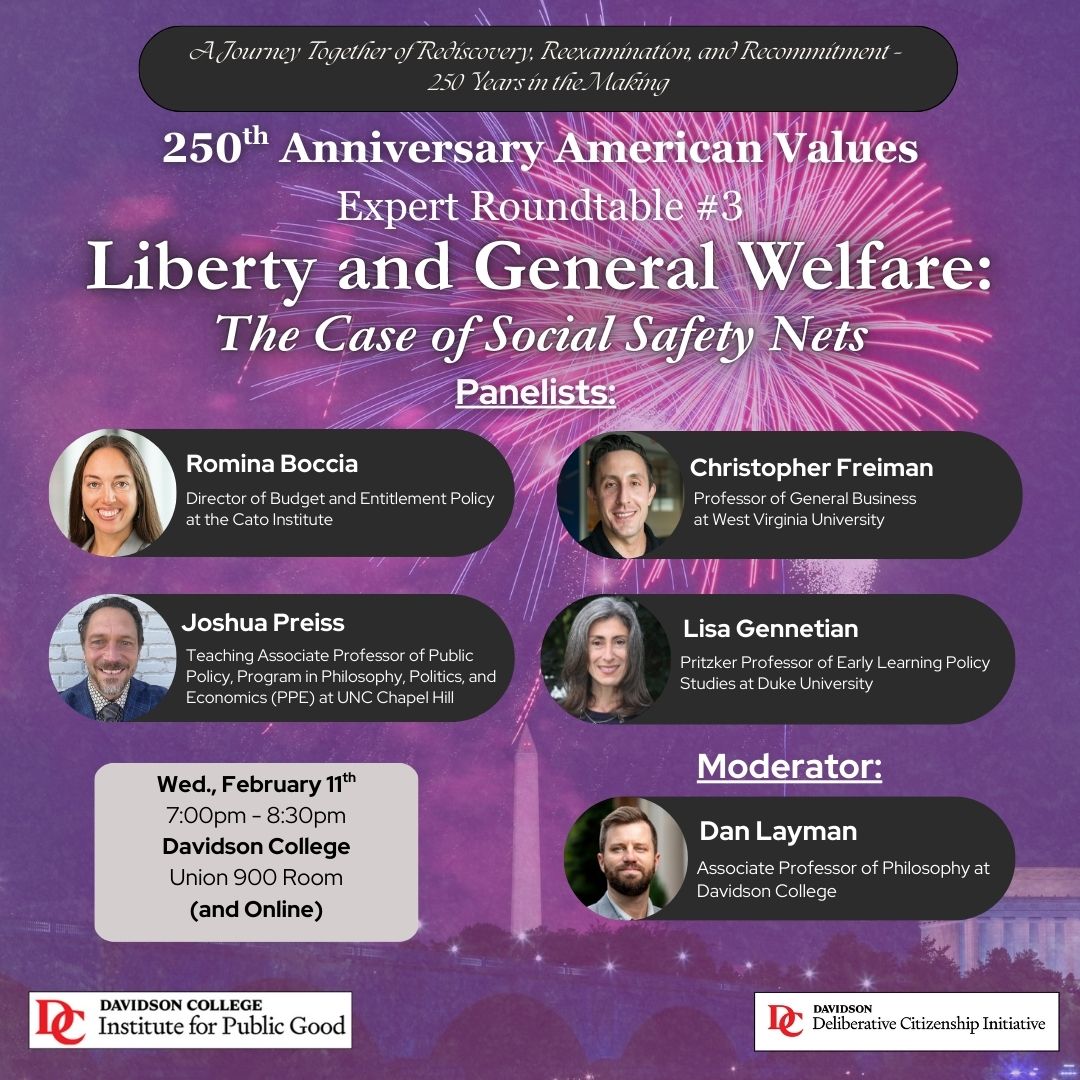
Poster for Liberty and General Welfare Expert Roundtable.

If you are ready to register to attend the Expert Roundtable either in-person or online, click here. If you’d like to learn more first, read on below.

Founding Commitments:

“…endowed by their Creator with certain unalienable Rights, that among these are Life, Liberty and the pursuit of Happiness…” (Declaration of Independence)
“…promote the general Welfare, and secure the Blessings of Liberty…” (Preamble)

A thriving democratic society must balance protection of individual liberty with policies aimed at collective welfare and prosperity. Ensuring broad-based societal flourishing may require significant governmental intervention, yet expansive government action risks encroaching upon individual freedoms and economic autonomy. Such government action may both reduce disparities in the general welfare of a nation’s citizens and promote economic growth that benefits all citizens while simultaneously limiting their liberties through higher taxes, stronger regulations, and other policies.

There has long been an inherent tension within American society between the individual and the group. The Declaration of Independence is often recognized as the ideological foundation on which America was founded, and no phrase is perhaps as recognizable as the one that states that all men are “endowed…with certain unalienable Rights, that among these are Life, Liberty, and the pursuit of Happiness.”

The Preamble of the Constitution builds on the foundation laid by the Declaration, laying out six essential objectives of our nation, including both securing “the Blessings of Liberty” and promoting “the general Welfare.” General welfare in this sense has both symbolic and substantive significance. It both encourages us to be mindful of the less unfortunate around us while also reminding us that the health and vitality of American society is the responsibility of every citizen. General welfare is further reflected in several core American aspirations, including public safety, public health, economic security, public infrastructure, and safety net programs designed to help out people who are most in need.

As part of the American Values Deliberative Forum Series it is co-hosting with Duke University and UNC Chapel Hill, Davidson College’s Deliberative Citizenship Initiative is hosting an Expert Roundtable that will explore these dynamics both conceptually and historically. This roundtable will be held on February 11 from 7 to 8:30 pm in the 900 Room on the Davidson College campus, and it will also be broadcast live online. Register here to reserve a ticket today (in-person seats are limited).

The Expert Roundtable is designed to stimulate conversations about the substantive compatibility of liberty and general welfare  as well as the tensions that inevitably arise when two fundamental American values are relevant to an issue of public concern. It explores different ways to understand these two values, their relationship to each other, and how they have interacted over the history of the United States. It brings all this together through a focus on public policy debates about existing social safety net programs like Medicaid, Medicare, and Social Security. While focused on the American context, these discussions are broadly relevant to similar questions being asked about liberty and general welfare in countries around the world.

The roundtable will include the scholars listed below, each of whom brings a unique set of expertise and knowledge to the conversation, both on the general questions related to liberty and general welfare and on the specific topic of social safety nets. Specifically, they will address the question, “Are the ideals of liberty and the general welfare compatible in American society, and what role should social safety nets play in balancing them?”

Expert Roundtable Panelist Bios

Romina Boccia is the Director of Budget and Entitlement Policy at the Cato Institute. She is a fiscal and economic expert specializing in federal spending, entitlement reform, and the long-term sustainability of major social programs such as Social Security and Medicare. Ms. Boccia publishes Debt Dispatch, a widely read fiscal newsletter for policymakers, and is the co-author of Reimagining Social Security: Global Lessons for Retirement Policy Changes (2025). She has also written about SNAP loopholes and accountability and is the principal author of the Heritage Foundation’s flagship budget plan, Blueprint for Balance. Ms. Boccia holds both her B.S. and M.A. in Economics from George Mason University.

Christopher Freiman is Professor of General Business at the John Chambers College of Business and Economics and Director of Outreach for the Kendrick Center for an Ethical Economy at West Virginia University. Dr. Freiman is a philosopher whose work engages with questions of distributive justice, liberty, and democratic engagement. He is the author of the book, Unequivocal Justice,  and articles on “Wealth Without Limits: In Defense of Billionaires,”  “Welfare,” “If You’re An Egalitarian, You Shouldn’t Be So Rich,” and “Equal Political Liberties,” among others. Dr. Freiman earned his Ph.D. in Philosophy from the University of Arizona after receiving his B.A. from Duke University.

Lisa Gennetian is the Pritzker Professor of Early Learning Policy Studies at Duke University’s Sanford School of Public Policy. Dr. Gennetian is an applied economist whose research focuses on child development, behavioral economics, and the effects of poverty and social policy on children and families. Her work combines economics, psychology, and public policy methods, including randomized controlled trials, to understand how socioeconomic conditions and programs influence long-term outcomes. She is a co-PI on Baby’s First Years, a multi-site study examining the causal impact of unconditional cash transfers to low-income mothers and their children. Dr. Gennetian earned her B.A. from Wellesley College and her Ph.D. in Economics from Cornell University.

Joshua Preiss is Teaching Associate Professor of Public Policy and Core Faculty in Philosophy, Politics, and Economics (PPE) at the University of North Carolina at Chapel Hill. Dr. Preiss is a philosopher and public policy scholar whose work spans political economy, ethics, freedom and markets, and justice in modern societies. His 2021 book,  Just Work for All: The American Dream in the 21st Century, argues for re-centering justice in debates about work, opportunity, and economic policy. He has also authored articles on “Freedom, Autonomy, and Harm in Global Supply Chains,” “Libertarian Personal Responsibility,” and “Did We Trade Freedom for Credit?” Dr. Preiss holds a Ph.D. in Philosophy from the University of Chicago. 

Dan Layman, Associate Professor of Philosophy at Davidson College, will serve as the moderator of the roundtable discussion. Dr. Layman’s research and teaching focuses on political philosophy and the character of political liberty, and he is the author of the book, Locke among the Radicals: Liberty and Property in the Nineteenth Century (Oxford University Press) and articles on “Robust Deliberative Democracy,” “The Fair Value of Economic Liberty,” and “Locke on Basic Income,” among others.

In the two weeks after the Roundtable, the DCI will be hosting a series of Deliberative “D” Team meetings that will build on the scholars’ deliberations. These two-hour deliberative discussions of 6-10 people will be moderated by trained facilitators. To learn more about these opportunities and reserve a spot at a time that works for you, click here (the deadline to do so is January 30). Duke, UNC, and potentially other institutions will be hosting similar conversations for their communities. If you are interested in hosting a conversation yourself at your organization, click here to watch a webinar on how both individuals and institutions can get involved — and how the DCI can help you with doing so.

For those unable to join a D Team, we will also be hosting a Community Conversation on the same topic on February 25 at 7 pm in the 900 Room. This will be an opportunity for students, faculty, staff, and community members to discuss the issues covered by the Expert Roundtable, guided by DCI facilitators. You can register to attend this conversation here.

The Expert Roundtable and Community Conversation are both part of the Deliberative Forum Series on American Values that Davidson College, Duke University, and the University of North Carolina, Chapel Hill are co-hosting in the lead-up to the 250th anniversary of the Declaration of Independence and the nation’s founding. Approaching this milestone in an era marked by historical amnesia and selective memory, the series aims to foster a more complete understanding of our nation’s past and present. To learn more about and register for the other forums and community conversations that are a part of this series, visit this webpage for more information and updates.

Inviting participants to reflect on the foundational ideals that have shaped our republic, each of the four forums in the series will draw from both the Declaration and the Constitution’s Preamble to explore a pair of core American values that often complement each other but also have been – and remain – at the heart of deep tensions, particularly during moments of national change. Through dialogue grounded in history, informed by philosophical inquiry, and connected to current policy challenges, this series and this guide is designed to encourage thoughtful deliberation on how best to uphold and balance these enduring commitments in an ever-changing democracy.

Register to Attend the Roundtable
Register to Join a D Team
Register to Participate in the Associated Community Conversation
Learn about the Webinar about the Series and How to Get Involved

Liberty-General-Welfare-and-Social-Safety-Nets-Forum-Poster

Filed Under: Announcements

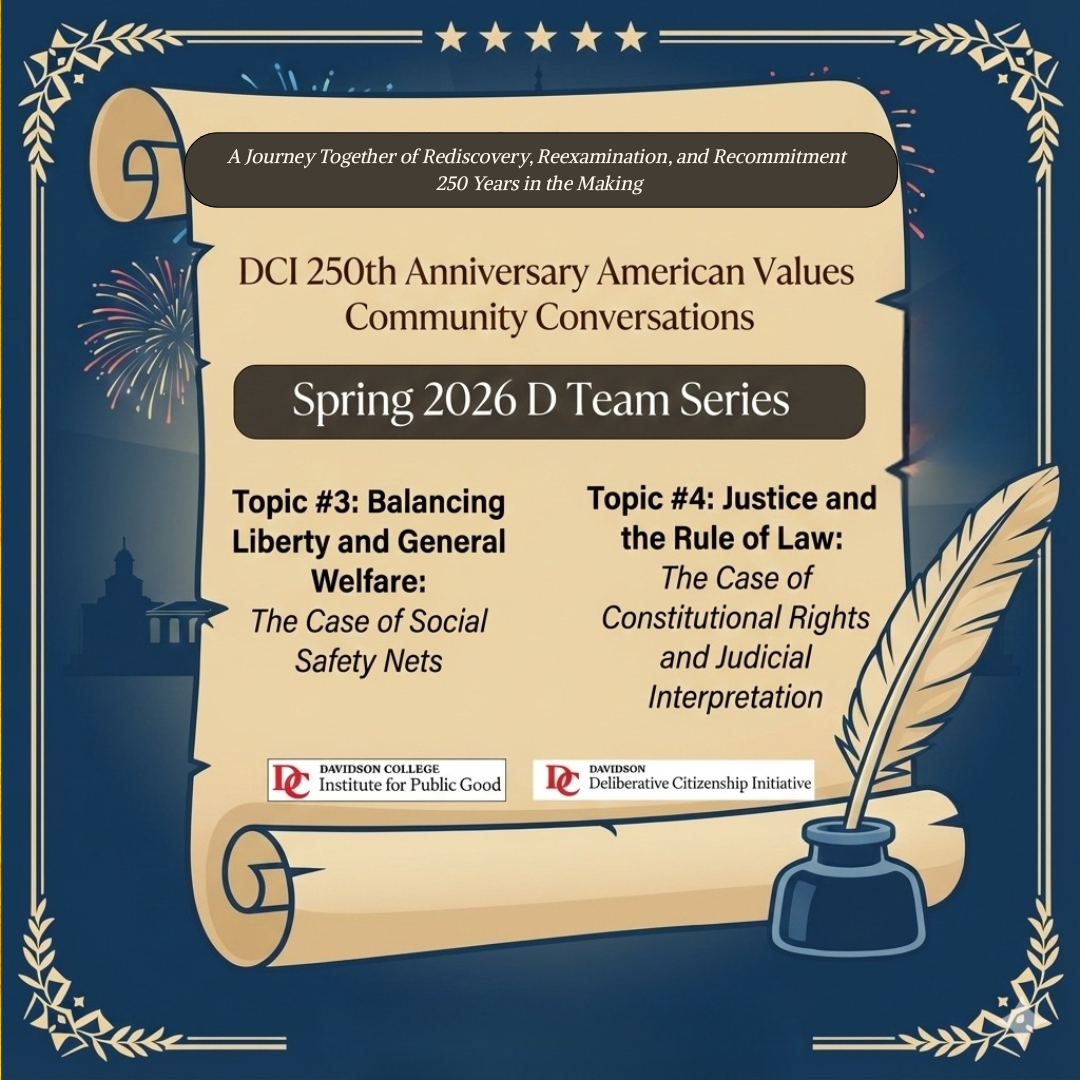
250th Anniversary Community Conversations about American Values: The Spring 2026 D Team Series

January 8, 2026 by Graham Bullock

If you are ready to sign-up for a Spring 2026 D Team Community Conversation, click here and it will take you to the registration form. If you’d like to learn more, read on below…

You might have heard that this year — 2026 — is the 250th anniversary of the Declaration of Independence. You might also be concerned about the state of our country — 3 out of 4 Americans are dissatisfied with its direction.

Perhaps you are looking for a way to both express and explore those concerns while also reflecting on the trajectory of American history in this anniversary year. How can we both celebrate the progress we have made (and the world has made) while also examining the progress we still have yet to achieve?

If so, you might be interested in participating in the Deliberative Forum Series on American Values being hosted by Davidson College, Duke University, and the University of North Carolina, Chapel Hill. The series aims to engage diverse public audiences with a nuanced and complex understanding of our nation’s history and the underlying principles, traditions, and stories on which our country was founded.

The series is organized around a series of four forums over the course of the 2025-2026 academic year. Each forum will consist of an Expert Roundtable that will explore two particular values and connect them to current events and issues facing the American public. The roundtables will be followed by Community Conversations by higher education institutions and other organizations across North Carolina and beyond.

The D Team Community Conversations hosted by Davidson College will follow a format similar to the D Teams it has been organizing for the past five years. They will be held in the week or two after each forum, and students, faculty, staff, alumni, and community members can sign up for meetings that will be held during the day or in the evening on both weekdays and weekends. You can sign-up for these conversations here; the registration deadline to register is January 30.

For those unable to join a D Team Community Conversations, we will also be hosting a single Community Conversation on the same topic as the first Expert Roundtable on February 25 at 7 pm in the 900 Room. This will be an opportunity for students, faculty, staff, and community members to discuss the issues covered by the roundtable’s panelists, guided by DCI facilitators. You can register to attend this conversation here.

The first American Values Deliberative Forum was hosted at Davidson College in the fall and focused on Balancing Equality and Unity: The Case of Immigration and Citizenship, while the second American Values Deliberative Forum, hosted at UNC Chapel Hill also in the fall, explored the topic of Balancing Self-Government and National Stability: The Case of Presidents, Institutions, and the People.”

Our third American Values Deliberative Forum topic is Balancing Liberty and General Welfare: The Case of Social Safety Nets. The associated Expert Roundtable will be held on February 11th at Davidson College. You can learn more about this Roundtable and the participating panelists here. The fourth American Values Deliberative Forum topic will focus on Justice and the Rule of Law: The Case of Constitutional Rights. This forum will be held on March 24 at Duke University, broadcasted online, and streamed live at a watch party at the Davidson College. More information about it will be coming soon.

This innovative two-stage process is designed to connect expert knowledge with diverse public audiences. Scholars with diverse backgrounds and divergent interpretations of the topics at hand will be invited to the Expert Roundtables to ensure a wide range of perspectives is represented.  They will share and discuss their perspectives on the values in question (e.g., unity and equality) and how they relate to the contemporary issue in focus (e.g. immigration and citizenship).

Then the Community Conversations will provide the public with the opportunity to share their own views on these topics, building on, contesting, or transcending the experts’ perspectives. A Deliberation Guide will be provided in advance of the forum to provide everyone with some baseline information about the topics and different perspectives on them. This process hopefully will help us break out of tendencies towards our selective amnesia so that we engage with the full range of American voices and how we each, individually and collectively, understand what our values are and how they are relevant to our current challenges as a nation.

To learn how your organization might host its own Community Conversation following one or more of the Expert Roundtables, you are welcome to watch this webinar that will introduce the forum series and map out a range of different ways to get involved.

To learn more about the D Team experience more generally, check out this page.

Register for the DCI’s American Values D Team Community Conversations
(Spring 2026 D Teams)

Spring-2026-D-Team-Flyer-11×17-1

Filed Under: Announcements

  • « Go to Previous Page
  • Page 1
  • Interim pages omitted …
  • Page 6
  • Page 7
  • Page 8
  • Page 9
  • Page 10
  • Interim pages omitted …
  • Page 75
  • Go to Next Page »

Footer

Blog Post Categories

  • Announcements
  • Blog Posts
  • DCI Posts
  • Events
  • Faculty Posts
  • Fellow Posts
Image of a compass superimposed by the text "Deliberative Citizenship Initiative" and "Davidson College." Clicking on this image leads to the Initiative page.

Recent DCI Blog Posts

  • We Tried to Fix Jubilee’s “Middle Ground” – Here’s How It Went
  • A Case for Deliberation in the Natural Sciences
  • Welcoming New Staff to the DCI and DCN
  • Facebook
  • Twitter
  • Instagram
  • LinkedIn


Copyright © 2026 · Infinity Pro on Genesis Framework · WordPress · Log in