• Skip to main content
  • Skip to footer

Deliberative Citizenship Initiative

Building Democracy One Conversation at a Time

  • The Initiative
    • Programs
      • Deliberation Across the Curriculum
      • Deliberation on Campus
      • Deliberation in the Community
      • Research on Deliberation
    • Motivations
      • Why Deliberative Citizenship?
      • Why Davidson? Why Now?
    • Who’s Involved?
      • DCI Fellows Cohorts
        • 2025-2026 Fellows
        • 2024-2025 Fellows
        • 2023-2024 Fellows
        • 2022-2023 Fellows
        • 2021-2022 Fellows
        • 2020-2021 Fellows
      • DeeP Collaborative Cohorts
        • 2024-2025 DeeP Collaborative Faculty
        • 2023-2024 DeeP Collaborative Faculty
      • Advisory Council
    • History
      • What Sparked the Initiative?
    • Key Deliberative Dispositions
    • Frequently Asked Questions (FAQ)
    • Annual Report
  • Get Involved!
    • Participate in a Forum
    • Join a D Team
    • Become a Fellow
    • Take Courses
    • Get Training
    • Come to Guest Lectures
  • Events
    • Upcoming Events
      • 250th Anniversary Deliberative Forum Series on American Values
    • Past Events
  • Connections
    • The Deliberative Citizen: The DCI’s Monthly Newsletter
    • Efforts on Campus
    • Efforts in the Community
    • Efforts Elsewhere
    • Readings and Resources
      • DCI-Published Guides
      • DCI Guide to One-on-One Conversations
      • How to Disagree
      • Demonstration of Facilitation Styles
      • Deliberative Pedagogy Mini-Course
    • How We Can Help: DCI’s LET’S DELIBERATE! Partnership Opportunities
    • DCI in the News
  • DCI Blog Posts
    • Recent Blog Posts
    • All Blog Posts

The DCI Blog

Sports Commentary as an Example of Unity Rather than Division

February 4, 2026 by Bolling Lewis

By Bolling Lewis ’28 (DCI Fellow)

In the United States, there are few aspects of society that unite people as powerfully as sports. Whether it’s Superbowl Sunday, the World Cup, or the NBA Finals, there are events in professional competition where people in different cities and countries share the same moment in real time. Universally, soccer fans remember the 2022 Argentina vs. France World Cup Final, and even casual NBA followers remember the 2016 Cleveland Cavaliers 3-1 series comeback. These collective memories create common ground among people with completely different life circumstances.

However, at the core of sports is an adversarial encounter. The zero-sum approach to matches and games means that one team’s success comes at the expense of another’s; when I cheer for a player at Wimbledon, I cannot witness my desired outcome without the opposition losing. The harsh reality of winning and losing in sports is misaligned with the idea of deliberation and community building. On paper, what people gain from the common experience of watching sports with millions of strangers can theoretically be taken away by the natural debate and animosity that competition instills. Yet, within the sports community, there are plenty of examples of deliberation and productive conversation that give reason to believe otherwise.

One of the leading examples of positive sports discussion is “Get Up.” A two-hour ESPN program that starts at 8 AM, the show primarily focuses on professional football and basketball. The first fifteen minutes usually contain highlights of games from the previous day along with complementary statistics; however, as time progresses, the dynamic shifts to commentary and opinions about players and teams. The host, Mike Greenberg (known by most as “Greeny”) is the facilitator. He dictates the topic of discussion and permits different analysts time to voice their stance. He once said about not dominating the conversation, but facilitating, “It was the first thing I learned when I started. An old boss said to me, “Your job is to reflect interest, not to create it.”[1] Therefore, rarely does Greenberg involve himself other than to play devil’s advocate with other members in the dialogue or ask probing questions to better understand certain viewpoints.

The analysts who sit at the table with Greenberg provide an array of perspectives. For example, when discussing football, “Get Up” incorporates experts such as Dan Orvolosky, Damien Woody, and Adam Schefter. Orvolosky is a former quarterback for the Detroit Lions. He brings an offense-oriented approach and helps viewers better understand a QB’s mindset. Damien Woody was an offensive guard who won multiple Super Bowls with the New England Patriots. Woody provides essential insight into the physical demands of football and the obstacles players face over a long season. Finally, Adam Schefter is an NFL reporter. He provides the conversation with information concerning player injuries and potential trades. Together, the crew’s diverse areas of expertise make the discussion more enlightening, but also smooth and effective. All of the people on the show see things differently, and even though they are often passionate about their beliefs, they respect other people’s opinions.

On Thanksgiving morning, “Get Up” focused its deliberation on the game between the Dallas Cowboys and the Kansas City Chiefs, which was to occur later that afternoon. One question Greenberg raised was who would be the most influential Cowboy if Dallas were to win. Woody argued that Quinnen Williams, a defensive lineman, would be the difference-maker. However, fellow analyst Josh McCourtney, a former NFL cornerback, disagreed. He believed that recently healed linebacker, DeMarvion Overshown, would determine the outcome of the game. Despite their fundamentally different stances, they were well-mannered and gave each other plenty of time to explain their reasoning.

When emotions run high in sports, it is often difficult to think rationally. Facts and statistics may tell one story, but team and city loyalties can easily override logic. “Get Up,” however, shows how potentially divisive topics can become constructive conversation when the participants bring varied perspectives and basic courtesy. The analysts may disagree, but their respect for one another ensures that the discussions remain productive and even enjoyable for both those at the table and the viewers at home.


[1]https://news.northwestern.edu/stories/2013/10/mike-greenberg-brings-radio-show-to-campus
Filed Under: Fellow Posts

Event Re-Cap: Campus Conversation on Civic Discourse in the Wake of Political Violence

February 4, 2026 by Stephen Walker

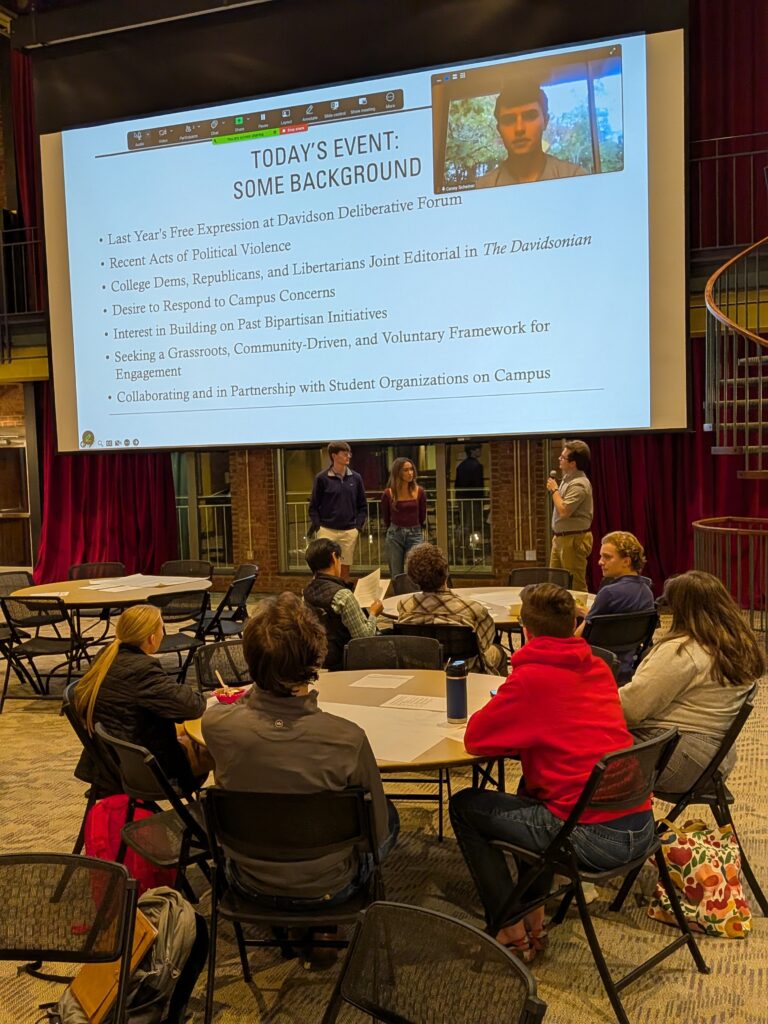
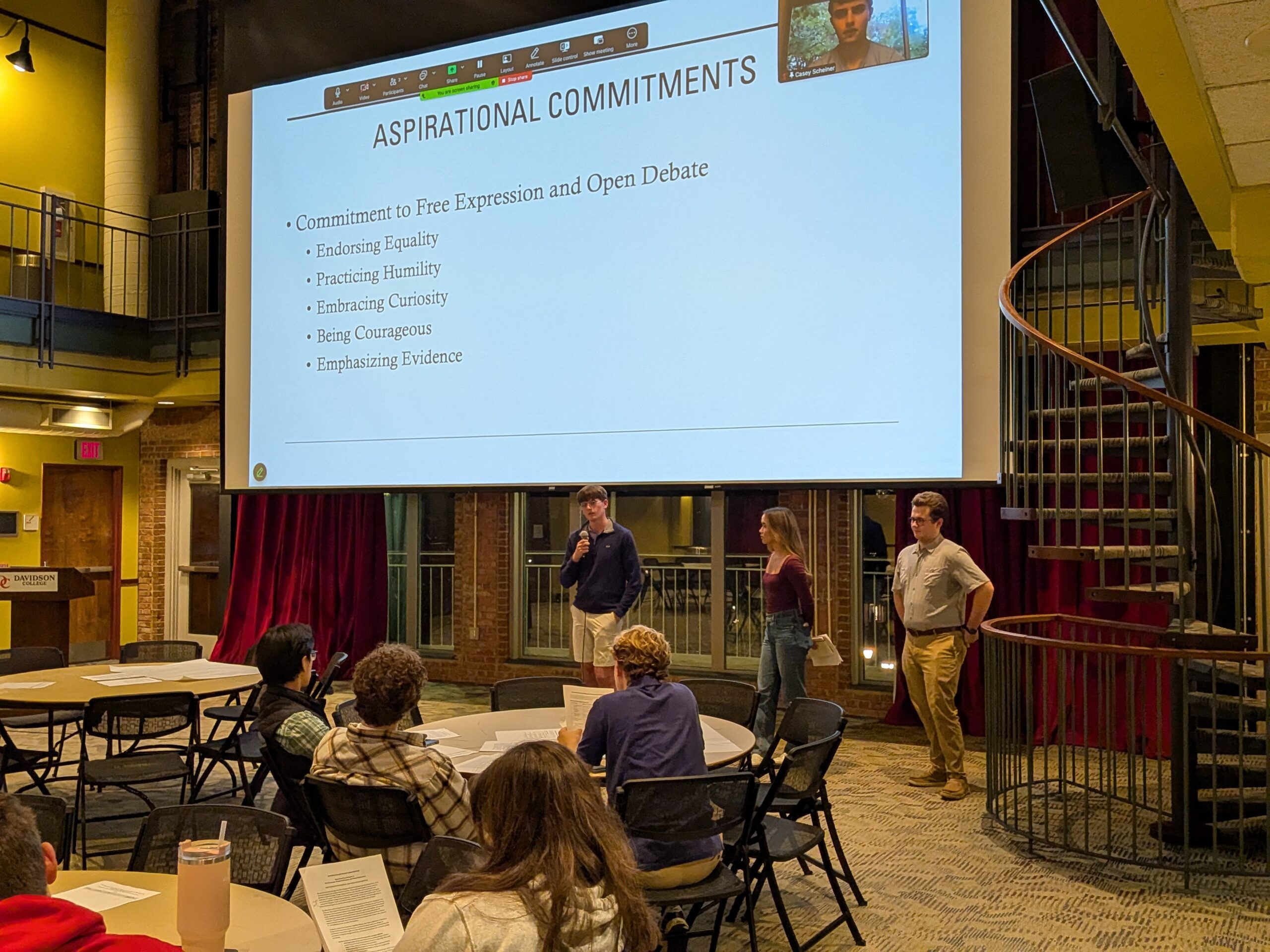
Students presenting in the 900 Room.

By Stephen Walker ’26 (DCI Senior Fellow and Co-Convener)

This Fall, Deliberative Citizenship Initiative Fellows Saeran Daewar ‘28 and Oliver Genovese ’28 and Senior Fellows Casey Scheiner ‘28 and Stephen Walker ‘26 worked with the guidance of DCI Director Graham Bullock and Professor Ike Baliey to host a Campus Conversation entitled “Civic Discourse in the Wake of Political Violence: How Can We Foster the Campus Culture We Want to Have?” on Thursday, November 20th.

The event builds on the work that they have been doing together this semester as they’ve thought about how Davidson can best respond to the assassination of Charlie Kirk and rising political violence in general. The work was motivated by the interest from students in following up on an opinion-editorial in The Davidsonian, in which the large political organizations on Davidson’s campus came together to condemn all forms of political violence.

Student participants, many of whom represented political organizations and student publications on campus, were treated to snacks and ice cream in the 900 Room of the College Union as the student fellows discussed the pertinent issues and the task of moving forward from it as a campus community.

The fellows began the presentation by walking attendees through relevant background details concerning free expression and campus discourse at Davidson, so all participants had some context before entering into the conversation portion of the event. This included strategies for maintaining a healthy political culture and past work to determine how that is best done at Davidson.

The Fellows also introduced themselves and their work to produce a list of aspirational commitments meant to bring community groups together around a set of community standards for engaging in public discourse. These standards were framed as rooted in the spirit of students’ shared decision to attend Davidson and agree to uphold an Honor Code and the college’s statement of purpose at all times.

Specific core components of the aspirational commitments document included a commitment to free expression and open debate, the inherent worth and dignity of all people, and organizing opportunities for respectful engagement across the political spectrum. The fellows then discussed a selection of passages from the College Constitution pertaining to free expression and rights of students, as well as the different terms at the heart of the commitment and the process by which students determine definitions for those terms.

The commitments document was designed to serve as a framework to start a conversation between participants, who were encouraged to discuss what they liked and thought should be added or changed in the document itself. The goal is to create a document truly shaped by the community it is designed to represent.

The participants were then asked to discuss the following questions to determine what their priorities were and how they would amend, if at all, the commitments document:

  • How can we foster civic discourse in the wake of political violence?
  • What should civic discourse look like on campus?
  • What value(s) or aspirational commitment(s) are most important to you in the context of civil discourse?

After sharing with other participants seated next to them and writing out their answers on a whiteboard, students shared their answers with the full group so everybody could see what their views on the three questions were.

The conversation then transitioned to several rounds of scenarios related to controversial expressions of speech. Participants were asked to discuss hypothetical situations and rank them on a scale ranging from 5 for maximum allowance to 1 for the least permissible forms of expression. Students were asked to contemplate the scenarios and discuss what specific facts influenced their ratings.

Then, students were asked to share with the full group before moving on to another round of hypotheticals. Each one was designed to demonstrate the nuance of a particular situation and the importance of a variety of relevant factors in determining whether a certain behavior was acceptable or not. It pointed towards the value of a document like the set of aspirational commitments that can serve as a point of reference in the future.

Such determinations are difficult, and the attending students showed careful consideration for the specifics of the document, the scenarios, and the issue of political violence at large. Being able to practice their analytical skills while contributing to a community document was a meaningful experience for the presenting fellows and participants in the audience. The conversations also provided important insights that will inform future revisions of the aspirational commitments document as it is further developed. Stay tuned for more updates coming soon!

Filed Under: Events

The Value of Deliberation In STEM

February 2, 2026 by Sharon Song

By Sharon Song ’28 (DCI Fellow)

As a Biology and Genomics major, I’ve spent most of my undergraduate training solidifying the idea that discussions are rigid and absolute. Every theorem must balance perfectly, every cellular pathway traced with care, every conclusion verified beyond doubt. Precision is a virtue; ambiguity, a shadow to be chased away.

When I joined the Deliberative Citizenship Initiative, I stepped into a space that felt both unfamiliar and quietly disarming, where answers did not wait at the finish line, and resolution was not the ultimate goal. At first, this deeply unsettled me; my instinct, honed by the drilling of data, proofs, and analysis, is to find certainty where it did not exist previously. But deliberation is not a problem to solve. It is a space to cultivate curiosity and to nurture mutual understanding.

There’s something profoundly human about deliberation. Unlike the structured world of hypotheses and proofs, deliberation breathes through the unique stories, emotions, and the intricate tapestry of lived experiences that deliberators bring to the table. It reminds me that knowledge isn’t built only in laboratories or lecture halls but built in moments of genuine listening and empathy. When people share how their lives have shaped what they believe, they’re offering a kind of truth that no experiment could ever capture or quantify.

DCI has taught me the value of slowing down, of resisting the pull towards immediate conclusions instead of lingering in the complexity and richness of a difficult conversation. I’ve learned that disagreement does not always have a negative connotation; there is an art to sitting with difference and silence, and in hearing another person’s perspective not as a challenge to defend against, but as a gift to receive with care.

What continues to surprise me is how this practice of deliberation has begun to reshape the way I see science itself. I once viewed science as something purely objective, detached from emotion or moral weight. But now I see how curiosity and compassion can coexist in guiding inquiry in ways that make discovery not just a pursuit of knowledge, but an act of empathy. Every scientific question begins with wonder; a quiet desire to understand something larger than oneself. And every discovery, no matter how technical, ultimately tells a human story. Deliberation and science, as I’ve come to realize, are not opposites but parallels. They are two distinct languages that seek the same truth, and both demand humility. Both remind us that learning begins when we acknowledge how little we truly know. 

This is what I love most about deliberation: it restores humanity to the act of learning more about those around us. It reminds me that wisdom isn’t measured by how much we know, but by how deeply we listen and effectively engage with one another in fostering a fruitful conversation. In a world that often rewards quick answers, DCI has taught me something gentler, and perhaps more radical: the quiet courage of asking better questions.

Filed Under: Fellow Posts

DCI Hosts Young European Leaders on State Department Visit

February 2, 2026 by Casey Scheiner

DCI x International House image with map of Europe in the background

By Casey Scheiner ’28 (DCI Senior Fellow and Co-Convener)

A group of ten European leaders, ranging from a member of the Croatian Parliament to an Austrian democracy advocate, paid the DCI a visit on Wednesday, August 20. As part of their tour of the United States with the State Department’s International Visitor Leadership Program, they spent a couple of days in Charlotte, where International House Special Projects Coordinator and Davidson alum Olivia Norten ‘25 brought the leaders to Davidson. On campus at the Cunningham Theater Center, Dr. Bullock and I led them in a deliberation on defensive democracy.

During the deliberation, I was in my usual spot as the facilitator moderating the discussion. However, this was uncharted territory for me: as a news junkie and DCI deliberation guide writer, I was accustomed to having a strong base of knowledge on the topic that would allow me to support deliberators’ thoughts with relevant factual insights. In this deliberation, I found myself by far the least versed member of the conversation in the inner workings of European politics and the defense of democracy across the Atlantic.

This made the experience all the more enriching for me, allowing me to learn so much from my deliberators, who were actively shaping the future of European democracy. Asking follow-up questions and calmly moving us from one section to the next, I did my best to play my usual role of the even-keeled facilitator, but I was awestruck by the sheer amount of knowledge, experience, and capacity to change the world in one room.

Insights from the delegation provided important reminders on things showing up in my own life, trivial and consequential. On the seemingly most mundane side, the leaders’ utter joy and fascination at seeing the pomp and circumstance surrounding Davidson freshman move-in that day let me appreciate the smaller things I don’t always recognize as a Davidsonian and American accustomed to certain things.

And on the promotion and defense of democracy, one of the defining issues of our time, the variety of different perspectives and solutions with which they approached the issue gave me hope that democracy does not require coalescence around a single correct solution, but rather a commitment to wrestle openly and honestly with its challenges.

It also reminded me that deliberation is not just an exercise for curious Davidson students, staff, and community members. It is equally, if not even more important, for leaders like these participants in the International Visitor Leadership Program who are the future (and, in many cases, the present) of European democracy to both embrace their differences and strive to find common ground in deliberative settings in ways that can solve the problems dominating our headlines.

Filed Under: Events

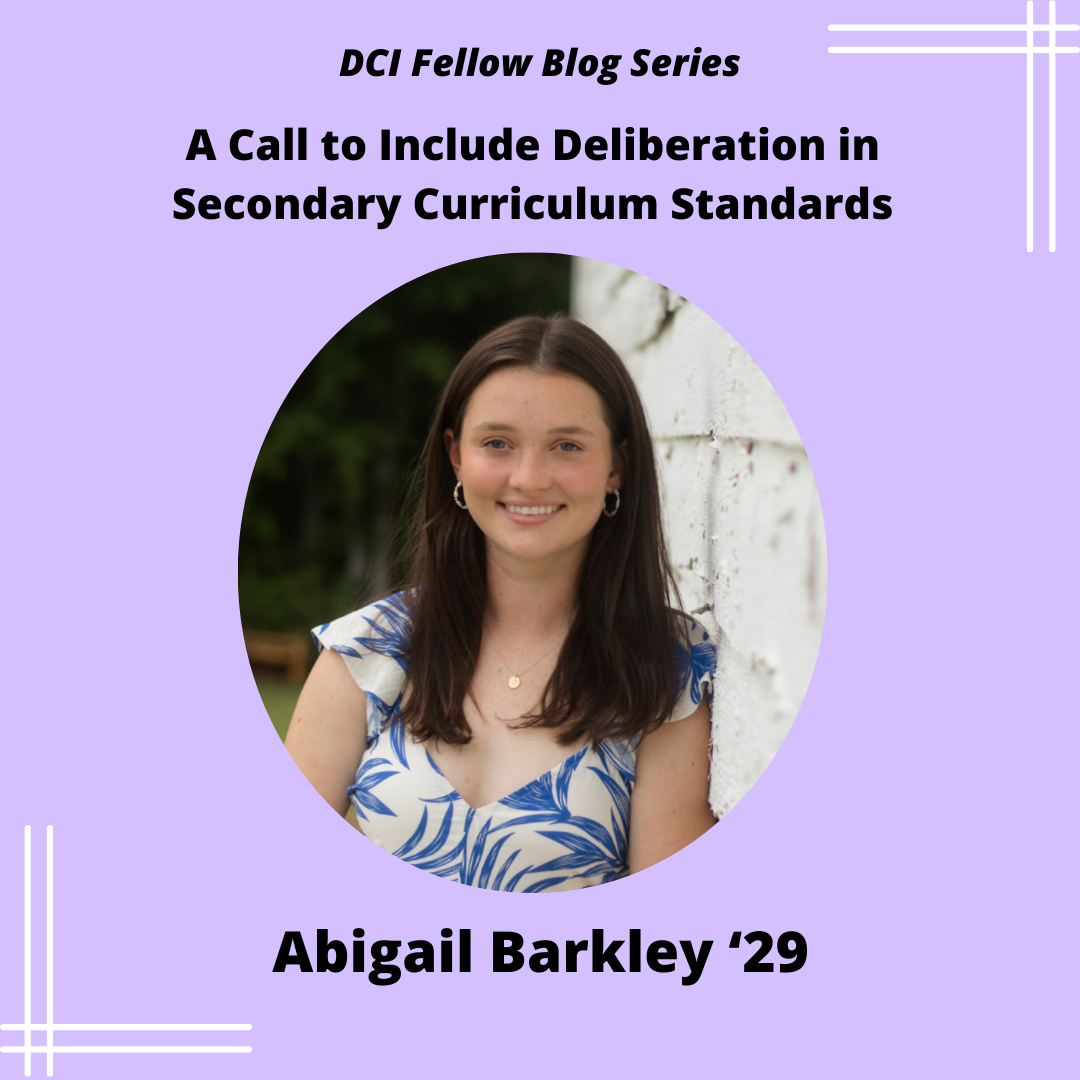
A Call to Include Deliberation in Secondary Curriculum Standards

January 30, 2026 by Abi Barkley

By Abigail Barkley ’28 (DCI Fellow)

In recent years there has been a rise in younger US citizens being politically active. Much of this rise is tied to social media and the accessibility of political information. While this is a positive trend, the discourse over social media leads to misinformation, a rise in polarization of views, and has inspired political violence and hate speech. These issues are what we try to tackle in the Deliberative Citizenship Initiative (DCI) through our Deliberative Forums and D Teams. While this is something that Davidson students and Davidson community residents can benefit from, there is not much practice in teaching deliberation skills to the wider population of young individuals. Teaching this in schools would provide students with the skill set to contribute to discourse in a productive way as they approach voting age and enter into the public sphere.

Because political research on individuals who cannot vote is limited, it is not clear how individuals in late Gen-Z and Gen-Alpha are affected by politics and social media. Most are present on social media sites; “Up to 95% of youth ages 13–17 report using a social media platform, with more than a third saying they use social media ‘almost constantly.’ (Office of the Surgeon General 2023) Because of this constant exposure to unregulated and informal discourse, it is becoming evident that there should be an example of how to participate in contentious conversations in a civil and productive manner.

Schools are an ideal place to teach kids conversational skills as they apply to controversial topics. Some schools provide opportunities for debate teams through extracurricular clubs or advanced courses. However, this is not available to the average student. Even when opportunities for debate are available, debate does not nurture the kind of conversation that deliberation provides. Debate is based in arguing a point with the intention of proving yourself to be correct. Deliberation allows for an environment that encourages participants to talk in a structured yet unscripted and natural manner that focuses on building understanding between those involved.

Instruction in deliberative methods in schools would provide students with an example of productive discourse. Because many have never been exposed to deliberative conversations, they need explicit instruction and modeling in order to convey their opinions as well as listen and disagree respectfully. Teaching students some seeds of deliberation such as, “Can you help me understand…?” to convey open-mindedness or “Building on what you just said…” to show attentiveness. Through explicit instruction across content disciplines, students could come to understand the key Deliberative Dispositions. Lessons on Deliberation would require students to: slow down their thinking, sit with ambiguity, value listening as much as speaking, hold competing truths at the same time, and reconsider positions in light of new evidence or stories. This isn’t something that should be done with the motivation that students will become political influencers or spend huge amounts of time arguing their points; it is a hope that they will carry deliberative values into their everyday conversations; with family, classmates, coworkers, or even strangers.

Filed Under: Fellow Posts

  • « Go to Previous Page
  • Page 1
  • Interim pages omitted …
  • Page 4
  • Page 5
  • Page 6
  • Page 7
  • Page 8
  • Interim pages omitted …
  • Page 75
  • Go to Next Page »

Footer

Blog Post Categories

  • Announcements
  • Blog Posts
  • DCI Posts
  • Events
  • Faculty Posts
  • Fellow Posts
Image of a compass superimposed by the text "Deliberative Citizenship Initiative" and "Davidson College." Clicking on this image leads to the Initiative page.

Recent DCI Blog Posts

  • We Tried to Fix Jubilee’s “Middle Ground” – Here’s How It Went
  • A Case for Deliberation in the Natural Sciences
  • Welcoming New Staff to the DCI and DCN
  • Facebook
  • Twitter
  • Instagram
  • LinkedIn


Copyright © 2026 · Infinity Pro on Genesis Framework · WordPress · Log in