• Skip to main content
  • Skip to footer

Deliberative Citizenship Initiative

Building Democracy One Conversation at a Time

  • The Initiative
    • Programs
      • Deliberation Across the Curriculum
      • Deliberation on Campus
      • Deliberation in the Community
      • Research on Deliberation
    • Motivations
      • Why Deliberative Citizenship?
      • Why Davidson? Why Now?
    • Who’s Involved?
      • DCI Fellows Cohorts
        • 2025-2026 Fellows
        • 2024-2025 Fellows
        • 2023-2024 Fellows
        • 2022-2023 Fellows
        • 2021-2022 Fellows
        • 2020-2021 Fellows
      • DeeP Collaborative Cohorts
        • 2024-2025 DeeP Collaborative Faculty
        • 2023-2024 DeeP Collaborative Faculty
      • Advisory Council
    • History
      • What Sparked the Initiative?
    • Key Deliberative Dispositions
    • Frequently Asked Questions (FAQ)
    • Annual Report
  • Get Involved!
    • Participate in a Forum
    • Join a D Team
    • Become a Fellow
    • Take Courses
    • Get Training
    • Come to Guest Lectures
  • Events
    • Upcoming Events
      • 250th Anniversary Deliberative Forum Series on American Values
    • Past Events
  • Connections
    • The Deliberative Citizen: The DCI’s Monthly Newsletter
    • Efforts on Campus
    • Efforts in the Community
    • Efforts Elsewhere
    • Readings and Resources
      • DCI-Published Guides
      • DCI Guide to One-on-One Conversations
      • How to Disagree
      • Demonstration of Facilitation Styles
      • Deliberative Pedagogy Mini-Course
    • How We Can Help: DCI’s LET’S DELIBERATE! Partnership Opportunities
    • DCI in the News
  • DCI Blog Posts
    • Recent Blog Posts
    • All Blog Posts

The DCI Blog

Duke University to Host Fourth Expert Roundtable on Justice and the Rule of Law

March 12, 2026 by Graham Bullock

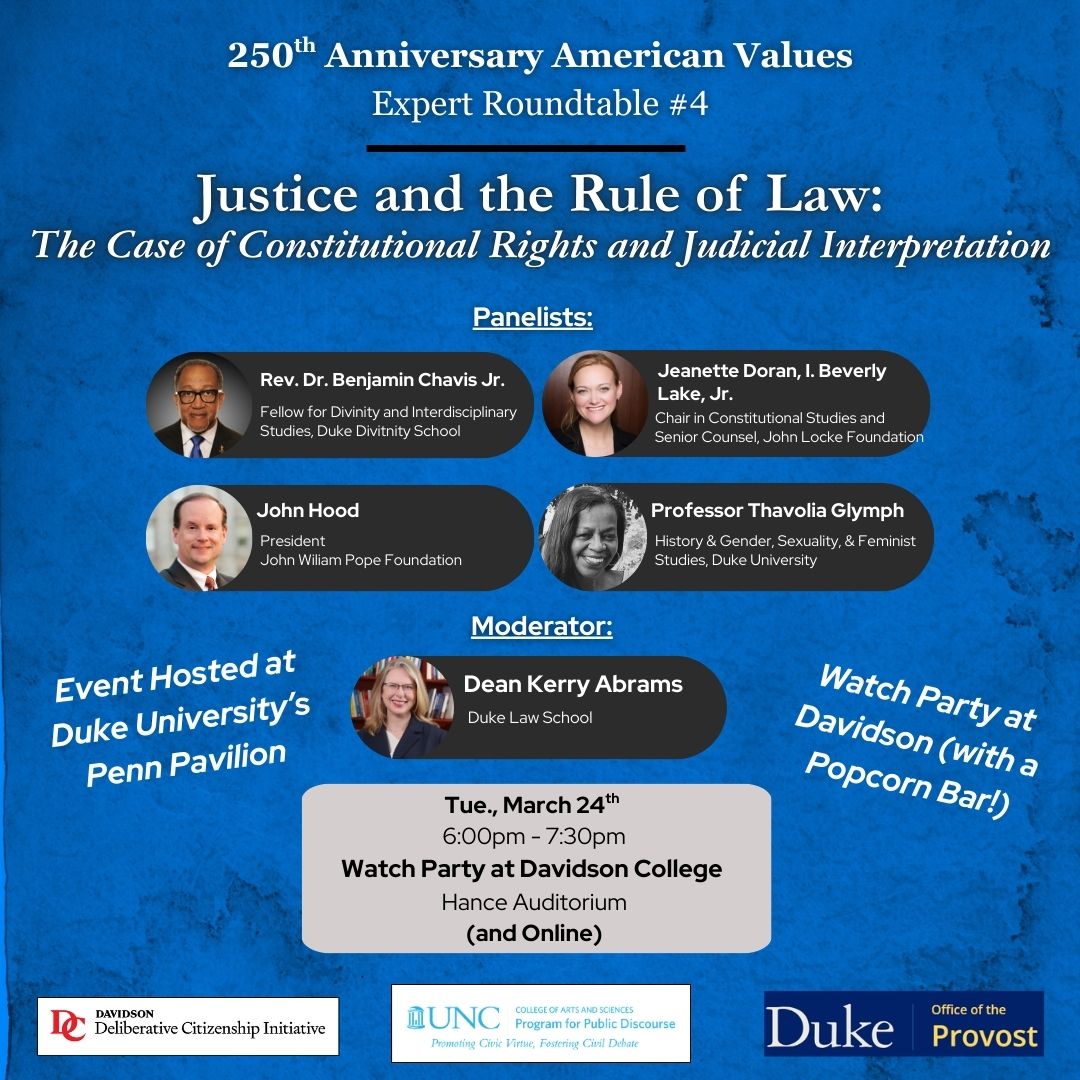
Poster for fourth forum in American Values Series hosted at Duke University

If you are ready to RSVP to attend the DCI’s Watch Party in Davidson’s Hance Auditorium, please click here. If you would like to register to join the event either online or in person at Duke University, click here.

As the 250th Anniversary of the signing of the Declaration of Independence approaches, the American Values Deliberative Forum Series continues with its fourth and final Expert Roundtable hosted by Duke University. This roundtable discussion brings together four leading voices to grapple with the principles of justice and the rule of law, core American values that often complement each other but that also have exposed deep tensions during moments of national change. 

This public event follows roundtables hosted by Davidson College and the University of North Carolina-Chapel Hill, co-organizers of the deliberative forum series that engages with the foundational ideals of our republic. The panel will consider the role that justice and rule of law have played in shaping the nation’s founding and the significance of these values as we think about our society today and the society that we hope to see in the future.

Through dialogue grounded in history and informed by current policy challenges, especially as they relate to constitutional rights and judicial interpretation of cases related to justice and the rule of law, this featured panelists will model thoughtful deliberation about how best to uphold and balance these enduring commitments in an ever-changing democracy.

“Justice and the Rule of Law: The Case of Constitutional Rights and Judicial Interpretation”
Tuesday, March 24, 2026 from 6:00-7:30pm
Location: Penn Pavilion, Duke University

Featured Panelists:

Rev. Dr. Benjamin Chavis, Jr., 2026 Senior Fellow for Divinity and Interdisciplinary Studies, Duke Divinity School

Jeanette Doran, I. Beverly Lake, Jr. Chair in Constitutional Studies and Senior Counsel, John Locke Foundation

Professor Thavolia Glymph, Peabody Family Distinguished Professor of History; Professor of Gender, Sexuality, & Feminist Studies, Duke University

John Hood, President of the John William Pope Foundation

Duke Law School Dean Kerry Abrams will moderate the roundtable conversation.

All members of the Duke University, Davidson College, UNC-Chapel Hill communities, alumni, and the general public are invited to attend this special event. The event is free, but registration is required. For questions, please contact Carolyn Mackman at carolyn.mackman@duke.edu.

To attend virtually or in person at Duke, please register here. Davidson College students, faculty, staff, and community members are invited to join a Watch Party in Hance Auditorium — we’ll have beverages and a popcorn bar to enjoy as we listen to the roundtable deliberate. Please RSVP for the watch party here; it is optional but helpful to us as we plan the event. Hope you can join us, or enjoy the event virtually or in person!

Forum-4-Poster-1

Filed Under: Announcements

Introducing the Davidson Deliberates Radio Show and Podcast

March 12, 2026 by Graham Bullock

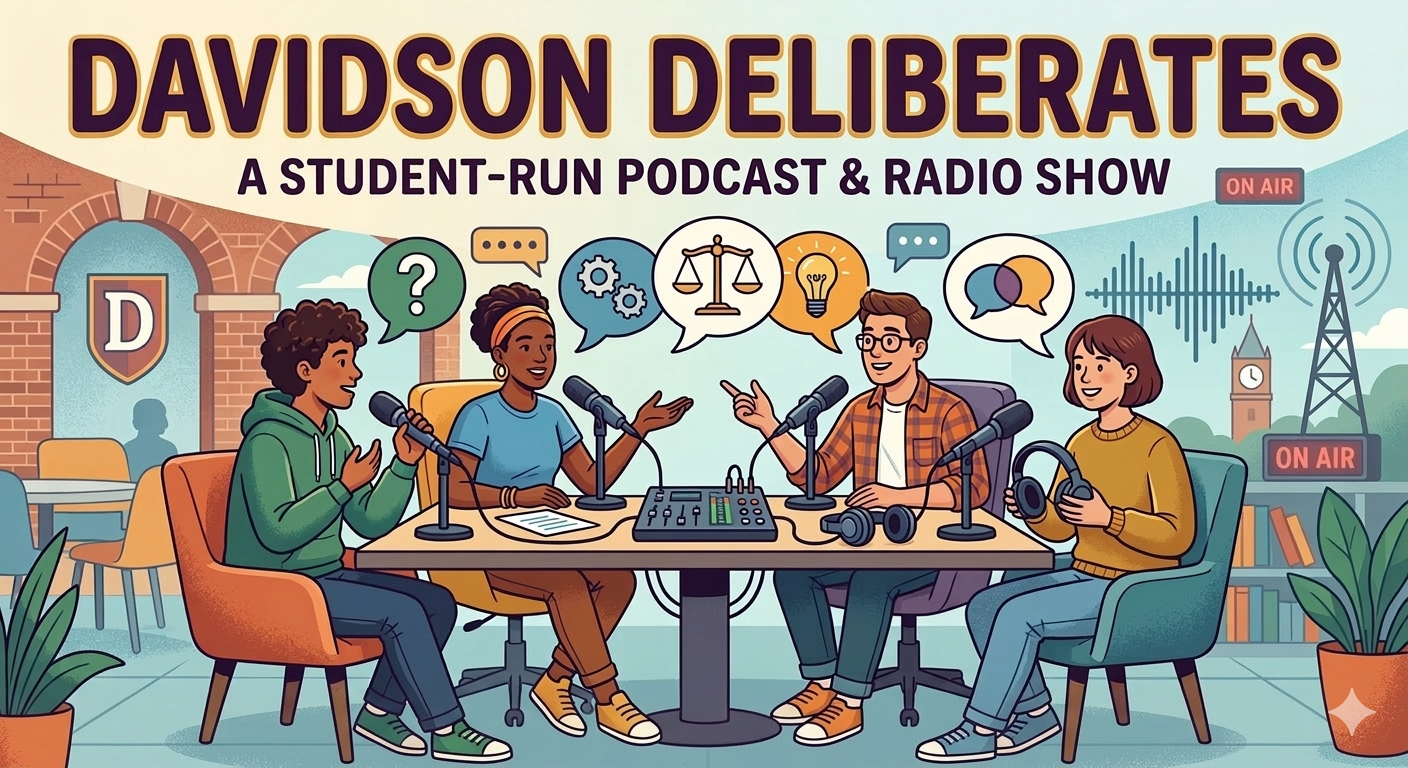
Davidson Deliberates cartoon image with four students sitting around a table talking to microphones.

Ezra Minard ’28 (DCI Fellow)

Davidson Deliberates is a new podcast and radio show dedicated to exemplifying the DCI’s deliberative spirit while offering members of the Davidson community a space to thoughtfully engage with contentious issues. The show, which airs from 1 pm to 2 pwm on Tuesdays on the Davidson student radio station (WALT 1610), aims to be a platform for examining challenging questions as close to home as campus and Davidson politics and as global as foreign affairs. At its core, the podcast is both a forum for serious discussion and an introduction to the DCI itself, highlighting its mission and events while also modeling good argument and deliberation.

The topics of deliberation have ranged from the low-stakes yet controversial “is a hotdog a sandwich?” question (see the February 3rd Episode below) to examinations of the benefits, shortcomings, and potential reforms to contemporary American society safety nets, such as Social Security (See the February 21st Episode below). The first pilot episode was hosted by DCI Fellows Grace Zagoria ’27 and Zach Abdulahi ’27 last spring, and then Zak and I continued the series this past fall as Grace is studying abroad this year. With Zak off campus as well this spring, DCI Fellow Bolling Lewis ’28 has stepped up to co-host the show with me this spring.

Rather than following a traditional question-and-answer interview format, Davidson Deliberates is more interested in the genuine exchange of ideas. Bolling and I have and will continue to alternate between modeling deliberation in conversation with one another and serving as facilitators whenever we host guests. Also, we perform the role of the devil’s advocate when necessary to promote productive dialogue. Intellectual diversity is paramount to the show’s purpose, as reflected by our desire to bring differing perspectives and experiences to the WALT studio table. By doing so, we hope to encourage open and rigorous participation from any and all groups that may be interested in participating in productive dialogue.

Questions surrounding the issue of platforming inevitably arise from this work. As I argue in my recent blog post, “The Case Against Denunciation,” condemnation often hardens opposition to one’s position, producing the very resistance that persuasion seeks to overcome. Persuasion, on the other hand, better preserves the possibility of changing minds because it invites its interlocutor to engage in good faith. Furthermore, I argue that deplatforming rarely prohibits conversation from occurring, but instead relocates those conversions to spaces where they are less likely to be challenged, thereby encouraging echo chambers.

Davidson Deliberates functions as a location where those conversations are not only allowed but encouraged and sought out. Finally, I do not assert that there is not a time nor a place for denunciation or for deplatforming. In fact, these practices may be justified in certain circumstances. But, here, in this moment marked by polarization and cynicism against good faith conversation, Davidson Deliberates seeks to meet the need for productive dialogue.

Check out some of our shows below…

“Davidson Deliberates” Radio Show and Podcast (Feb. 3, 2026 Episode)

“Davidson Deliberates” Radio Show and Podcast (Feb. 21, 2026 Episode)

Filed Under: Announcements, Blog Posts, Fellow Posts

The Case Against Denunciation

March 4, 2026 by Ezra Minard

By Ezra Minard ’28 (DCI Fellow)

Denunciation and persuasion are two common tools in the rhetorician’s repertoire. Both seek to affect change. Both recognize the inherent self-interestedness of any interlocutor. However, they are far from equal. Denunciation is easy, instinctive, and emotionally satisfying. Persuasion, by contrast, is difficult, uncomfortable, demanding, and frustratingly the far less common of the two. It is the path less traveled, one which requires patience, humility, and tact. Persuasion is preferable to denunciation because it engages others without hardening opposition or undermining dialogue through condemnation.

Denunciation operates by attacking motive and appealing to guilt and shame. It signals moral superiority and implies that the other’s beliefs place them beneath serious engagement. It is more comfortable to regard oneself as morally superior to an opponent than to consider the possibility of being wrong, which is exactly the disposition which civil discourse requires. Predictably, denunciation invites reciprocal denunciation. Rather than expanding dialogue, it constricts it by hardening opposition and dividing people among in-groups and out-groups. Do denouncers reasonably expect those they criticize to join them condemning themselves? More often, the denounced feel attacked and become less willing to listen as a result. While denunciation may project a belief in one’s own moral superiority, it undermines fruitful deliberation.

Contemporary debates about the platforming issue illustrate this tension. Some defend exclusion (and denunciation by extension) as a means to prevent the popularization of harmful ideas. They might view exclusion as an instrument of the court of public opinion, and I agree that there are circumstances in which conversation refusal or avoidance is not only justified, but perhaps necessary. Similarly, no one has a moral obligation to engage with anyone in any conversation and the freedom of association is an overlooked but essential right under the First Amendment. But consider the maxim: “The child who is not embraced by the village will burn it down to feel its warmth.” Do denunciation and exclusion inadvertently popularize certain views by making them appear edgy or off-limits? If so, deplatforming could be a tragic mistake. And where do those “off-limits” conversations move ?

Conversations rarely disappear when suppressed. Instead, they often relocate into more ideologically homogenous spaces. Such insulation intensifies partisanship and deters deliberative dialogue, especially between those who are most diametrically opposed and subsequently, most in need of deliberation. If a democracy relies on productive dialogue between disagreeing parties, then ideological sectionalism compromises it.

I do not mean to suggest that there is neither a time nor a place for denunciation or for choosing not to platform someone. Conversation is only one tool among many for affecting political change. Protest is another. Our current political moment, however, feels oversaturated with denunciation and greatly in need of dialogue. The architecture of the internet feeds on rage, fear, panic, and character assassination, as they generate more online traffic than empathy, humility, and moderation. Dialogue is simply less cinematic. It does not trend as denunciation does.

Additionally, online spaces provide anonymity that weakens accountability. The social costs of harsh rhetoric decline in the absence of face-to-face settings. While online privacy is essential, its utilization in the dialogue sphere encourages caricatures, condemnation, and condescension as one is less prone to regard their interlocutor’s humanity on X (Twitter), for example.

A more effective alternative to denunciation is persuasion, which logically appeals to one’s interlocutor’s self-interest. Rather than trying to compel belief through shame, persuasion invites the interlocutor to agree, if she finds it aligned with her self-interest. Treating an interlocutor as a moral equal, even despite disagreement, does not necessarily concede moral complicity but instead recognizes shared humanity and seeks positive transformation.

Filed Under: Fellow Posts

Davidson Represented at Leadership Symposium on Civil Discourse

March 2, 2026 by Graham Bullock

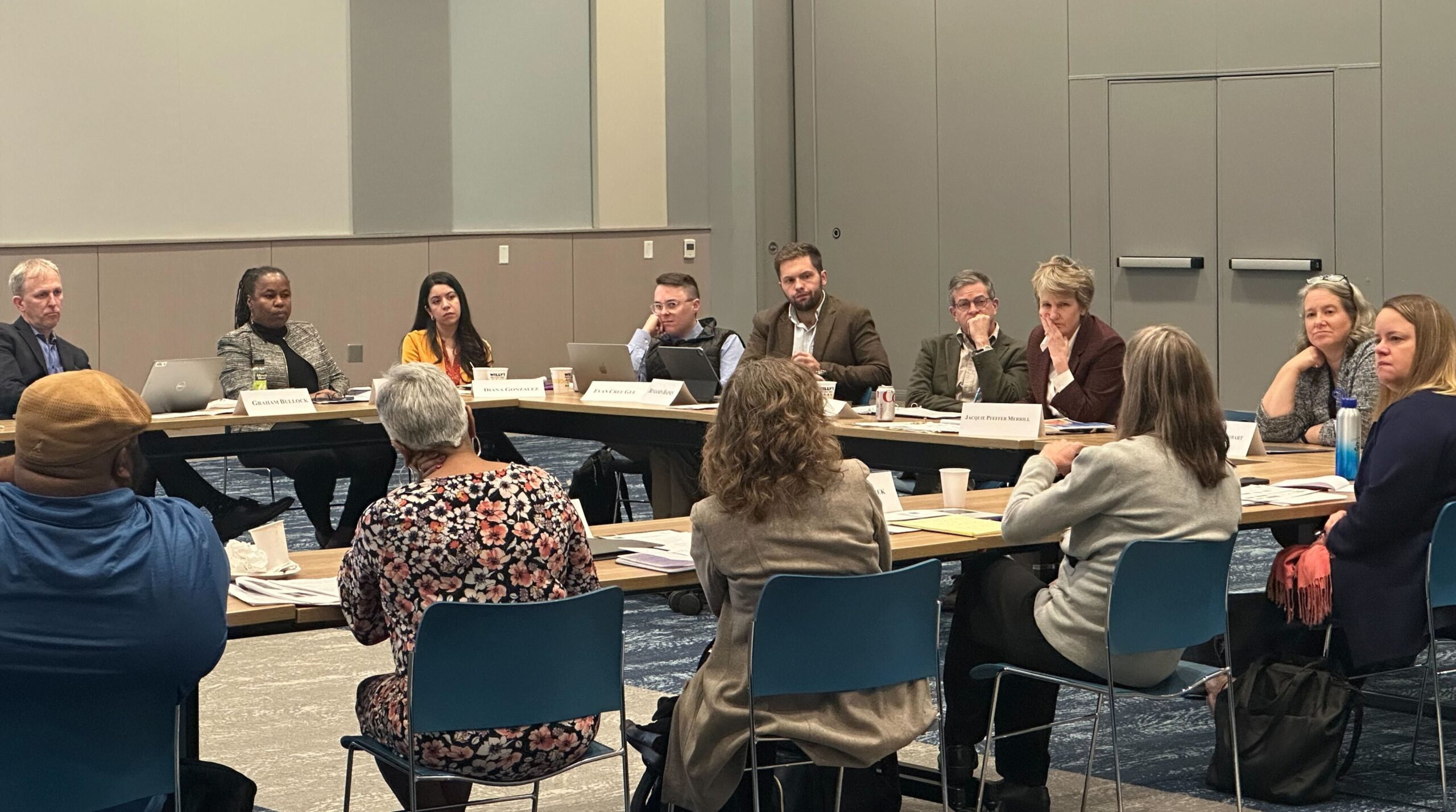
people sitting around a large conference table

By Graham Bullock (DCI Faculty Director)

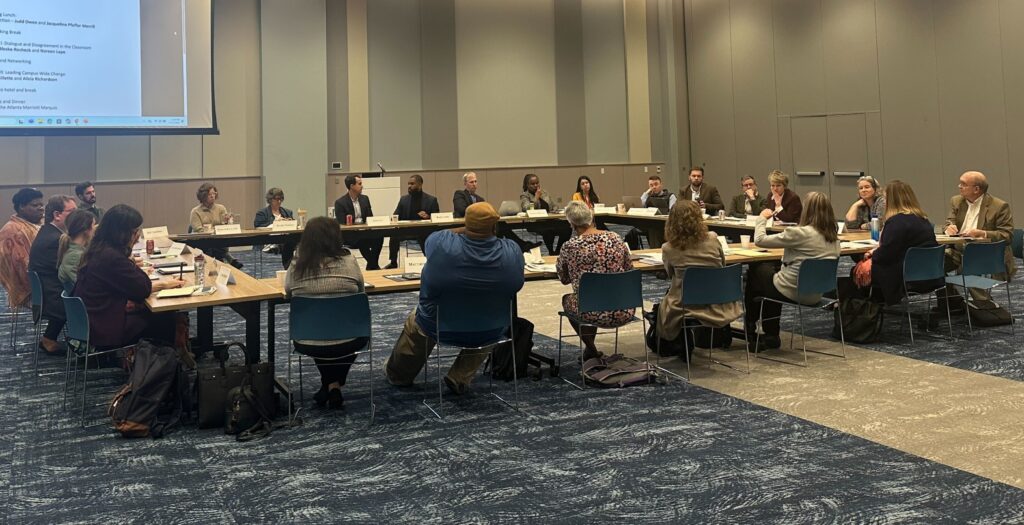
On November 13–14, 2025, I had the opportunity to participate in a Leadership Symposium on Civil Discourse: Conversations in the Classroom, Quad, and Community, hosted by Jacqueline Pfeffer Merrill and the Council of Independent Colleges (CIC) in partnership with Emory University.

Dr. Merrill, CIC’s Senior Director for Civic Learning and Free Expression Projects, used the  symposium to bring together faculty members and higher education leaders from across the country to share ideas and strategies for strengthening civil discourse on our campuses. The gathering, held in Emory’s Student Center, focused on how institutions can foster thoughtful dialogue in classrooms, co-curricular programming, and the broader campus community.

I was honored to have the opportunity to co-lead Session III, “Civil Discourse Co-Curriculars,” with Daryl Lowe, Associate Vice President for Student Affairs at Spelman College. Our session explored how colleges can build meaningful opportunities outside the classroom that equip students to engage across difference with curiosity, respect, and intellectual rigor.

Wide angle view of conference attendees at main table

The symposium featured an impressive range of institutions and perspectives. Participants and session leaders represented colleges and universities including Emory University, Spelman College, Trinity University, Dickinson College, Hartwick College, Agnes Scott College, Oglethorpe University, Dalton State College, The University of the South, Carnegie Mellon University, Presbyterian College, The College of Wooster, Goshen College, and the University of Wisconsin, Eau Claire.

Throughout the two days, discussions emphasized practical approaches to navigating disagreement, supporting faculty and student development, and embedding civil discourse into the fabric of campus life. I was grateful for the chance to share insights from Davidson’s Deliberative Citizenship Initiative and to learn from colleagues who are leading innovative programs in dialogue, free expression, and student engagement at their institutions. At a moment when many in higher education feel under siege from multiple fronts, the symposium offered a powerful reminder that colleges and universities remain vital spaces for rigorous inquiry, principled disagreement, and meaningful community-building. I look forward to continuing the conversations that we started in Atlanta and following up on the great ideas we discussed together. The more we can share, the more we can make our own work better.

Filed Under: DCI Posts, Events

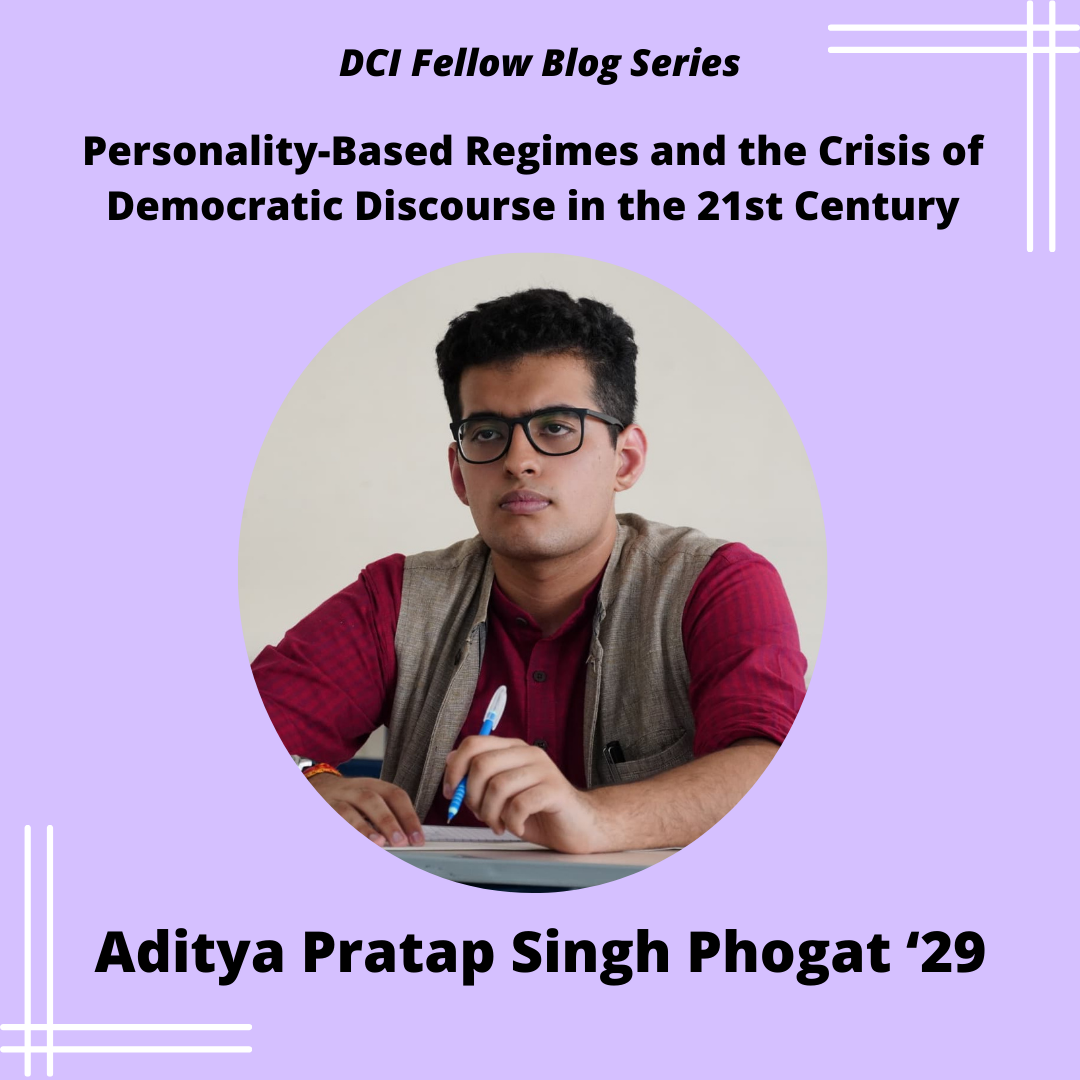
Personality-Based Regimes and the Crisis of Democratic Discourse in the 21st Century

February 25, 2026 by Aditya Phogat

By Aditya Pratap Singh Phogat ’29 (DCI Fellow)

“A democracy dies not only when tanks roll out, it dies when institutions cave in. When constitutional functionaries become partisan puppets. When media becomes a megaphone, not a mirror. When courts begin to delay what they dare not deny. When dissent is sedition, protest is provocation and every question is branded ‘anti-national’–then you know that the Republic is on a ventilator.”[1] -Abhishek Singhvi

The global order of the 21st century in which we live today is marked by the rise of personality-based regimes and their replacement of institutional ones. The ordinary business of the democratic state is no longer dictated by institutions and norms established by general practice of the law, but rather by the demands of both popular leaders and unelected dictators. What are the implications of the supersession of the system by individualistic leaders in the social, economic, and political spheres of life for the prospects of democratic processes, and specifically deliberative discourse? That is the question that this blog post will examine.

It would be apt to begin with an almost-empirical assertion that strong individualistic officers who weaken state institutions for some agenda ultimately cause great damage to the prospects of democracy in their countries. This is something that is very evident in the cases such as post-Cold War Russia, India, and Venezuela. The “cult of personality” leaders may also be seen today in my own country with Prime Minister Modi, who not long ago removed the credibility of the Election Commission of India, a historically apolitical body, by changing the appointment procedure of its commissioners for  his own benefit.[2]  As a matter of fact, one of the more egregious violations of the principles of democracy also happened in India in the 1970s when the-then Prime Minister, Indira Gandhi, “packed” the Supreme Court, disemboweled administrative structures, and had a State of Emergency declared soon after her election as a member of parliament was voided by the Allahabad High Court.[3] What soon followed after was one of the darkest periods in the legal and political history of the Republic of India that was marked by the unconstitutional withdrawal of fundamental rights and the corruption of democratic discourse throughout the country. After all, one of the more prolific slogans propagated by the government back then was “Work more, talk less!”[4]

What these examples indicate is that individual-based regimes are antithetical to the desire of a people to govern themselves. This is the very reason why the establishment of such governance coincides with the era of global democratic backsliding. Building off of this phenomenon, when such despotism is disguised under a popular mandate in a democracy, all hope for deliberative discourse is lost, for the leader in this scenario is equated to the state and any opposition posed to either them or their ideas is equivalent to an act of treason. As a result, the backsliding accelerates, and independent state watchdogs, human rights organizations, professors, and students are disarmed by punitive force. In this scenario, political leaders who are democratically elected consolidate power and declare any dissenting opinions to be “against the spirit of the nation.” Behind such leaders also stand electorates that support their populist attitudes and aid and abet this overall process. Despots are able to sustain this support by maintaining control over the narrative through social media and by removing deliberation from the national setting. Consequently, what we see at the end of the day is an environment wherein strongmen monopolize the public sphere for their personal benefit and push people into a seemingly cultural conflict against the “foreign” values of constitutional liberalism and democracy.

The reasons as to why such a global crisis festers in a world such as ours may be many, but an extremely critical factor is us forgetting that deliberation is both a fundamental right and duty when considering the interaction of a single citizen with the state mechanism. Citizens must remember that exercising their duty of dissent and differing with a leader who possesses the ability to literally exercise the power of life and death against both them and their fellow citizens is the most critical charge they have as members of the body politic of their country. In this regard, deliberative discourse–which is founded upon the principles of reasoning, agreement, and disagreement–is both an end and a means vis-a-vis democracy. An extension of  this principle, which involves citizens working together to reach reflective, sharable policy conclusions which are then taken under advisement by the  government for implementation, is termed as deliberative democracy and can be used by the political system to preserve its foundational values.[5]

The global order of the 21st century is a war against mindless violence and unwarranted tyranny. The freedom and greater good of the masses are on the losing side of this conflict. Our liberty to think differently and still be able to come to a mutually-acceptable conclusion is at risk here today. It is in the supreme interest of people worldwide to assert their rights in a cooperative fashion and not an adversarial one: as a result, it is the duty of civilization itself to preserve this possibility for its present and its future.


[1] ‘Won’t Allow India to Become Nation of One Voice, One Party, One Ideology: Abhishek Singhvi – The Economic Times’. https://economictimes.indiatimes.com/news/politics-and-nation/wont-not-allow-india-to-become-nation-of-one-voice-one-party-one-ideology-abhishek-singhvi/articleshow/123059927.cms?from=mdr (November 8, 2025).

[2] ‘Appointing Election Commissioners: The Government Must Not Control the Watchdog’. 2023. The Indian Express. https://indianexpress.com/article/opinion/columns/appointing-election-commissioners-the-government-must-not-control-the-watchdog-8917864/ (November 8, 2025).

[3] ‘The Emergency 50 Years on | Echoes from Courtroom No. 24: Verdict Unseated PM Indira Gandhi, She Struck Back at Nation’. 2025. The Indian Express. https://indianexpress.com/article/long-reads/the-emergency-50-years-on-echoes-from-courtroom-no-24-verdict-unseated-pm-indira-gandhi-she-struck-back-at-nation-10061483/ (November 8, 2025).

[4]July 6, Forty Years Ago: Talk Less, Work More’. 2015. The Indian Express. https://indianexpress.com/article/opinion/july-6-forty-years-ago-talk-less-work-more/ (November 8, 2025).

[5] Layman, Daniel. 2016. ‘Robust Deliberative Democracy’. Critical Review 28(3–4): 494–516. doi:10.1080/08913811.2016.1264161.

Filed Under: Fellow Posts

  • « Go to Previous Page
  • Page 1
  • Page 2
  • Page 3
  • Page 4
  • Page 5
  • Page 6
  • Interim pages omitted …
  • Page 75
  • Go to Next Page »

Footer

Blog Post Categories

  • Announcements
  • Blog Posts
  • DCI Posts
  • Events
  • Faculty Posts
  • Fellow Posts
Image of a compass superimposed by the text "Deliberative Citizenship Initiative" and "Davidson College." Clicking on this image leads to the Initiative page.

Recent DCI Blog Posts

  • We Tried to Fix Jubilee’s “Middle Ground” – Here’s How It Went
  • A Case for Deliberation in the Natural Sciences
  • Welcoming New Staff to the DCI and DCN
  • Facebook
  • Twitter
  • Instagram
  • LinkedIn


Copyright © 2026 · Infinity Pro on Genesis Framework · WordPress · Log in