• Skip to main content
  • Skip to footer

Deliberative Citizenship Initiative

Building Democracy One Conversation at a Time

  • The Initiative
    • Programs
      • Deliberation Across the Curriculum
      • Deliberation on Campus
      • Deliberation in the Community
      • Research on Deliberation
    • Motivations
      • Why Deliberative Citizenship?
      • Why Davidson? Why Now?
    • Who’s Involved?
      • DCI Fellows Cohorts
        • 2025-2026 Fellows
        • 2024-2025 Fellows
        • 2023-2024 Fellows
        • 2022-2023 Fellows
        • 2021-2022 Fellows
        • 2020-2021 Fellows
      • DeeP Collaborative Cohorts
        • 2024-2025 DeeP Collaborative Faculty
        • 2023-2024 DeeP Collaborative Faculty
      • Advisory Council
    • History
      • What Sparked the Initiative?
    • Key Deliberative Dispositions
    • Frequently Asked Questions (FAQ)
    • Annual Report
  • Get Involved!
    • Participate in a Forum
    • Join a D Team
    • Become a Fellow
    • Take Courses
    • Get Training
    • Come to Guest Lectures
  • Events
    • Upcoming Events
      • 250th Anniversary Deliberative Forum Series on American Values
    • Past Events
  • Connections
    • The Deliberative Citizen: The DCI’s Monthly Newsletter
    • Efforts on Campus
    • Efforts in the Community
    • Efforts Elsewhere
    • Readings and Resources
      • DCI-Published Guides
      • DCI Guide to One-on-One Conversations
      • How to Disagree
      • Demonstration of Facilitation Styles
      • Deliberative Pedagogy Mini-Course
    • How We Can Help: DCI’s LET’S DELIBERATE! Partnership Opportunities
    • DCI in the News
  • DCI Blog Posts
    • Recent Blog Posts
    • All Blog Posts

The DCI Blog

Deliberation Beyond Davidson: Breaking out of the Bubble

July 9, 2026 by Aditya Phogat

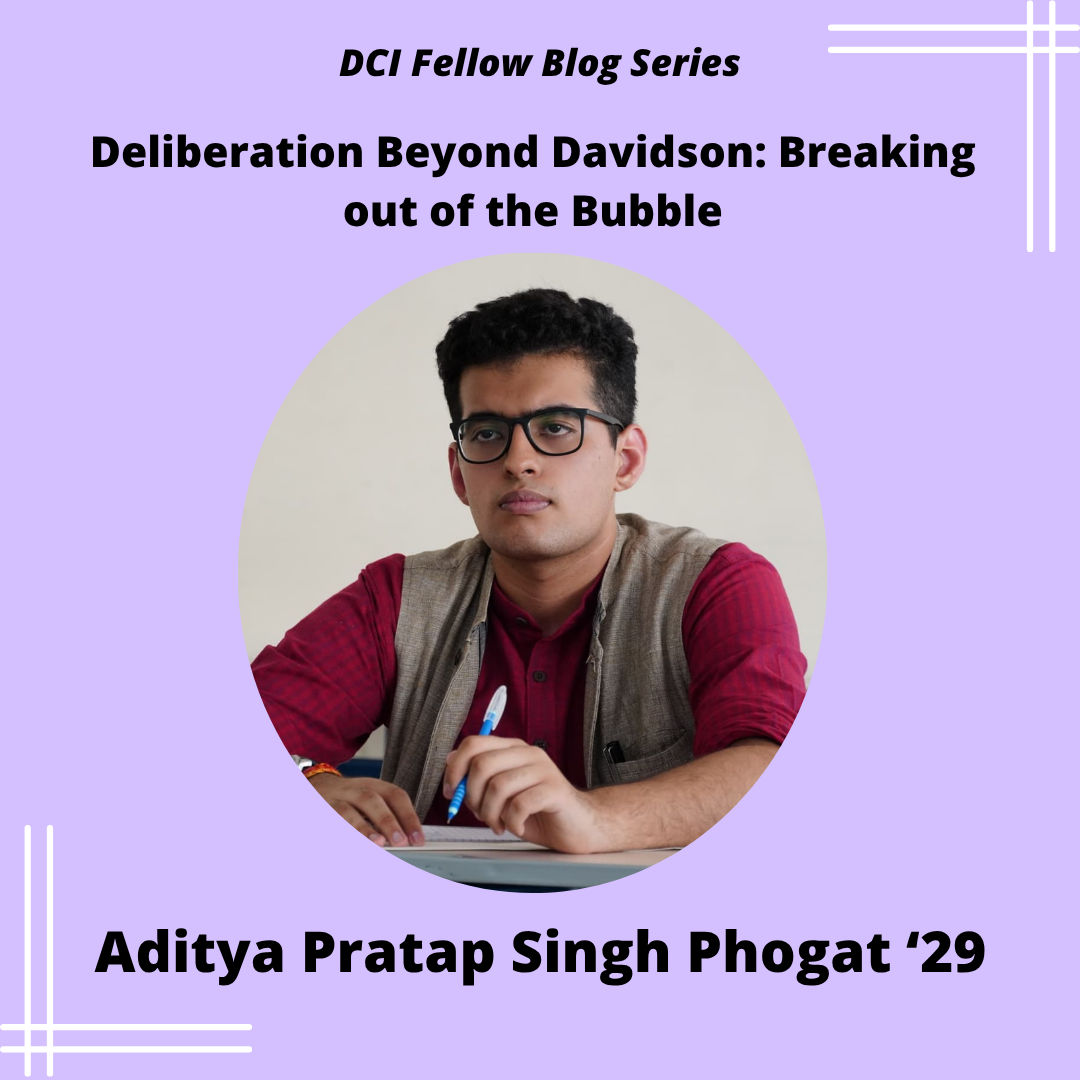
By Aditya Pratap Singh Phogat ’29 (DCI Fellow)

The idea of deliberative democracy is something that can be sustained only when there are people willing to commit themselves to the cause of responsible citizenship. To be courageous enough to speak, to listen to what one’s peers have to say, and critically engage with such “theses” and “antitheses” is the foundation of a sustainable community, and the Deliberative Citizenship Initiative appears to be in a continuous quest to cultivate such a culture of valour.

My time with the DCI has so far permitted me to explore the idea of deliberative discourse and apply it here at Davidson College through our D Teams that attempt to bring students, faculty, and community members from across the socio-political spectrum together at a single platform as equals to discuss some of the most polarizing issues the United States faces today. To be certain, the DCI’s work to foster a deliberative atmosphere in our community has certainly led to positive outcomes. Co-inhabitants of this ecosystem are less likely to engage in adversarial conflict with a zero-sum, “warrior” mindset, are more open to receiving ideas that differ vastly from their own, and most importantly, are willing to refuse to believe the worst of their fellow human beings. 

Seeing the persistence of such a mechanism here at Davidson is in startling contrast to the ugly political adversariality and ad hominemism that pervades the national system of governance here in the United States and on the global stage at large. One therefore might be forgiven for wondering if the DCI is able to prevail in a bubble of a small town where both the walls of its buildings and the polite Southern manners of its inhabitants haven’t changed all that much. Is the principle of deliberative citizenship able to operate exceptionally at Davidson because of the exceptional circumstances it is placed in? This is a question that stung me more times than I can count during my time with the DCI.

That is, until it stung less after our excursion at Duke University.

This past spring the DCI was invited to cover facilitation skills in Duke’s POLSCI 112L, Devil’s Advocate: Exploring Pluralism, Free Inquiry, and Belonging. Offering a crash course on deliberative citizenship to a hundred-odd students in an hour followed by a mock deliberation on social safety nets in a second hour certainly was a challenging task, but it also had a significant set of rewarding results. I saw students cycle through the roles of deliberator, disruptor, and facilitator as they discussed pressing problems with genuine commitment to the fundamental principle underlying deliberative discourse – critical engagement with diverse perspectives with an open mind and a set of alert ears. 

During the deliberative exercise that followed their training, I served as the facilitator for a dozen engineering students from different social and even national settings. The topic of social safety nets required them to enter into the politico-economic realm, and it was heartening to see them talk about sensitive issues without fear of judgement in an environment where their equality as individuals and the acceptance of their experiences was guaranteed in our deliberations. My discussions with individual members of my D Team allowed me to see their earnest hopefulness for the possibility of a deliberative environment on the Duke campus and in their own communities and affirmed my own trust in the principles of deliberative discourse. 

Yes, it will take effort. Yes, it will take determination. Yes, it will take a great deal of courage to get out of our own communities to bring about positive change in others. At the end of the day, however, all of it counts as we strengthen our belief that words are a better alternative to violence and attempt to institutionalize it in environments that desperately need it. For me, deliberative citizenship is not sourced from our exceptional circumstances, but rather from the will to get the job done. All we need is that will and the means to perpetuate it across communities. once we have the will and the way, we will start bringing change to the ugliness that currently plagues our public sphere.
Filed Under: Fellow Posts

Teaching Deliberation at Duke University

July 8, 2026 by Bolling Lewis

By Bolling Lewis ’28 (DCI Fellow)

On February 12th, I, along with six fellow DCI members, packed into a rented Jeep Wagoneer and set out on a daunting goal of bringing deliberation to Duke University. We had been invited to introduce our approach to facilitating constructive deliberations on challenging topics to a university class exploring the challenges and opportunities of pluralism in modern society. Students in the class would be hosting small group discussions at Duke following an upcoming expert roundtable on justice and the rule of law, and we were tasked with putting on an interactive class workshop on how best to organize and facilitate their deliberations.    

Since the inception of the Deliberative Citizenship Initiative in 2020, the task of including as many people as possible in the conversation has centered around engaging a small two-thousand-person liberal arts campus. Word of mouth, deliberative forums, and inclusion of dialogue in course materials have all been successful ways to hear new perspectives and experiences from the Davidson community. Yet, such effective methods can be rendered useless in a different environment. Duke, in many ways, is the exact opposite of Davidson, with an almost 18,000-person student body, an emphasis on research, and little exposure to formal deliberation. All the signs pointed  to a big question: were the successes we’ve had at Davidson transferrable to other campuses and contexts? 

Huddled in the car for our two-hour journey to Durham, we reviewed our plan for the visit. We collectively stressed the importance of emphasizing deliberative dispositions and the realistic challenges of facilitating conversations at another campus. With Professor Bullock, head of the DCI program and our faculty leader for the trip, at the wheel, we discussed the size disparity between the average Davidson and Duke classroom. We realized that we should be prepared for students who may not be as well versed in small-group conversations, given their significantly larger class sizes. With this in mind, we mapped out how we would introduce the principles and practices of deliberative dialogue in a context very different from our own. 

Upon arrival, we quickly headed towards the academic buildings and were guided through a maze of hallways to finally arrive at our lecture hall. Once again, the stark contrast between Davidson and Duke was glaring when we arrived in our room. The class seated roughly a hundred students, tightly packed together, in a room roughly three times the size of any Chambers classroom. Still, despite the differences, the Duke students seemed quite receptive to the idea of deliberation. They asked questions and engaged with the practice prompts. Furthermore, they listened attentively to the dispositions we presented in the lecture hall, and after about sixty minutes of presentations (we each presented a different dimension of effective facilitation), we split into breakout groups based on career aspirations to put the ideas into practice.

My breakout session featured mainly pre-law students. The discussion, which centered around welfare, social security, and liberty, went exceptionally well. Despite the fact that no one in the conversation had participated in a structured deliberation before, they all jumped in to provide insights and perspectives about the topics. Some students integrated law-based arguments, while others focused on personal anecdotes. To me, it appeared as if the Duke students were naturals who had simply not had the opportunity to engage in an organized deliberative dialogue. They often wrestled with difficult ideas, including social security reform and efficient government spending, acknowledging that they could not solve everything today, but that the discussion of the issue was an important step forward. There were undoubtedly awkward moments, or periods of silence that created discomfort, but by the end, the conversation felt both casual and purposeful.

When the conversation wrapped up, I joined the reception dinner and discovered that many other DCI Fellows had similar experiences. In spite of the surface-level differences, the Duke students quickly picked up deliberation. Every conversation had its ups and downs, but the core concept of sharing viewpoints in a safe space to listen and learn from others was successfully passed along. On the car ride back to Davidson, we all took turns reflecting on the afternoon at Duke; one of my main takeaways I expressed was how easily a different community picked up the unique skill of deliberation. Personally, it gave me another reason to believe in the DCI mission. In just two hours, another institution fully embraced some of the hardest skills in modern society: listening to others, expressing one’s own beliefs, and disagreeing respectfully.

Filed Under: Fellow Posts

Deliberating about the Purpose of College: Is It for Me or for Us?

July 7, 2026 by Mohamed Mustafa

By Mohamed Mostafa ’26 (DCI Fellow)

As a senior, I have found that some of the most meaningful conversations I’ve had about the future did not happen in classrooms or career workshops but with friends trying together to make sense of what comes next.

In one of those conversations, a friend told me plainly that he did not see a social responsibility tied to his career choice. For him, the goal was stability: a well-paying job to support his family. He wasn’t dismissive of social impact or contribution but rather that those considerations came second, if at all. What struck me was not the position itself, but how often I had heard it before.

Across conversations with classmates, a pattern began to be obvious. Many of us had entered college with language about making a difference, contributing to society, or pursuing meaningful careers. Yet as senior year approached, those ideas often became harder to prioritize. Conversations shifted toward job security, salaries, and the pressure to “figure it out.” The question was no longer just what we cared about, but what felt safe and financially rewarding.

In many ways, this shift is understandable. College is often framed as an investment and something we pursue to secure our futures, justify its cost, and create stability for ourselves and our families. For some students, especially those navigating financial pressures or immigration constraints, choosing a stable and predictable path is not simply a preference but a responsibility. In this light, prioritizing individual success can reflect responsibility and obligation rather than self-interest alone.

Yet, this framing feels incomplete.

At Davidson, we are reminded that education is not only about personal advancement, but about preparing students “for lives of leadership and service.” Implicit in that vision is the idea that our choices, especially those related to our careers, are not neutral. They shape not only our own lives, but also the communities and systems we become part of.

This is where the tension becomes more difficult to ignore. If college is both a private good and a public one, therefore the decisions we make are not simply about what we can achieve, but about how we choose to contribute. Yet in practice, the structures surrounding us (recruiting cycles, prestige hierarchies, and cultural expectations) often reward paths that are relatively safe, stable, and individually beneficial. In that environment, it becomes easier to measure success by outcomes we can point to, rather than impact that is harder to quantify.

Still, the conversations I’ve had suggest that this is an unresolved question. When friends speak about choosing more secure paths, they often do so with a quiet awareness of what may be left out of the conversation. And when others pursue work more explicitly oriented toward service or impact, they usually do so with an understanding of the risks involved. Neither path is arbitrary. Both are shaped by values, constraints, and competing responsibilities.

What feels missing is not clarity, but space to deliberate about these tradeoffs more openly. Too often, decisions are made under pressure, guided by urgency rather than reflection. We compare outcomes without fully understanding the motivations behind them. We assume that certain paths are more responsible than others, without asking responsible to whom?

Deliberation offers a way to approach these questions differently. It does not resolve the tension between personal success and social impact, but it allows us to examine it more honestly and understand where each position is coming from. It asks us to consider not only what we want, but what we owe to our families, to our communities, and to the society we are part of.

One concrete example of creating such space at Davidson was the Values and Vocations Forum, a dialogue program Coralyn Cairns ’29 and I helped organize in partnership with the Matthews Center for Career Development, Center for Student Diversity and Inclusion. This 90-minute interactive session brought together students, staff, and faculty to reflect on how personal values like impact, integrity, and non-compromise areas intersect with career choices amid real-world tradeoffs, such as organizational missions, business practices, and ethical complexities. Through structured activities including individual reflections, pair-shares, and small-group case studies on scenarios like working for education tech firms or defense companies with mixed impacts, participants engaged in honest, non-prescriptive deliberation that revealed shared tensions between stability, personal beliefs, and societal contribution. This event fostered the exploration of “for me or for us” that has felt missing in other similar conversations.

As I prepare to leave Davidson College, I find myself thinking less about finding The Answer and more about asking better questions. What does it mean to live a life of service in practical terms? How do we balance stability with contribution? And perhaps most importantly, what are we willing to prioritize when those goals come into conflict?

While I have come to better understand how attractive stability and individual success are, I am also left with the sense that an education like this asks something more of us. Not necessarily that we reject personal ambition, but that we position it within a broader sense of responsibility. That we remain attentive to the impact of our choices, even when they are difficult to measure or pursue.

If college has prepared us for anything, it may not be certainty about what comes next, but a deeper awareness of the stakes involved in our decisions. In that sense, the question is not simply whether college is for ourselves or for something larger. It is whether we are willing to carry both and to act with intention when they pull us in different directions.

Filed Under: Fellow Posts

Event Re-cap: Watch Party of the Fourth Expert Roundtable in the American Values Deliberative Forum Series 

May 25, 2026 by Ruby Aaver

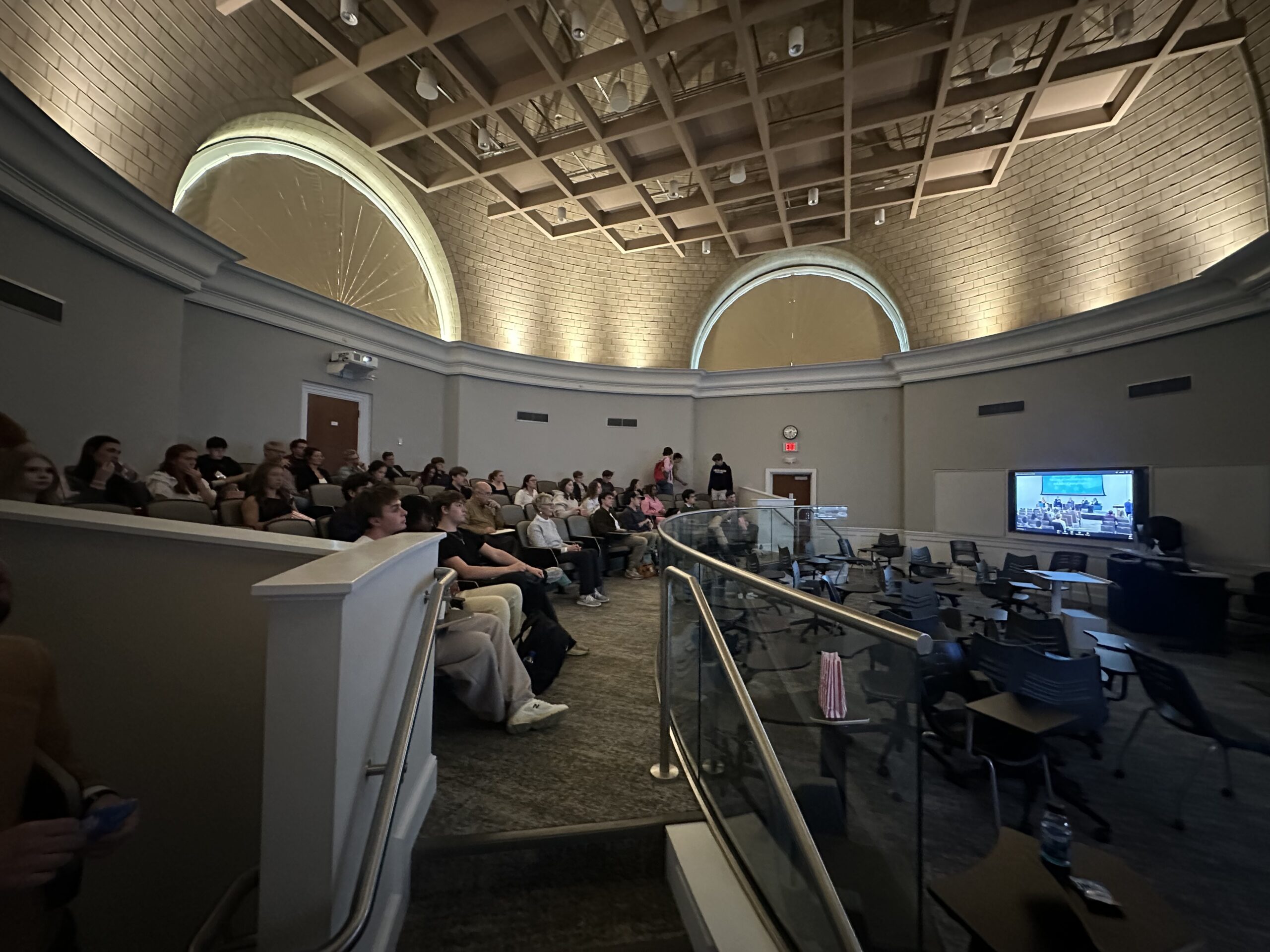
Photo of auditorium with audience and tv showing expert roundtable.

On March 24th, The Deliberative Citizenship Initiative wrapped up its American Values Deliberative Forum series with its final installment, Justice and the Rule of Law: The Case of Constitutional Rights and Judicial Interpretation.

Our watch party brought together more than 50 students, faculty, staff, and community members to watch a livestream of the panel that was being held live at Duke University. Attendees gathered in Hance Auditorium and enjoyed refreshments and a popcorn bar during the event.

The roundtable explored questions surrounding constitutional rights, judicial interpretation, and the role of the courts in shaping how justice is understood and applied. As the final event in the series, it offered participants one last opportunity to hear directly from experts grappling with complex and timely issues in commemoration of the 250th anniversary of the Declaration of Independence.

While the watch party itself centered on viewing the discussion, it also served as an important entry point into deeper engagement. Participants will continue these conversations in upcoming D Team sessions, where they will have the opportunity to reflect, deliberate, and share their own perspectives in a more interactive setting.

With strong attendance throughout the series, DCI’s live forums and watch parties have created space for the community to come together, engage with expert insights, and prepare for meaningful dialogue beyond the event itself.

Missed the event or want to watch it again? Click Here to view the recording! You can also check out our flyer and deliberation guide for the event below.

Justice-and-the-Rule-of-Law-Expert-Roundtable

DCI-Justice-and-Rule-of-Law-Deliberation-Guide

Filed Under: Events

Vote on Next Year’s DCI Topics!

May 14, 2026 by Graham Bullock

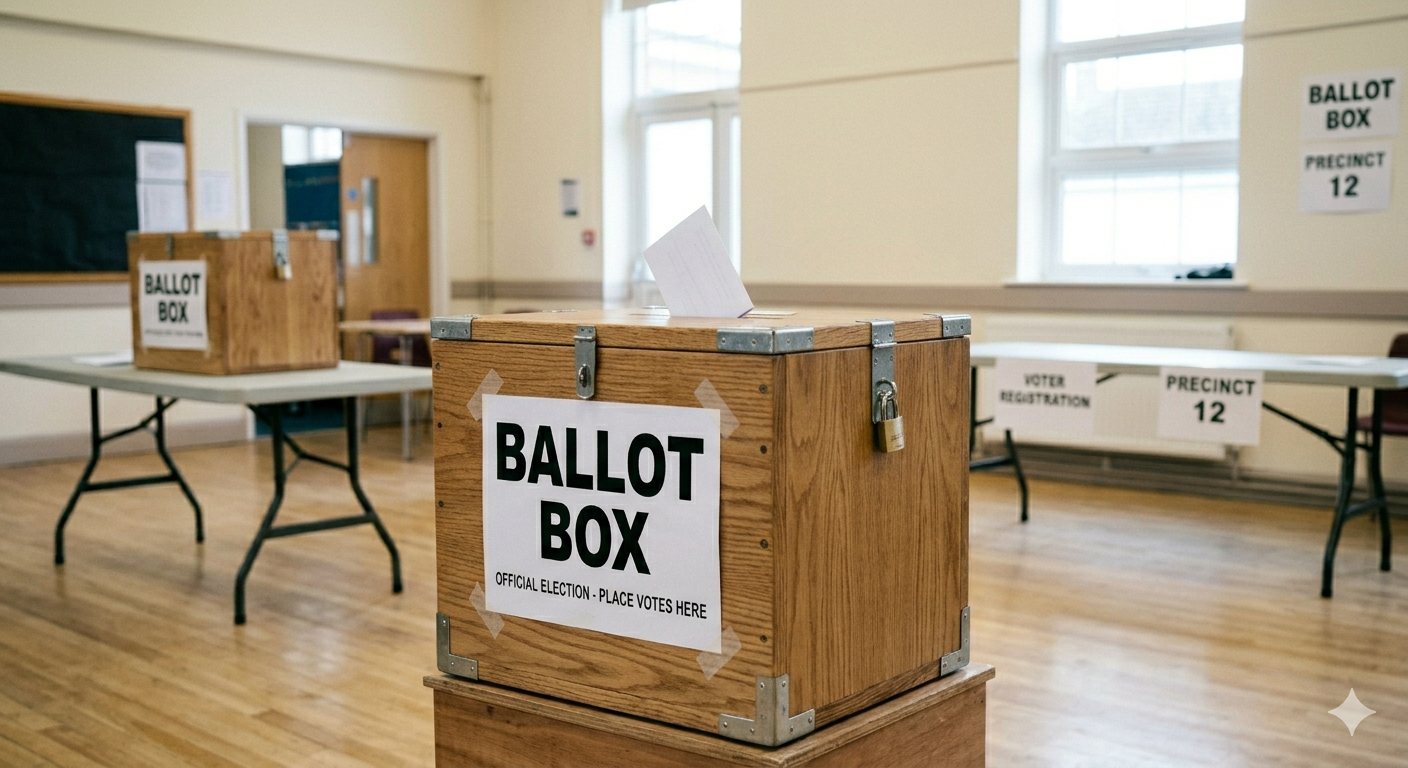
Photo of ballot box

Thank you to those of you who shared topics ideas for our Deliberative Forums and D Teams next year. We have organized the 60(!) topics that were submitted into 15 broad themes and questions, and we would love your feedback on which ones you find most interesting and compelling for our 2026-27 programs. If you complete this short survey by next Wednesday (May 20), we’ll take your responses into account as we decide on what topics to cover in the coming academic year.

2026-27 DCI Topics Survey

Thanks in advance for your input!

Filed Under: Announcements

  • « Go to Previous Page
  • Page 1
  • Page 2
  • Page 3
  • Page 4
  • Interim pages omitted …
  • Page 75
  • Go to Next Page »

Footer

Blog Post Categories

  • Announcements
  • Blog Posts
  • DCI Posts
  • Events
  • Faculty Posts
  • Fellow Posts
Image of a compass superimposed by the text "Deliberative Citizenship Initiative" and "Davidson College." Clicking on this image leads to the Initiative page.

Recent DCI Blog Posts

  • We Tried to Fix Jubilee’s “Middle Ground” – Here’s How It Went
  • A Case for Deliberation in the Natural Sciences
  • Welcoming New Staff to the DCI and DCN
  • Facebook
  • Twitter
  • Instagram
  • LinkedIn


Copyright © 2026 · Infinity Pro on Genesis Framework · WordPress · Log in