• Skip to main content
  • Skip to footer

Deliberative Citizenship Initiative

Building Democracy One Conversation at a Time

  • The Initiative
    • Programs
      • Deliberation Across the Curriculum
      • Deliberation on Campus
      • Deliberation in the Community
      • Research on Deliberation
    • Motivations
      • Why Deliberative Citizenship?
      • Why Davidson? Why Now?
    • Who’s Involved?
      • DCI Fellows Cohorts
        • 2025-2026 Fellows
        • 2024-2025 Fellows
        • 2023-2024 Fellows
        • 2022-2023 Fellows
        • 2021-2022 Fellows
        • 2020-2021 Fellows
      • DeeP Collaborative Cohorts
        • 2024-2025 DeeP Collaborative Faculty
        • 2023-2024 DeeP Collaborative Faculty
      • Advisory Council
    • History
      • What Sparked the Initiative?
    • Key Deliberative Dispositions
    • Frequently Asked Questions (FAQ)
    • Annual Report
  • Get Involved!
    • Participate in a Forum
    • Join a D Team
    • Become a Fellow
    • Take Courses
    • Get Training
    • Come to Guest Lectures
  • Events
    • Upcoming Events
      • 250th Anniversary Deliberative Forum Series on American Values
    • Past Events
  • Connections
    • The Deliberative Citizen: The DCI’s Monthly Newsletter
    • Efforts on Campus
    • Efforts in the Community
    • Efforts Elsewhere
    • Readings and Resources
      • DCI-Published Guides
      • DCI Guide to One-on-One Conversations
      • How to Disagree
      • Demonstration of Facilitation Styles
      • Deliberative Pedagogy Mini-Course
    • How We Can Help: DCI’s LET’S DELIBERATE! Partnership Opportunities
    • DCI in the News
  • DCI Blog Posts
    • Recent Blog Posts
    • All Blog Posts

The DCI Blog

The Art of Neutrality: What I Learned About Staying Unbiased as a Facilitator

January 28, 2026 by Nikita Aleksii

By Nikita Aleksii ’28 (DCI Fellow)

As a DCI fellow and international student, I facilitated my first deliberation on a contentious and timely issue – how to manage the already overwhelmed U.S. immigration system. Before my D Team meeting, I prepared robustly to facilitate an overarching and respectful deliberative discourse on immigration by reading different background information, discussing the issue with my DCI peers, and, most importantly, reflecting on immigration myself. Yet despite all that preparation, nothing prepared me for how complex genuine neutrality would be.

I had always assumed that being unbiased simply meant avoiding taking sides out loud. But I quickly learned that neutrality is not silence – it is an intentional practice that requires constant self-awareness, restraint, and a willingness to step back even when you want to lean forward. Oftentimes, I had to suppress the emotional aspect that usually guides me to encourage robust deliberation and ensure that every voice has space to be heard. As a facilitator, I had to learn to manage not only what I said, but also how I carried myself – my body language, my reactions, and even my pauses.

During preparation, I also realized that immigration, as a topic, holds layers of personal meaning for me. As someone who has navigated visas, borders, and cultural transitions, I naturally brought my own lived experiences into the room. Neutrality did not mean erasing those experiences but rather making sure they didn’t unconsciously shape the conversation. I had to ask myself: Am I creating space for every perspective, even the ones that might challenge my own story? That question followed me throughout the entire deliberation.

When the session began, the difficulty of neutrality became even more real. Facilitation is not passive– it is active work. Every time someone spoke, I had to listen for balance: Who has not spoken yet? Is one perspective dominating? The challenge was to guide the conversation without guiding the content.

One of the moments that taught me the most was when participants expressed strong emotional reactions. In those moments, my instinct was to respond with sympathy or agreement. But as a facilitator, my role was different. My job was not to match their sentiment but to foster a culture of free expression and diverse views. Neutrality, I realized, is not the absence of care. It is care expressed through fairness.

By the end of the deliberation, I realized that neutrality is a skill I am still learning. It requires confidence but not dominance, empathy without alignment, and structure without direction. It is an art precisely because it is practiced, refined, and never fully mastered. And in a world where people often rush to take positions, defend views, and prove points, choosing to stay neutral may be one of the most challenging – and most valuable – skills we can develop. This experience reaffirmed for me why deliberation matters. It reminds us that conversations do not need winners and losers; they need space, patience, and a willingness to understand rather than convince. And that begins with the art of neutrality.
Filed Under: Fellow Posts

Fall 2025 Kickoff Party Re-Cap: Building the Best Democracy…with Legos!

January 27, 2026 by Graham Bullock

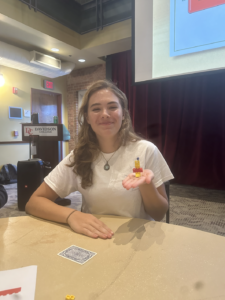
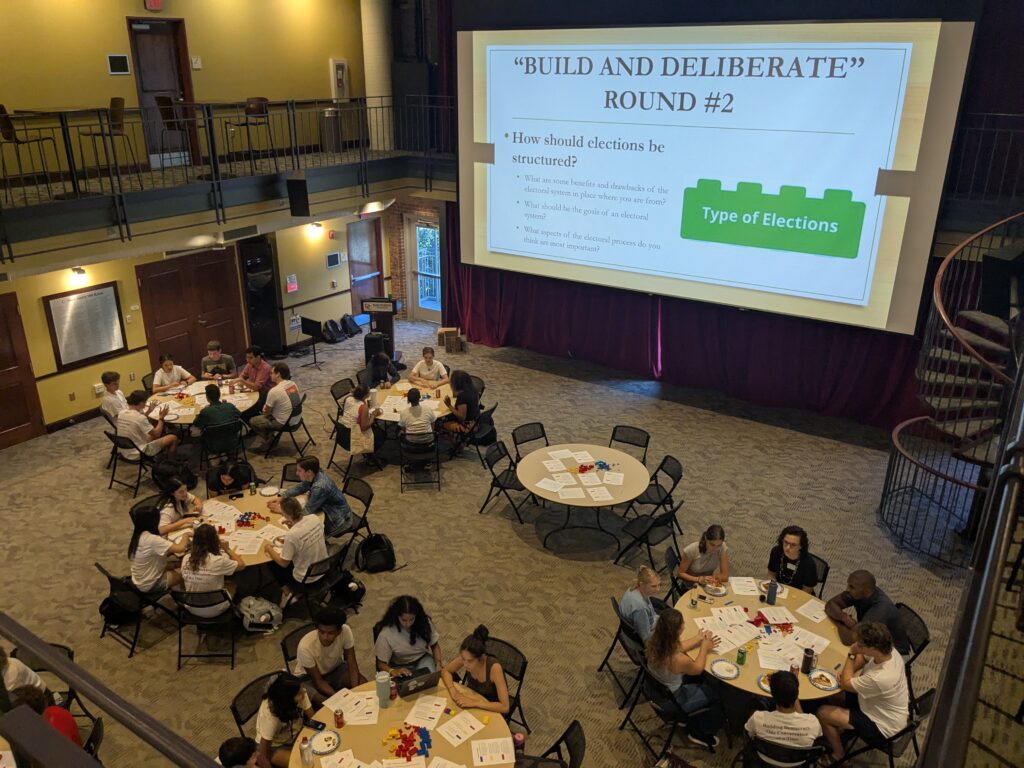
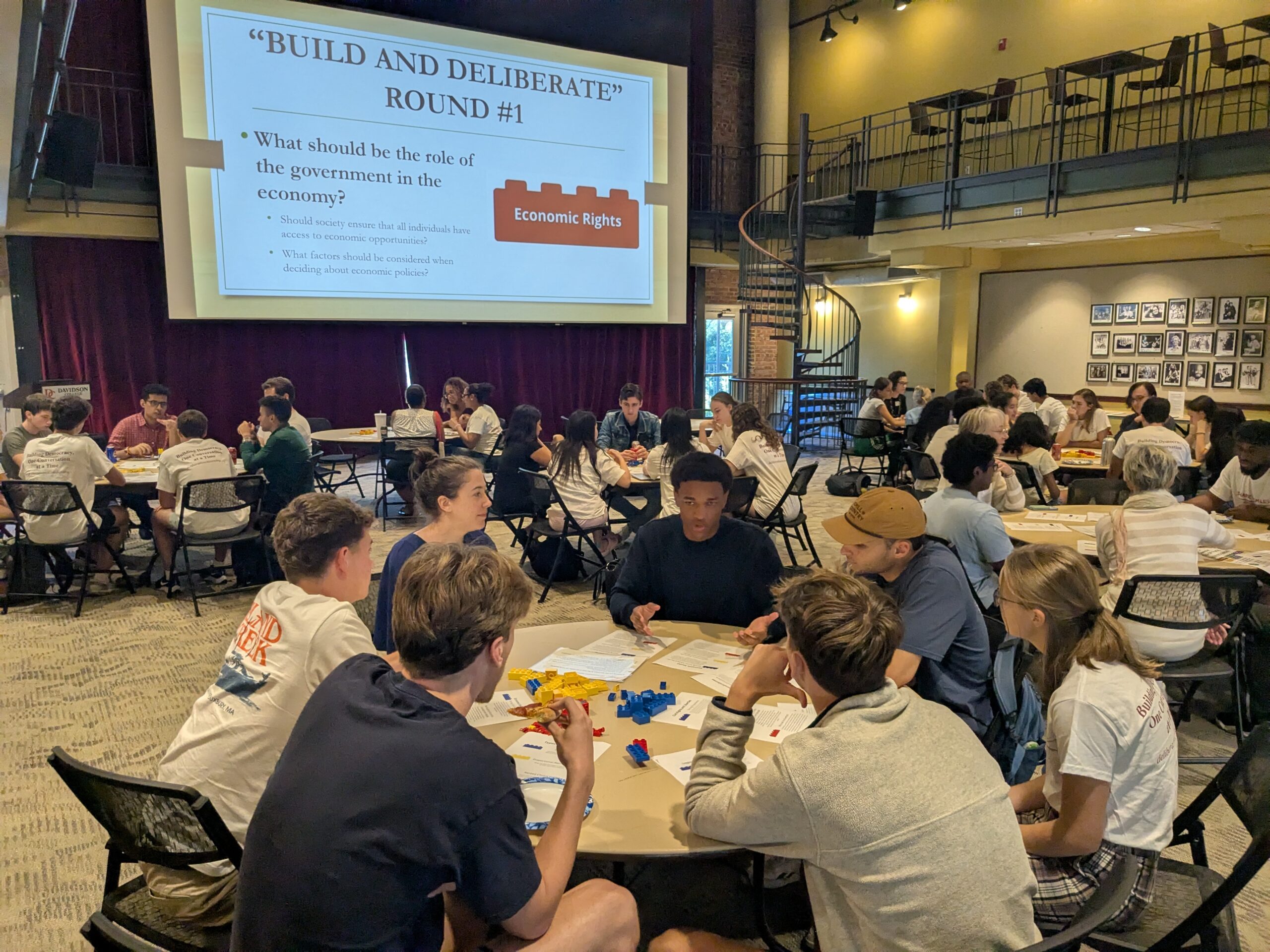
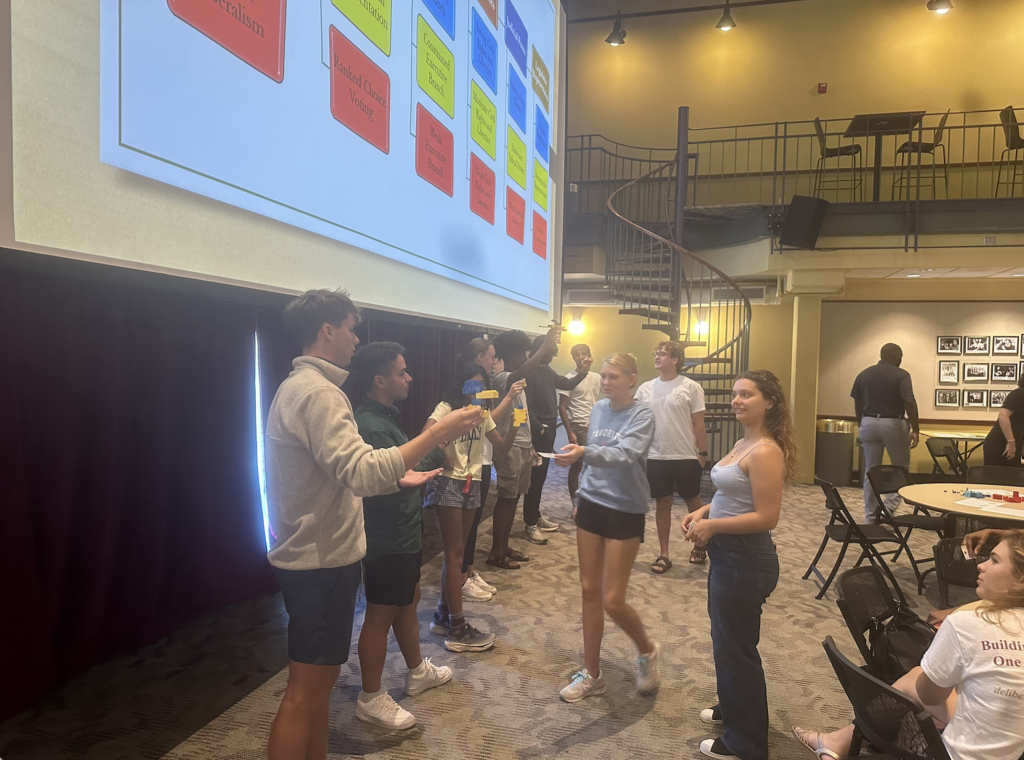
Every fall, the DCI hosts a Semester Kickoff Party to welcome students back to campus and introduce them to the principles and practices of deliberation and dialogue. We continued this tradition this year on August 29th in the Union’s 900 Room, and it was a blast. We had a great turnout, with over 40 students, staff, and community members engaging in active discussions over pizza. A range of people both new to and familiar with the DCI were there to listen to each other and share their perspectives.

This year, in addition to being able to learn about upcoming DCI programs, participants also had a chance to practice their deliberative skills as they worked to “Build the Best Democracy…” using Legos! They discussed with each other what they thought are the most important aspects of a democracy and then built a Lego structure that reflected those democratic elements. They ended up creating some colorful objects that represented different combinations of economic rights, types of elections, executive authority, judicial power, legislative representation, and civil rights and liberties that they argued made for the most responsive, resilient, and effective democratic republic.

Attendees had a blast discussing some key questions in a low-key context, and then they got to vote – in good democratic fashion – which creations – first at their tables and then overall – were the best representations of democracy. The overall winner took home a grand prize and the honorable mentions all won some prizes as well!

The event was a wonderful kickoff to the school year, providing participants with a meaningful opportunity to connect in new and fun ways. It highlighted the DCI’s efforts to foster meaningful dialogue about important topics facing our society, one Lego piece at a time!

Filed Under: DCI Posts

Winning vs. Problem-Solving  

January 26, 2026 by Ceyda Yesillik

By Ceyda Yesllik ’28 (DCI Fellow)

When you get into an argument with someone, do you want to win or do you want to solve the problem?

That summarizes the main difference between two common forms of political discussion: deliberation and debate. I think most of us are used to hearing the latter one with the famous presidential debates aimed at winning over undecided voters. Though we are less exposed to deliberation, it just might be a more effective way to engage with our disagreements.

The purpose of debate is to win; it is a competitive form of discourse. Debates have clearly defined sides, and each side tries to persuade an audience that their ideas are the correct ones. In a debate, you try to defeat the other side, whereas in deliberation, you try to find common ground with other people who aren’t as distinctly on the other side. The purpose of deliberation is to understand different perspectives, discuss options, and find the best course of action for the group; it is a collaborative form of discourse. Success in deliberation is measured by how good the outcome is rather than who is correct.

The execution of a debate mainly involves defending your position while attacking the other side. Debate promotes strategic thinking; it teaches its practitioners to highlight the facts that support their side and ignore or disprove the facts that don’t support their ideas. Many famous debaters are very good manipulators of their audience’s emotions. They know when to rile people up and when to play with their heartstrings. Emotions are also a big part of deliberation, but they are handled in a different way. They are taken into consideration when trying to come up with a final solution, rather than used as a tool of persuasion. The execution of deliberation encourages listening and mutual respect. Deliberation works by its practitioners being open-minded and willing to revise their views.

The outcome of a debate features a clear winner and a set of ideas that were supported the best. Due to the nature of competition, the winning set of ideas might not be the best solution out there. In a debate, a compromise is a sign of weakness; you are not supposed to let go of your ideas. A debate is not the grounds to generate new ideas, unlike a deliberation, where almost everybody is expected to build upon their preexisting conceptions to accept a solution that is inclusive of the whole group. The outcome of a deliberation is ideally a new idea or a system that is built on empathy and compromises. Even if a mutual solution isn’t reached, participants come out with a better understanding of each other’s situations, feelings, and contexts.

Debate and deliberation are both valid forms of democratic discourse, but they serve very different purposes. Debate seeks to win, while deliberation seeks to understand and decide together. Deliberation prioritizes empathy, curiosity, and shared progress over personal victory, and is generally better at coming up with solutions that work for everyone. Replacing some debate with deliberation in public life can lead to better policies, stronger communities, and more legitimate decisions. That is not to say debate should become irrelevant, as it holds a specific value in situations where there must be a clear winner, but a leap towards deliberation might lead us to a more peaceful society.

Filed Under: Fellow Posts

Teaching Students to Navigate Public Health’s Toughest Conversations

January 21, 2026 by Sally Bullock

The Deliberative Pedagogy (DeeP) Faculty Collaborative consists of faculty from Davidson College and other higher education institutions who are committed to learning and implementing new ways to improve and deepen the quality of their class discussions. These faculty come from a wide array of disciplines and backgrounds to study and discuss deliberative pedagogy methods, share their ideas and questions with one another, and work to embed deliberation in their classrooms. In this special blog series, members of the Collaborative describe and reflect on their experiences developing and teaching their deliberation-involved courses.

By Sally Bullock (2024-25 Deliberative Pedagogy Collaborative Faculty Fellow)

Between the opioid epidemic, COVID-19, measles outbreaks, and the current administration’s push to “Make America Healthy Again,” public health has been in the spotlight a lot recently. As an Assistant Professor of Public Health, one of my biggest challenges over the past few years has been teaching my students the public health fundamentals while also keeping up with all these pressing issues and the wide range of opinions on how to tackle them.

There are certainly evidence-based approaches that work for many major public health problems. But every intervention and policy decision involves complex trade-offs and competing values that affect our individual and collective well-being, which is why people see these issues so differently. While I encourage my students to critically analyze the public health topics we cover, I’ve noticed that this diversity of viewpoints doesn’t always come through in our class discussions or assignments. Students often seem reluctant to explore different perspectives, and many struggle to really understand viewpoints that don’t align with their own.

This concerns me because as future health professionals, my students will need to engage with diverse stakeholders and facilitate productive discussions about complex health challenges that uniquely affect different communities. So, when the Faculty Director of the Deliberative Citizenship Initiative (DCI) approached me about having students in my classes join Deliberative “D” Team discussions on topics relevant to public health, I was immediately interested. It sounded like a great opportunity for my students and dovetailed nicely with my efforts to integrate deliberation into my courses as a member of the DCI’s Deliberative Pedagogy (DeeP) Collaborative.

As part of my Introduction to Public Health and Health Disparities classes, my students participated in “D” Teams where they discussed three challenging public health topics – substance abuse, pandemic preparedness, and healthcare reform – over the course of three sessions. These small group discussions brought together community members, students, staff, and alumni. The format gave students a chance to hear different perspectives on these complex issues, share their own thinking, and work together toward potential solutions.

At the end of the semester, students submitted essays reflecting on their D Team experience. The feedback was overwhelmingly positive; students found the discussions both valuable and surprisingly civil. Many had expected contentious, winner-take-all debates, but instead found themselves in respectful conversations where people listened to each other with genuine empathy.

Despite coming from different backgrounds, students were often surprised by how much common ground they found. While a few wished for more ideological diversity, others saw the ability to reach consensus as encouraging. As one student wrote, “our unity in these conversations gives me hope that real change could be attainable and is best fostered through intentional and thoughtful deliberation.” Another noted, “The best part was seeing people change their views after hearing new perspectives. It showed how effective open discussion can be.”

What excited me most was seeing students bridge course content with their deliberations. They referenced frameworks we’d studied in class, like the social ecological model for understanding the opioid epidemic and used them to help their groups think through complex problems. Students appreciated how the class prepared them to contribute meaningfully, and they could really see the “real world” applications of what we’d been learning.

The impact went both ways. D Team participation enriched our classroom discussions too, as students would bring back perspectives and ideas they’d encountered in their small groups.

I’m thrilled my students had this opportunity. The D Teams didn’t just reinforce course content, they helped students grasp the true complexity of public health issues and develop confidence in contributing to difficult conversations. As one student reflected, “Participating in these deliberations helped me to appreciate the difficulty of public health policymaking, as I came in with opinions, but left with unanswered questions. I think that’s a good thing, as being a ‘deliberative citizen’ means being willing to listen and reconsider views in light of new information and experiences.”

Several students left inspired to keep working on skills like articulating ideas under pressure, improving their listening, and staying open to different viewpoints. Perhaps most importantly, they grasped something fundamental about deliberation. As another student put it, “One of the most important things I learned was that deliberation is not about winning an argument or choosing a side. It’s about understanding the ‘why’ behind different views and finding common ground.”

Filed Under: Faculty Posts

Would You Rather

January 20, 2026 by Savannah Dowtin

By Savannah Dowtin ’28 (DCI Fellow)

“Would you rather be reincarnated as Trisha Paytas or Jojo Siwa?” I break the silence of the solemn lunch table as my friends look up with confused expressions, scoffing through bites of spaghetti. These types of outrageous Would You Rather questions are far from rare in our Commons table conversations. On the surface, they seem ridiculous, random, and you may start to wonder what type of person even comes up with something like that. But they all have one thing in common: they spark deliberation.

The first deliberation skill my friends employ is the ability and willingness to disagree with one another. What happens when everyone in the room says they would rather have toes for fingers when having fingers for toes seems like the obviously more advantageous option? Unlike problems that plague our world today, these questions don’t suggest a level of expertise is necessary to solve them. When discussing the former, it is important to acknowledge that everyone as citizens in the public sphere can bring value to a conversation with their unique experiences and local expertise. But while one might hesitate to contribute to a discussion on immigration if they feel ill-prepared, anyone can jump into a Would You Rather debate with equal ethos. Thus, the deliberative disposition, egalitarianism, is not only exercised but encouraged in these conversations because entertainment arises within disagreement.

What follows shortly after the initial proposition are the qualifiers: “If I’m Trisha Paytas, do I have to act like her? Am I Jojo Siwa currently, or when she was on Dance Moms?” To engage in proper deliberation, we crave complete context, even when discussing a problem that is entirely fabricated and hypothetical. Unfortunately, having complete context is a near-impossible feat. Instead, as Scott F. Aikin and Robert B. Talisse write in their book, Why We Argue, we must exercise earnestness and responsibility, meaningfully addressing as many arguments as we can with respect and validity. When we disagree with people, there is a common assumption that because we went through a logical process to arrive at our conclusion, there must be a gap in logic on the opposing side. This reflects the tendency to underestimate the power of context, framing, and information available about an issue.

Another deliberative aspect infused in this example is the flexibility and expectation that one’s opinion will change as new information is given. At first, one might argue that being the worst player on the best sports team is better than being the best player on a worst sports team, because they’re considering what’s beneficial for the team as a whole as opposed to prioritizing their personal achievements. However, someone might counter that being the best player on the worst sports team means that their contributions are meaningful to the team, and this way, they aren’t weighing the team down as the worst player. In both of these arguments, the team is valued most, but the conclusions differ based on the interpretation of the information. This illustrates how disagreements can still arise when people harbor the same core values; the steps a person takes from the data to their decision must be well understood to understand their belief. Additionally, reassessing our beliefs as we gain new information, and practicing what Aikin and Talisse describe as cognitive hygiene, is crucial to maintaining the productivity of deliberations and remaining authentic with ourselves and our communities.

Unlike a Would You Rather question, real issues rarely only have two sides. Being able to tease apart the nuance within problems helps us understand the various pinpoints of disagreement more clearly and address them with attuned focus. Oftentimes, we are forced to use our citizenship responsibility to make binary choices, like choosing to elect person A or person B, when in actuality, both of these options represent a plethora of other Would You Rather questions. However, if we can take the time to disagree with our peers and defend our opinions using emotion and experience to motivate instead of blind us when the stakes are Trisha Paytas versus Jojo Siwa, then there is hope that we can exercise these principles on issues that affect our communities, our schools, and our nation.

Filed Under: Fellow Posts

  • « Go to Previous Page
  • Page 1
  • Interim pages omitted …
  • Page 5
  • Page 6
  • Page 7
  • Page 8
  • Page 9
  • Interim pages omitted …
  • Page 75
  • Go to Next Page »

Footer

Blog Post Categories

  • Announcements
  • Blog Posts
  • DCI Posts
  • Events
  • Faculty Posts
  • Fellow Posts
Image of a compass superimposed by the text "Deliberative Citizenship Initiative" and "Davidson College." Clicking on this image leads to the Initiative page.

Recent DCI Blog Posts

  • We Tried to Fix Jubilee’s “Middle Ground” – Here’s How It Went
  • A Case for Deliberation in the Natural Sciences
  • Welcoming New Staff to the DCI and DCN
  • Facebook
  • Twitter
  • Instagram
  • LinkedIn


Copyright © 2026 · Infinity Pro on Genesis Framework · WordPress · Log in