• Skip to main content
  • Skip to footer

Deliberative Citizenship Initiative

Building Democracy One Conversation at a Time

  • The Initiative
    • Programs
      • Deliberation Across the Curriculum
      • Deliberation on Campus
      • Deliberation in the Community
      • Research on Deliberation
    • Motivations
      • Why Deliberative Citizenship?
      • Why Davidson? Why Now?
    • Who’s Involved?
      • DCI Fellows Cohorts
        • 2025-2026 Fellows
        • 2024-2025 Fellows
        • 2023-2024 Fellows
        • 2022-2023 Fellows
        • 2021-2022 Fellows
        • 2020-2021 Fellows
      • DeeP Collaborative Cohorts
        • 2024-2025 DeeP Collaborative Faculty
        • 2023-2024 DeeP Collaborative Faculty
      • Advisory Council
    • History
      • What Sparked the Initiative?
    • Key Deliberative Dispositions
    • Frequently Asked Questions (FAQ)
    • Annual Report
  • Get Involved!
    • Participate in a Forum
    • Join a D Team
    • Become a Fellow
    • Take Courses
    • Get Training
    • Come to Guest Lectures
  • Events
    • Upcoming Events
      • 250th Anniversary Deliberative Forum Series on American Values
    • Past Events
  • Connections
    • The Deliberative Citizen: The DCI’s Monthly Newsletter
    • Efforts on Campus
    • Efforts in the Community
    • Efforts Elsewhere
    • Readings and Resources
      • DCI-Published Guides
      • DCI Guide to One-on-One Conversations
      • How to Disagree
      • Demonstration of Facilitation Styles
      • Deliberative Pedagogy Mini-Course
    • How We Can Help: DCI’s LET’S DELIBERATE! Partnership Opportunities
    • DCI in the News
  • DCI Blog Posts
    • Recent Blog Posts
    • All Blog Posts

The DCI Blog

Upcoming Expert Roundtable on Equality, Unity, and Immigration: Part of the 250th Anniversary American Values Series

August 13, 2025 by Graham Bullock

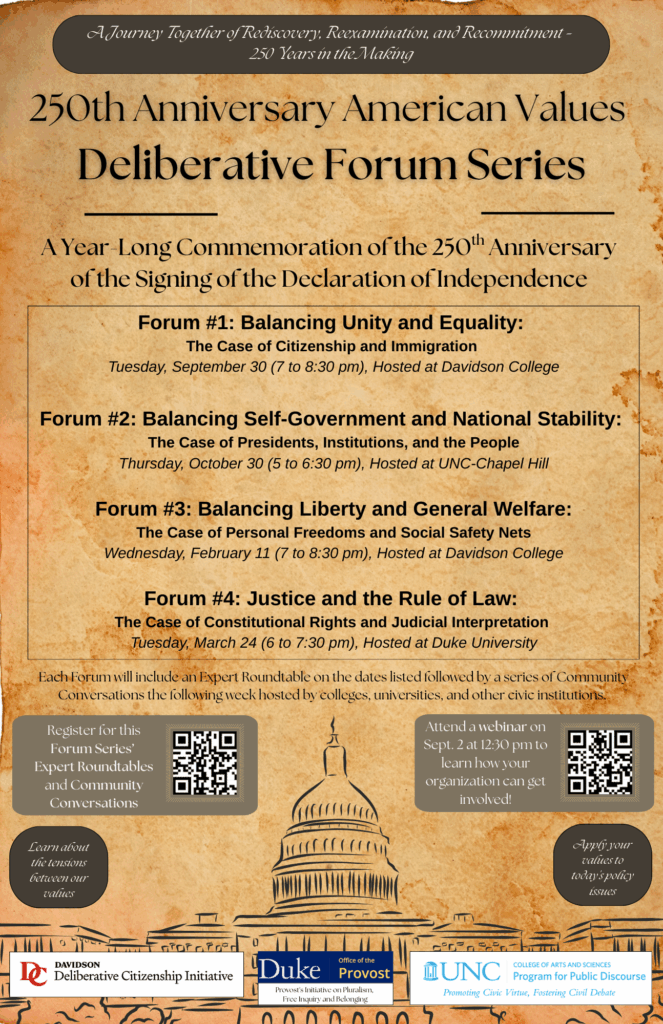
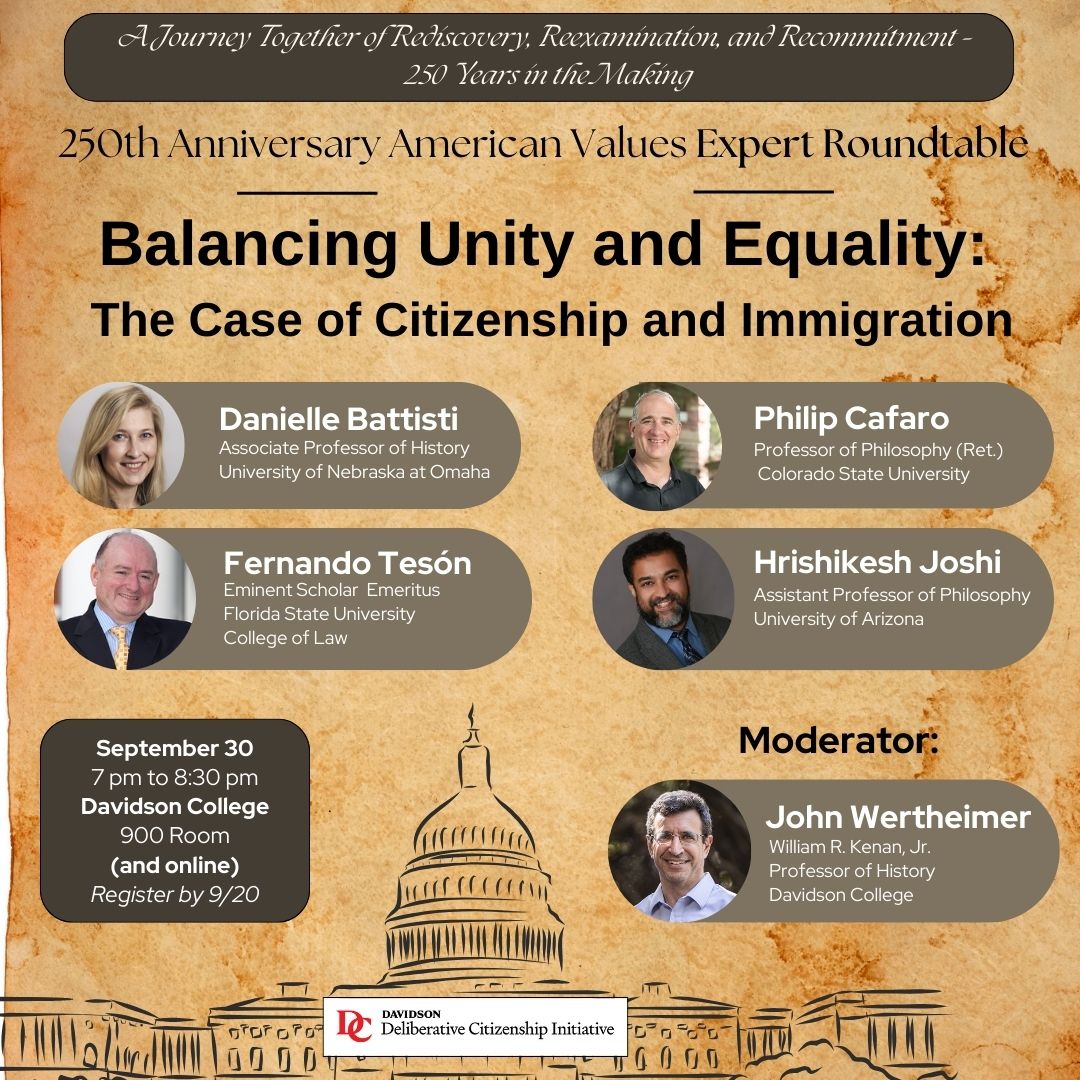
poster of forum event

If you are ready to register to attend the Expert Roundtable either in-person or online, click here. If you’d like to learn more first, read on below.

“We hold these truths to be self-evident, that all men are created equal…” (Declaration of Independence)
“We the People of the United States, in Order to form a more perfect Union…” (Preamble)

250 years ago next July, the Declaration of Independence, drafted by Thomas Jefferson and approved by the Second Continental Congress, formally separated the 13 colonies from British rule, placing the nascent country on the path to democracy. Beyond the Declaration’s grievances against the Crown or assertions about the nature of government, one line stands out in the collective memory of the American people: “We hold these truths to be self-evident, that all men are created equal.”

Those thirteen words and the doctrine of equality they promote have proven remarkably durable in American political culture. Referenced by the Seneca Falls Convention in its pleas for women’s rights, Abraham Lincoln in his Gettysburg Address, and Martin Luther King Jr. in his “I Have A Dream” speech, the foundational commitment to equality established in the Declaration has guided the country in some of its most pivotal moments. However, equality has never stood alone as the nation’s guiding value.

In 1787, as the US transitioned from the aspirational ideals of the Declaration to the practical governing framework of the Constitution, another value emerged as the Founding Fathers’ first priority: unity. They open the Constitution’s preamble not by echoing Jefferson’s emphasis on equality, but by anchoring the preamble in a sense of shared purpose through the words, “We the People of the United States, in Order to form a more perfect Union.”

After the 1786 Shays’ Rebellion exposed the weakness of the Articles of Confederation, the Constitution’s predecessor, Americans increasingly saw the need for a stronger framework to preserve the unity of the new republic. Since then, the importance of such unity would connect with many broader purposes and issues. As Abraham Lincoln’s famous line, “A house divided upon itself cannot stand,” suggests, a modicum of shared values that unites the country might be necessary for the American experiment to succeed.

This emphasis on unity, together with the Declaration’s statement about equality, represent the importance of considering both the nation’s egalitarian founding principles as well as its need to promote an enduring national identity. From the slavery debate to the New Deal to the failed adoption of the Equal Rights Amendment, the complementarities and conflicts between equality and unity have been a key feature of the American experiment. National unity fundamentally relies on recognizing and achieving equality and the inherent dignity of all individuals. However, the pursuit of equality – particularly policies addressing longstanding injustices and social disparities – can sometimes intensify societal divisions and challenge the existing sense of unity that holds the country together. Conversely, appeals to unity without adequately addressing existing inequalities risk perpetuating injustice and providing justifications for social unrest.

Davidson College’s Deliberative Citizenship Initiative is hosting an Expert Roundtable that will explore these dynamics both conceptually and historically. It will also explore how they are relevant to contemporary policy debates about immigration and citizenship, a domain where arguments about both unity and equality are frequently deployed from all sides of the political spectrum. The Roundtable will be held on September 30 from 7 to 8:30 pm in the 900 Room on the Davidson College campus, and it will also be broadcast live online. Register here to reserve a ticket today (deadline is 9/23).

The roundtable will include the scholars listed below, each of whom brings a unique set of expertise and knowledge to the conversation, both on the general questions related to unity and equality and on the specific topic of citizenship and immigration. Specifically, they will address the question, “How should immigration policies balance national cohesion with a commitment to the equal dignity of all people?”

Expert Roundtable

  • Danielle Battisti is an associate professor of history at the University of Nebraska at Omaha where she specializes in immigration and ethnic history. Her book, “Whom We Shall Welcome: Italian Americans and Immigration Reform” (Fordham University Press, 2019) examines both the liberal and conservative elements of Italian American efforts to influence American immigration policies in the 1950s and 1960s. It was awarded the Immigration and Ethnic History Society’s best first book award for 2019. She is also the co-editor of Hidden Histories of Unauthorized Migrations from Europe to the United States (Illinois University Press 2025). One of her current projects is examining the immigration laws that largely facilitated Euro-Americans’ efforts to adjust their status from “illegal alien” to “legal permanent resident.” 

  • Philip Cafaro, a philosophy professor who recently retired from Colorado State, is the author of the book, How Many Is Too Many? The Progressive Argument for Reducing Immigration into the United States (University of Chicago Press, 2015), which argues that current immigration levels—the highest in U.S. history—undermine efforts to achieve a more economically just and ecologically sustainable society. He is also the co-editor of Life on the Brink: Environmentalists Confront Overpopulation (University of Georgia Press, 2012) and Virtue Ethics and the Environment (Springer-Verlag 2010) as well as the author of Thoreau’s Living Ethics: Walden and the Pursuit of Virtue (University of Georgia Press 2004) and “The Impact of Immigration Policy on Future US Population Size” in The Journal of Population and Sustainability (2025).
  • Fernando Tesón is Eminent Scholar Emeritus at Florida State University College of Law. An Argentine-American legal scholar, he is a leading authority on humanitarian intervention and the philosophy of international law. He is the editor of The Theory of Self-Determination (Cambridge University Press 2016) and co-author of Debating Humanitarian Intervention: Should We Try to Save Strangers? (Oxford University Press (2017) and Justice at a Distance: Extending Freedom Globally (Cambridge University Press 2015). He has also published articles supporting less restrictive immigration policies, including  “The Bourgeois Argument for Freer Immigration” in The Cambridge Handbook of Classical Liberal Thought and “Brain Drain” in the San Diego Law Review.

  • Hrishikesh Joshi is an Assistant Professor of Philosophy at the University of Arizona, where he also serves as a core faculty member at the Center for the Philosophy of Freedom. His research focuses on normative issues at the intersection of philosophy, politics, and economics (PPE). He has published several chapters related to immigration and citizenship, including “Immigration Enforcement and Fairness to Would-Be Immigrants” (in The Handbook of Philosophy and Public Policy), “Immigration” (in The Routledge Companion to Libertarianism), and “Immigration: Some Arguments for Limits” (in The Routledge Handbook of the Ethics and Economics of Immigration). He has also published a book on Why It’s Okay to Speak Your Mind (Routledge).

John Wertheimer, the William R. Kenan, Jr. Professor of History at Davidson College, will serve as moderator of the roundtable discussion. Dr. Wertheimer’s research and teaching focuses on modern U.S. history and legal history; his two books – Law and Society in the South: A History of North Carolina Court Cases (University Press of Kentucky) and Race and the Law in South Carolina: From Slavery to Jim Crow (Amherst College Press) – explore the legal history of the U.S. South.

In the week following the Roundtable, the DCI will be hosting a series of Community Conversations that will build on the scholars’ deliberations. These two-hour deliberative discussions of 6-10 people will be moderated by trained facilitators and will use a similar format to the DCI’s D Teams. To learn more about this opportunity and reserve a spot at a time that works for you, click here (the deadline to do so is September 5). Duke, UNC, and potentially other institutions will be hosting similar conversations for their communities. If you are interested in hosting a conversation yourself at your organization, click here to learn more about a webinar we are hosting on how both individuals and institutions can get involved — and how the DCI can help you with doing so.

The Expert Roundtable and Community Conversation are both part of the Deliberative Forum Series on American Values that Davidson College, Duke University, and the University of North Carolina, Chapel Hill are co-hosting in the lead-up to the 250th anniversary of the Declaration of Independence and the nation’s founding. Approaching this milestone in an era marked by historical amnesia and selective memory, the series aims to foster a more complete understanding of our nation’s past and present. To learn more about and register for the other forums and community conversations that are a part of this series, visit this webpage for more information and updates.

Inviting participants to reflect on the foundational ideals that have shaped our republic, each of the four forums in the series will draw from both the Declaration and the Constitution’s Preamble to explore a pair of core American values that often complement each other but also have been – and remain – at the heart of deep tensions, particularly during moments of national change. Through dialogue grounded in history, informed by philosophical inquiry, and connected to current policy challenges, this series and this guide is designed to encourage thoughtful deliberation on how best to uphold and balance these enduring commitments in an ever-changing democracy.

Register to Attend the Roundtable
Register to Participate in an associated Community Conversation
Learn about the Webinar about the Series and How to Get Involved

Unity-Equality-and-Immigration-Roundtable-Poster
Filed Under: Announcements

DCI Semester Kickoff Party! Come and Build the Best Democracy

August 13, 2025 by Ruby Aaver

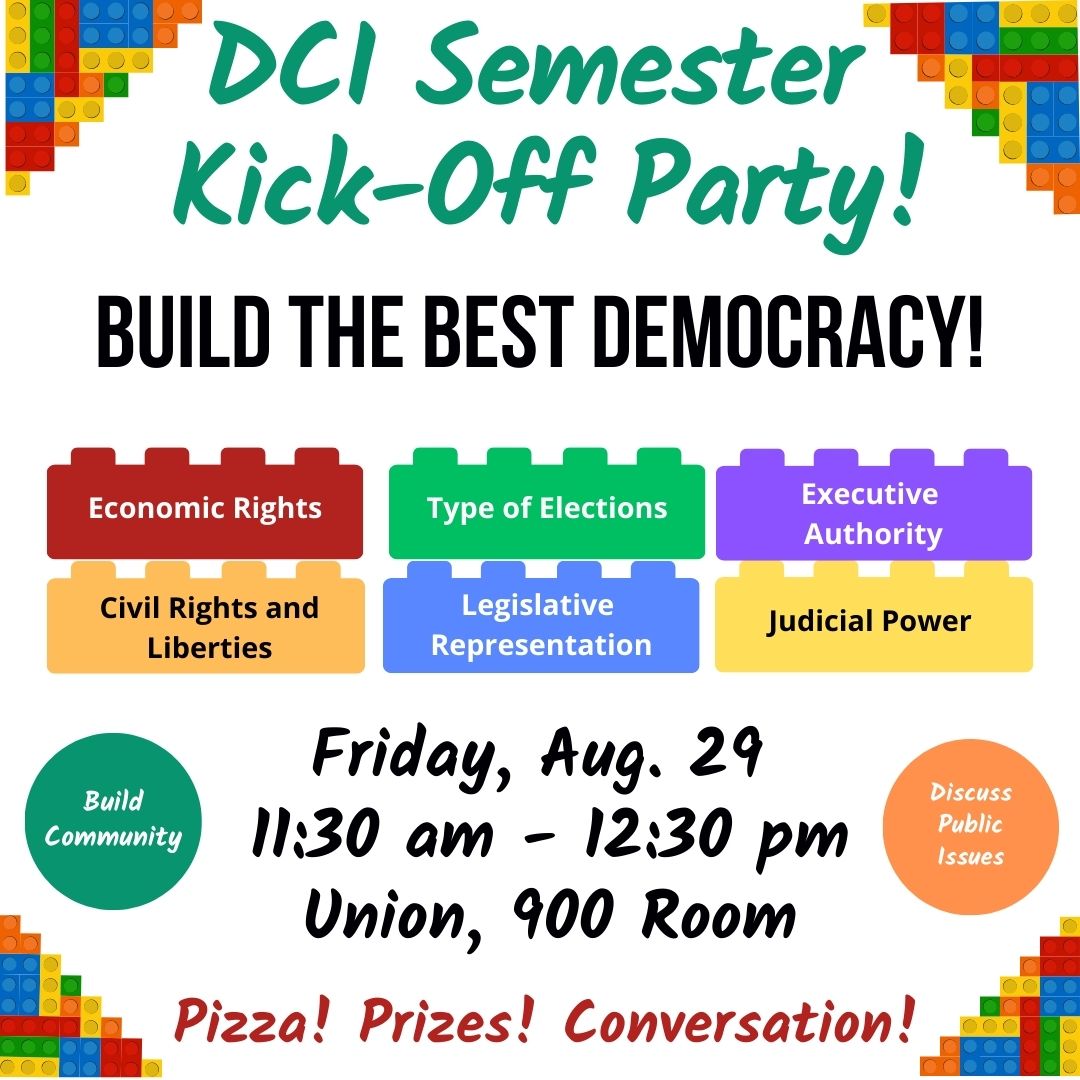
Flyer for DCI Semester Kickoff Party about building the best democracy.

On Friday, August 29, as part of Davidson’s back-to-school Welcome Week, the DCI is hosting a Semester Kickoff Party in the 900 Room at the Alvarez Student Union from 11:30 AM to 12:30 PM. We welcome all Davidson students, faculty, and staff to join us for pizza, deliberation about some hot topics, and even a few prizes…No need to RSVP—bring your friends and drop in any time!

Our Kickoff Party is a place to learn how you can get involved in deliberation about contentious topics of public interest on campus and beyond, and to meet others interested in deliberation on campus. You will also get a chance to meet current DCI Fellows, Senior Fellows, and some members of the DCI leadership team along the way. You’ll also be able to talk with us about our upcoming programs and to find your own way to get involved—whether that means joining a D Team, becoming a Fellow, attending a Deliberative Forum, and/or attending our Deliberative Citizenship Speaker Series.

You will also have a chance to practice your deliberative skills as we talk about some engaging topics and play some deliberative games over free pizza courtesy of the DCI. The theme of this year’s fall semester kickoff party is “Build the Best Democracy!” Come discuss with others what you think are the most important aspects of a democracy and then build a Lego structure that reflects those democratic elements. What colorful combination of economic rights, type of elections, executive authority, judicial power, legislative representation, and civil rights and liberties make for the most responsive, resilient, and effective democratic republic? You decide!

You’ll have a blast discussing some key questions in a low-key context — and you’ll be able to win some prizes in the process! We hope you’ll join us for a fun event that will help us get energized for the coming year.

Fall-2025-Kickoff-11×17-1

Filed Under: Announcements

Introducing our 250th Anniversary Deliberative Forum Series on American Values

August 13, 2025 by Graham Bullock

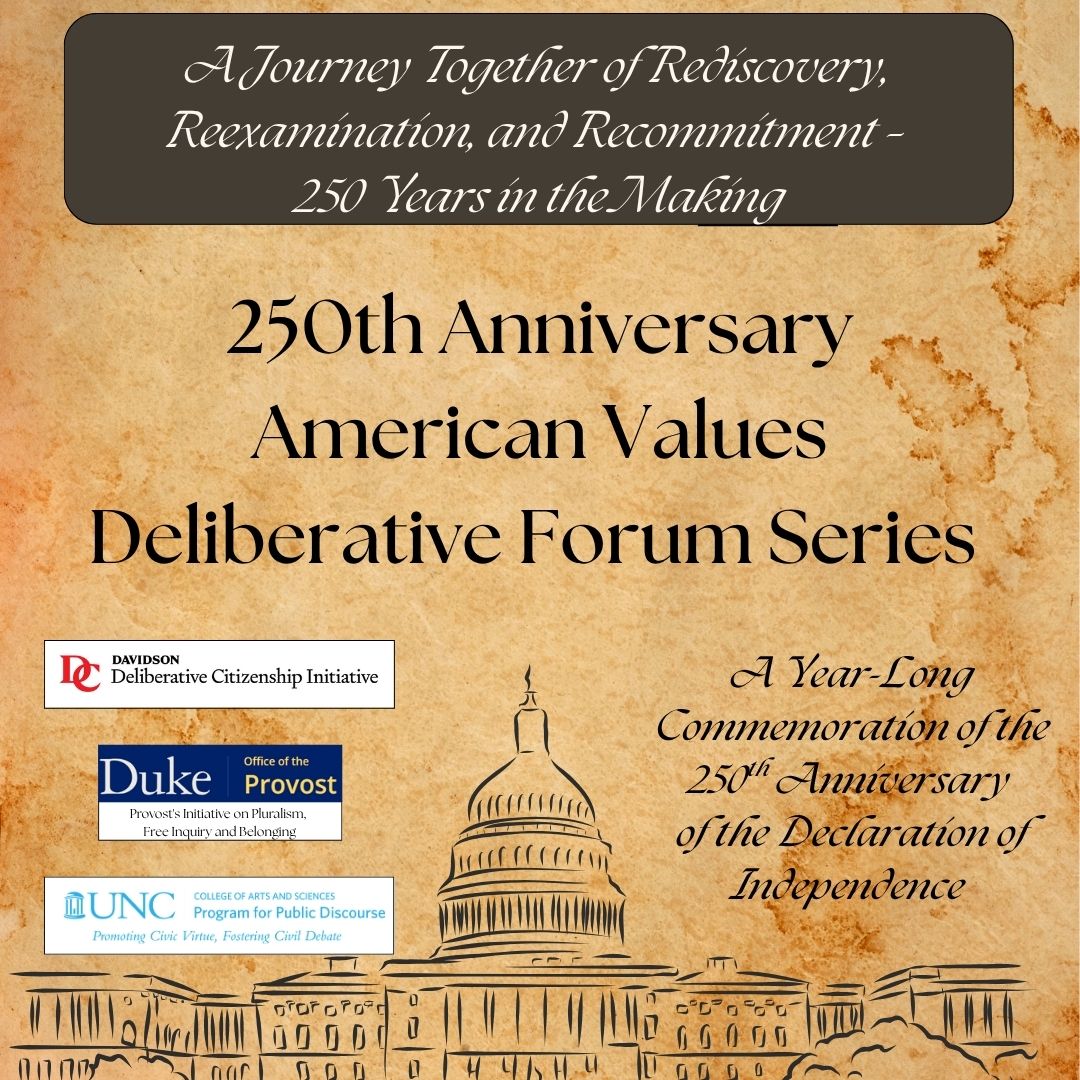
Image with text about the 250th Anniversary American Values Forum Series.

250 years ago next July, the Declaration of Independence proclaimed to the world that all men are created equal and that governments must derive “their just powers from the consent of the governed.” As America prepares to commemorate this milestone and the nation’s semiquincentennial with small-town parades, Smithsonian exhibitions, and the Great American State Fair, Davidson College’s Deliberative Citizenship Initiative, in collaboration with Duke University and the University of North Carolina, Chapel Hill, is organizing a year-long series of forums focused on the values defining the American ethos.

Whether our deliberations are on healthcare reform, the role of religion in public life, or the results of the presidential election (all DCI events in the past year), American values play a significant role in the perspectives of our participants. Within our invocations of justice, self-government, and other ideals lie far more nuance than can be expressed in these policy conversations. At the root of each of these values lies a long history of shared and contested meaning. This year’s Series on American Values is a year-long program of forums and deliberations dedicated to unpacking, understanding, and applying the concepts that are foundational to the United States – and to many other countries around the world.

Between the more aspirational philosophical ideals of the Declaration and the more practical governing precepts of the Constitution, American values do not all fit neatly into a  perfectly interlocking puzzle. Instead, they are often in conflict and subject to challenging contradictions, requiring citizens to determine what matters most when choices must be made. Each of our four forums this year will wrestle with two values that are at once fundamental to our country and can be both complementary to and in conflict with one another. They include Unity and Equality, Self-Government and National Stability, Liberty and General Welfare, and Justice and Rule of Law. Recognizing the relevance of these values to current events, each theme will also connect to a politically salient issue facing the nation today.

This Series on American Values is designed to connect the insights of experts with the views of the people. Each forum will begin with a 90-minute Expert Roundtable where invited scholars with different backgrounds and perspectives will share their insights on the history, meaning, and contemporary relevance of the values at stake. For those who would like to get them on their calendars now, below are the dates and locations of our forums.

  • Forum #1: Balancing Unity and Equality: The Case of Citizenship and Immigration – Tuesday, September 30 (7 to 8:30 pm), Hosted at Davidson College
  • Forum #2: Balancing Self-Government and National Stability: The Case of Presidents, Institutions, and the People – Thursday,  October 30 (5 to 6:30 pm) Hosted at UNC-Chapel Hill
  • Forum #3: Balancing Liberty and General Welfare: The Case of Personal Freedoms and Social Safety Nets – Wednesday, February 11 (7 to 8:30 pm), Hosted at Davidson College
  • Forum #4: Justice and the Rule of Law: The Case of Constitutional Rights and Judicial Interpretation – Tuesday, March 24 (6 to 7:30 pm), Hosted at Duke University

The first of these forums is on “Balancing Unity and Equality: The Case of Citizenship and Immigration” and will feature a roundtable of experts who will explore what these different values mean and how they have both complemented and conflicted with one another in American history. They will also discuss how immigration policies should balance national cohesion with a commitment to the equal dignity of all people. To learn more about and reserve an in-person or online ticket for this forum, click here.

In the week after the Roundtable, the DCI invites members of the public – students, staff, faculty, and community members – to participate in a series of Community Conversations that will build on the roundtable discussions. These two-hour deliberative discussions of 6-10 people will be moderated by trained facilitators and will use a similar format to the DCI’s D Teams. To learn more about this opportunity and reserve a time that works for you, click here (the deadline to do so is September 5).

This year, we’re proud to partner with two other North Carolina institutions of higher education, Duke and UNC Chapel Hill, to expand the reach of the series. Davidson will host two of the Expert Roundtables, while Duke and UNC will each host one roundtable on their respective campuses. All four will be available to watch online, with potential for “watch parties” to be held at higher education institutions and other organizations across North Carolina and beyond. We’ll be hosting such watch parties at Davidson, and Duke and UNC will be doing so as well. In the week after the Expert Roundtables, students, staff, and community members at Duke, UNC, and potentially other institutions will also have the opportunity to participate in deliberations on what they heard from the roundtable discussion.

Given the importance of the topics we will be covering, we hope other colleges, universities, and other civil society organizations will attend these forums and organize conversations around them. Please invite organizations you are involved with to consider developing their own programs in conjunction with this Series on American Values. To support these efforts, on August 25, we will be hosting a webinar for individuals and institutions interested in organizing their own programs related to this American Values Forum Series (register here). The DCI will also be hosting its annual Deliberation Facilitator Training Program on August 31 and September 7; if you are interested in learning how you might host a conversation in association with our American Values Forum Series, we encourage you to register for this training here.

We hope you will join us in this yearlong exploration on the meaning and importance of American values and add your voice to the ongoing conversation about who we are, what we stand for, and where we go from here.

Below are links to register for the first Expert Roundtable, the webinar introducing the American Values Forum, and the DCI’s Community Conversations (this fall’s D Teams) and Deliberation Facilitation Training Program. Links to our later Expert Roundtables and Community Conversations hosted at other institutions will be posted to this webpage – check there later for more info coming soon!

Register for Equality, Unity, and Immigration Expert Roundtable
Register for Fall 2025 DCI Community Conversations
Register for DCI Deliberation Facilitator Training
Register for American Values Forum Webinar

Filed Under: Announcements

A DCI Overview: Presentation to the Greater Good Bridging Differences Alumni Network

August 12, 2025 by Graham Bullock

DCI Logo and Motto

There are an increasing number of programs across the country organizing public discourse opportunities on college campuses. With such a proliferation, there is a risk that they all go in disparate directions, re-inventing the wheel and not learning from one another. Fortunately, several efforts have also been underway to facilitate sharing and cross-fertilization across these different programs so that lessons can be learned and promising practices can be identified together.

One of these efforts has been run by the Greater Good Science Center (GGSC), which is based out of the University of California, Berkeley. For the last several years, GGSC has run a Bridging Differences in Higher Education Learning Fellowship for higher education faculty and staff to develop or strengthen a project to foster healthier dialogue and understanding across divides at their school.

During the 2023-24 academic year, the DCI’s Faculty Director, Dr. Graham Bullock, participated in the GGSC’s Project-Based Cohort, which included small groups of campus leaders who exchanged ideas and provided feedback related to their existing initiatives. The group has continued to stay connected through the GGSC’s Bridging Differences Alumni Network, which is made up of faculty and staff who have gone through the fellowship program. It also hosts regular presentations by leaders in the field who share their insights about how to stimulate constructive conversations across differences on college campuses.

Professor Bullock was invited in the spring of 2025 to provide an overview of the Deliberative Citizenship Initiative to the Network and share what he has been working on as its Faculty Director. In the interests of stimulating further learning and collaboration across higher education (and beyond), we have posted Dr. Bullock’s presentation below. This video was originally recorded by the Greater Good Science Center at UC Berkeley under their Bridging Differences in Higher Education Learning Fellowship. You can learn more about their work via their online magazine, Greater Good.

Filed Under: DCI Posts

Bridging Perspectives: Leadership Through Deliberation

August 11, 2025 by Tehinnah Kitcher

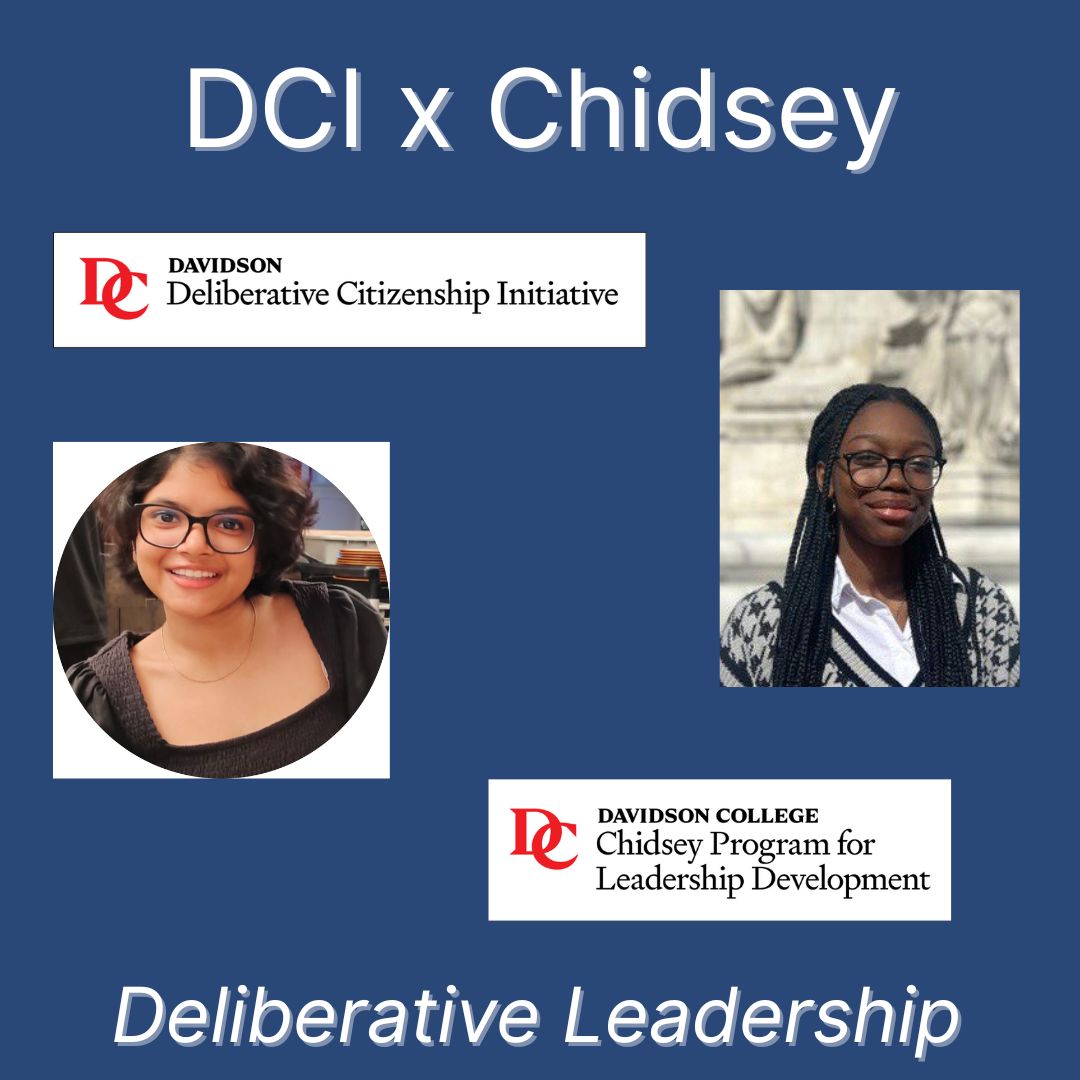
Chidsey and DCI logos and photos of Tehinnah and Atyantika

By Tehinnah Kitcher ’27 (DCI Fellow)

This past March, I had the opportunity to co-lead a project called “Bridging Perspectives: Empowering Leaders to Connect, Deliberate, and Drive Change Together” alongside senior DCI fellow Atyantika Mookherjee that united the Chidsey Program for Leadership Development and the Deliberative Citizenship Initiative (DCI).

The Chidsey Leadership Fellows’ Program emphasizes leadership as an intentional and evolving practice, focusing on personal choice, resilience, opportunity, and connection. It views leadership as a journey shaped by decisions, the courage to tackle challenges, the openness to see possibility, and the commitment to build connections. By embracing these pillars, Chidsey Fellows learn to grow as leaders who can positively impact their communities through empathy, responsibility, and collaboration. As both Chidsey and DCI Fellows, Atyantika and I both noticed that together, the DCI and Chidsey provide students with a powerful set of complementary skills: DCI cultivates the ability to navigate complex discussions, while Chidsey emphasizes leading with empathy and purpose.

In our session with the Chidsey Fellows, we gave them an overview of the four facilitation styles and specific techniques to enhance communication and build understanding. We drew from the same frameworks that we learned in our official DCI facilitator training. Each style offered a different way of guiding a conversation and shaping group dynamics. The Chidsey Fellows then had the opportunity to play these roles through a mock deliberation. Afterwards, they reflected on their facilitation styles and skills.

This unique collaboration between DCI and the Chidsey Leadership Program helps to create future leaders who are equipped not only with technical skills but also with a deeper understanding of how to navigate complex, real-world challenges. By integrating DCI’s facilitation skills, which are centered around being attentive, respectful, and open-minded, with Chidsey’s core values, we’re fostering leaders who can engage in constructive, inclusive conversations. Such leaders are more adaptable, open to diverse viewpoints, and skilled at finding common ground, all of which are critical in a rapidly changing and interconnected world.

I am excited to see the DCI continue to collaborate and engage with the campus and broader community. Future collaborations would undoubtedly provide greater insights as to how dialogue and deliberation influence other fields. In a world that is growing more polarized and intolerant, quality deliberation and dialogue are essential. If you are interested in getting connected with the DCI, be sure to join a D Team in the fall or attend one of our forums!

Filed Under: Blog Posts, Fellow Posts

  • « Go to Previous Page
  • Page 1
  • Interim pages omitted …
  • Page 16
  • Page 17
  • Page 18
  • Page 19
  • Page 20
  • Interim pages omitted …
  • Page 75
  • Go to Next Page »

Footer

Blog Post Categories

  • Announcements
  • Blog Posts
  • DCI Posts
  • Events
  • Faculty Posts
  • Fellow Posts
Image of a compass superimposed by the text "Deliberative Citizenship Initiative" and "Davidson College." Clicking on this image leads to the Initiative page.

Recent DCI Blog Posts

  • We Tried to Fix Jubilee’s “Middle Ground” – Here’s How It Went
  • A Case for Deliberation in the Natural Sciences
  • Welcoming New Staff to the DCI and DCN
  • Facebook
  • Twitter
  • Instagram
  • LinkedIn


Copyright © 2026 · Infinity Pro on Genesis Framework · WordPress · Log in