• Skip to main content
  • Skip to footer

Deliberative Citizenship Initiative

Building Democracy One Conversation at a Time

  • The Initiative
    • Programs
      • Deliberation Across the Curriculum
      • Deliberation on Campus
      • Deliberation in the Community
      • Research on Deliberation
    • Motivations
      • Why Deliberative Citizenship?
      • Why Davidson? Why Now?
    • Who’s Involved?
      • DCI Fellows Cohorts
        • 2025-2026 Fellows
        • 2024-2025 Fellows
        • 2023-2024 Fellows
        • 2022-2023 Fellows
        • 2021-2022 Fellows
        • 2020-2021 Fellows
      • DeeP Collaborative Cohorts
        • 2024-2025 DeeP Collaborative Faculty
        • 2023-2024 DeeP Collaborative Faculty
      • Advisory Council
    • History
      • What Sparked the Initiative?
    • Key Deliberative Dispositions
    • Frequently Asked Questions (FAQ)
    • Annual Report
  • Get Involved!
    • Participate in a Forum
    • Join a D Team
    • Become a Fellow
    • Take Courses
    • Get Training
    • Come to Guest Lectures
  • Events
    • Upcoming Events
      • 250th Anniversary Deliberative Forum Series on American Values
    • Past Events
  • Connections
    • The Deliberative Citizen: The DCI’s Monthly Newsletter
    • Efforts on Campus
    • Efforts in the Community
    • Efforts Elsewhere
    • Readings and Resources
      • DCI-Published Guides
      • DCI Guide to One-on-One Conversations
      • How to Disagree
      • Demonstration of Facilitation Styles
      • Deliberative Pedagogy Mini-Course
    • How We Can Help: DCI’s LET’S DELIBERATE! Partnership Opportunities
    • DCI in the News
  • DCI Blog Posts
    • Recent Blog Posts
    • All Blog Posts

The DCI Blog

The Importance Of “Why?”

August 22, 2025 by Ben Files

By Ben Files ’25 (DCI Fellow)

Time of day is a fleeting thing in the digital age. Whether it be on social media, or even in person, the end goal of political discussions increasingly seems to be finding ways to one up or outsmart the person you disagree with, rather than trying to understand their perspective and find middle ground.

This trend manifests itself well in the rise of pop-up debates or tables, pioneered by internet stars Steven Crowder and Charlie Kirk. In theory, these pop-up debates are brilliant: they are framed as spaces for anyone to come and discuss any political topic with someone, including Crowder and Kirk themselves, who are incredibly knowledgeable on most political subjects. While these pop-up debates do produce some productive, thoughtful, deliberation, Crowder and Kirk are incentivized to share on social media the exact opposite.

In practice, the most famous clips from Crowder or Kirk are when they “punk” people whose views differ from them. In turn, this incentivizes hosts such as Crowder and Kirk to seek out less real deliberation, and more opportunity to defeat the person who takes the stand to talk to them. In some instances, these hosts will make a point of not answering certain questions to ensure that their position remains superior. This process is only beneficial for the hosts and their staff.

The brave participants who take the stand at these pop-ups often do not have a healthy deliberation. This result can discourage many participants from engaging in similarly framed events, which may indeed involve meaningful discourse across party lines. Further, the viewers gain little from these clips – sure, they may pick up some new talking points, but overall they learn that the point of political discussions is to win, because winning is fun.

But, deliberation isn’t about winning. For my deliberation project with the DCI, in which I collaborated with DCI Fellows Liam Mann and Jane McNeill, I wanted to implement on campus a pop-up deliberation table similar to those created by Crowder and Kirk. Crucially, though, I wanted to ensure that all participants felt comfortable being, in a way, vulnerable around complete strangers, able to talk about their political opinions without fear of being “punked.”

To do so, I decided to take an approach that was the opposite of the common practice of Crowder and Kirk. Instead of asking hard hitting follow-up questions, I would reply to participants’ responses with a simple “why?” This simple follow up is not rudely interrogative and does not attempt to steer the conversation off-course or throw off a participant’s train of thought. Rather, it is almost like an alley-oop, a way to extract more information in a non-hostile and respectful manner.

The use of “why?” was surprisingly effective in our conversations. Our pop-up discussion table featured 27 questions covering a wide range of topics, from politics to philosophy to pop culture. These questions were printed on note cards and folded, allowing participants to choose a question at random. Then, participants would answer the question on the card they had selected, and if their original answer was not sufficient, we would ask the famous “why” question.

Following conversations with approximately 35 participants, I have drawn two key takeaways regarding thoughtful deliberation and the use of a “why?” question. The first, broader trend I noticed was that participants were far more apprehensive and concise when answering political questions. Often, we needed to follow up with a “why?” question here, to better understand participants’ views on term limits or abortions, for example.

Second, I noticed that any apprehension around answering was compounded when participants approached us in groups, whether it be friends or other students. Again, the use of “why?” helped here, as participants were encouraged to explain their position more, which in turn (I think) put them more at ease. Across the board, our “why?” question gave participants the time and place to explain why they believe the things they do, an opportunity that is often not afforded to people in political discussions.

A simple “why?” is crucial for improving deliberation and political discourse because, quite simply, it gives people the time of day. When people feel comfortable expressing how they truly feel, real personal and societal growth is possible. It may not get the most internet clicks, but true understanding of our political differences is crucial to creating a better tomorrow.
Filed Under: Fellow Posts

Upcoming Webinar on the 250th Anniversary American Values Deliberative Forum Series

August 13, 2025 by Graham Bullock

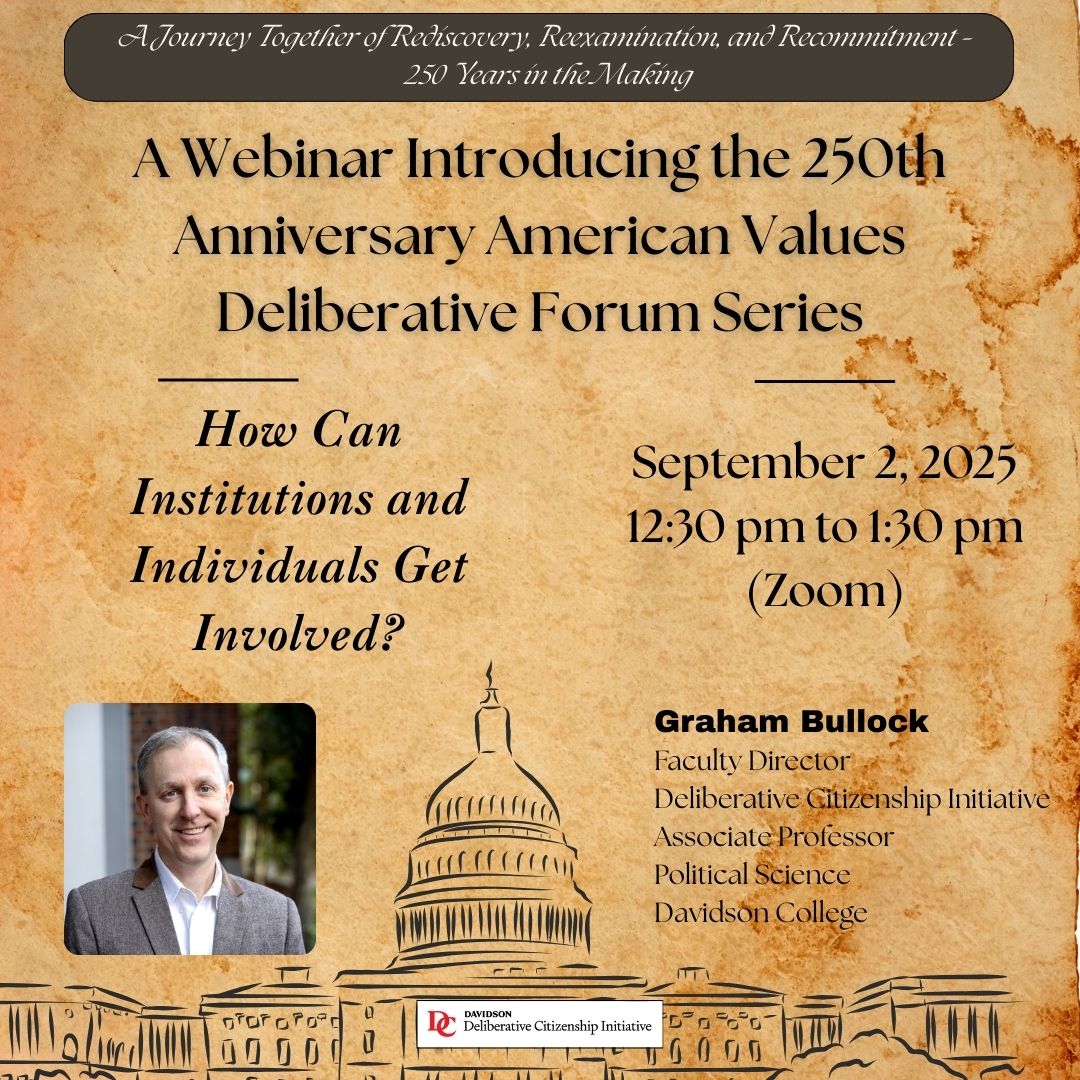
Poster for webinar introducing 250th Anniversary American Values Deliberative Forum Series featuring Graham Bullock

Excited about celebrating the upcoming 250th anniversary of the Declaration of Independence? Interested in doing something substantive and interesting to celebrate the  founding of the world’s oldest democratic republic? Concerned that we might pass the nation’s Semiquincentennial without thinking about how far we have come, and how far we have to go to become a “more perfect union?” Want to help organize an opportunity for your institution, organization, friends, family, or neighbors to engage with our nation’s history, values, and policy debates in the lead-up to July 4, 2026?

Then we encourage you to attend our upcoming webinar on “The 250th Anniversary American Values Deliberative Forum Series,” which will provide an overview of the series and ways both institutions and individuals can get involved. Join us from 12:30 pm to 1:30 pm on September 2, 2025 over Zoom to learn how you can take part in this timely opportunity to celebrate and examine our history in an engaging way. Co-hosted by Davidson College, Duke University, and the University of North Carolina at Chapel Hill, the series will include Expert Roundtables and Community Conversations over the course of the 2025-26 academic year.

These Roundtables will include scholars with a diverse range of perspectives and academic backgrounds who will deliberate about the role of different values in American history and policy debates. The first Roundtable, for example, will be held on September 30 and will explore the tensions and complementarities between our commitments to national unity and political equality, both generally and in the specific context of immigration and citizenship.     

The week following each Roundtable, Davidson, Duke, and UNC-Chapel Hill will be hosting Community Conversations that will enable members of their communities to engage with the same questions that the experts discussed. Each institution will design their conversations so that they best match particular contexts. The conversations organized at Davidson, for example, will follow the Deliberative Citizenship Initiative’s D Team model, which are two-hour small group discussions guided by a trained facilitator, but many other models will work as well.

We welcome other institutions and organizations – as well as individual citizens – to organize similar conversations for their communities that utilize the Expert Roundtables as a catalyst for deeper engagement with the values that have animated our history and continue to permeate our political debates. Hosting such conversations is a great way to help bridge the political divides in our country, improve our ability to deliberate with one another as citizens (broadly defined), and start celebrating the upcoming 250th birthday of the United States.

To that end, in the upcoming webinar DCI Faculty Director and Associate Professor of Political Science Graham Bullock will provide more information about the series itself as well as some ideas for how you might organize something for your community. The DCI has developed a series of Deliberation Guides and Pathways Guides that it will be using for the Community Conversations it will be hosting, and Dr. Bullock will share how you might adapt these guides to your purposes. He will also outline a range of different deliberative formats and designs you might use so that you can select the one that makes the most sense for your specific situation, whether it is a small group of friends gathered for dinner or a large forum with 50-100 people (or more!).  

Please RSVP to attend this webinar at the link below – we hope you can join us, and feel free to encourage your friends and colleagues who might be interested as well.

Register for the Webinar

Fall-2025-Webinar-Flyer

Filed Under: Announcements

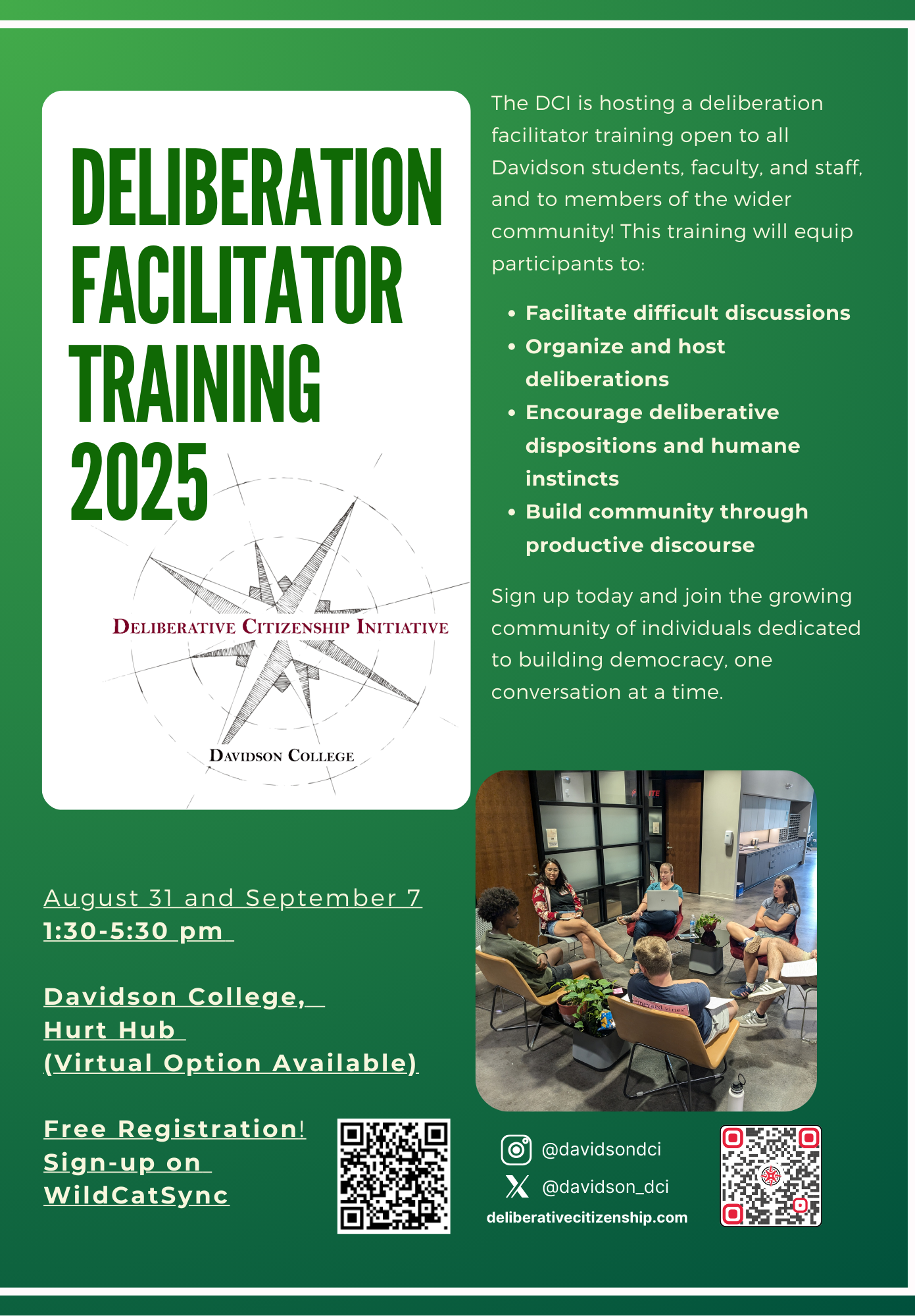
DCI Offers Free Deliberation Facilitator Training: Registration is Open!

August 13, 2025 by Ruby Aaver

Flyer for Deliberation Training Program

How should we engage in meaningful, productive disagreement, discussion, and problem-solving with others, especially when the issue at hand is highly contentious and politicized? This is the fundamental question the DCI has been working to answer, and we believe there is a way to do it well. We can disagree respectfully, we can discover the truth in spite of—and indeed, because of—our differences, and we can solve pressing issues democratically using the tools of deliberative democracy.

Deliberation, as we see it at the DCI, is a method of discussion that enables citizens—broadly construed so as not to limit this notion to persons with one particular legal status—to state their views and the presuppositions behind them, reconstruct the arguments for their positions, and to make progress toward solutions to problems where there is entrenched disagreement.

While such discourse can sometimes happen organically in conversation or in the political sphere, we often find that we are so uncomfortable in the face of disagreement that we would rather not engage. But living together requires coming to a shared understanding of difficult problems and making constructive decisions together.

Our experience, and the experience of similar programs around the world, has found that well-trained and intentional facilitators can help participants overcome these obstacles and engage in meaningful and productive deliberation, even when they disagree deeply.

This is why the DCI is hosting its seventh Deliberation Facilitator Training Program this year. The training will take place over two sessions from 1:30 pm to 5:30 pm, one on Sunday, August 31 and the other on Sunday, Sept. 7th. The sessions complement each other and are both required components of the training. Virtual and in-person options are available, but space is limited so sign up soon if you are interested. 

This hands-on and interactive program enables participants to lead deliberation sessions in their community, with colleagues, with their families, or in their classrooms, and to facilitate DCI-hosted forums on matters of public interest. The DCI supports facilitators with learning materials we send out before the training days, and participants get a chance to practice facilitating a mock deliberation.

Do you feel your community, your family, your students, or your colleagues would benefit from deliberating about an issue with the help of a trained facilitator? Then sign up here by Tuesday, August 26th!

Filed Under: Announcements

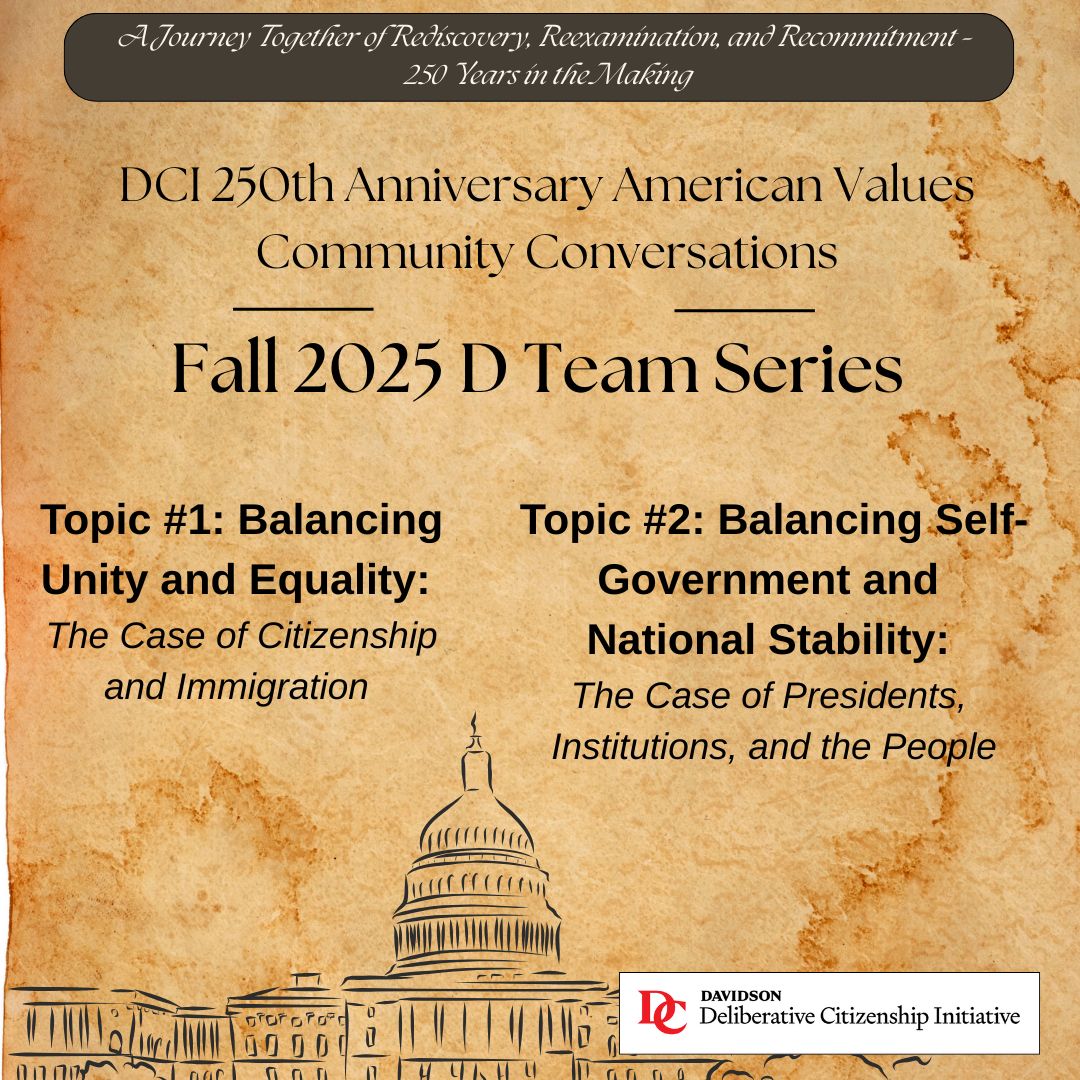
250th Anniversary Community Conversations about American Values: The 2025 D Team Series

August 13, 2025 by Graham Bullock

Flyer for Fall 2025 D Team Series.

If you are ready to sign-up for a Fall 2025 D Team Community Conversation, click here and it will take you to the registration form. If you’d like to learn more, read on below…

In 2002, Bruce Cole, then Chairman of the National Endowment for the Humanities, asserted that the United States faces a “serious challenge that lies within our borders – and even within our schools: the threat of amnesia.”  He feared that we are forgetting our collective traditions, stories, histories, and even values, and offered numerous examples supporting this concern. 

The threat we are facing today, however, goes beyond a general amnesia. It also involves a selective form of memory – or partial amnesia – that only remembers parts of our heritage and then frames those parts according to our current political beliefs and personal experiences. 

This fragmentation and misrepresentation of our history is in many ways worse than fully forgetting it, as it allows us to weaponize our incomplete and unnuanced understanding to advance our own group’s interests and denigrate, demonize, and dismiss those who remember and emphasize different parts of our history.  The pitched battle between proponents of The New York Times 1619 Project and the Woodson Center’s 1776 Campaign is just one of many examples of this dynamic.

The upcoming 250th anniversary of the Declaration of Independence represents an important opportunity to address the historical amnesia that has become so common in American life.  The Deliberative Forum Series on American Values being hosted by Davidson College, Duke University, and the University of North Carolina, Chapel Hill aims to engage diverse public audiences with a nuanced and complex understanding of our nation’s history and the underlying principles, traditions, and stories on which our country was founded. It will highlight the underlying pluralism and overarching unity that animate America’s past and present. 

The series will be organized around a series of four forums over the course of the 2025-2026 academic year. Each forum will explore the meaning of the values at issue and connect them to current events and issues facing the American public. They will consist of an Expert Roundtable followed a week later by Community Conversations hosted by higher education institutions and other organizations across North Carolina and beyond.

To learn how your organization might host its own Community Conversation following one or more of the Expert Roundtables, you are welcome to join an upcoming webinar that will introduce the forum series and map out a range of different ways to get involved. Please encourage anyone who might be interested to register for the webinar.  

The Community Conversations hosted by Davidson College will follow a format similar to the D Teams it has been organizing for the past five years. They will be held the week after each forum, and students, faculty, staff, alumni, and community members can sign up for meetings that will be held during the day or in the evening on both weekdays and weekends. There will be two types of conversations — the first are D Team Community Conversations that will meet after both of the Expert Roundtables, allowing the members of the group to get to know each other over two conversations. The registration deadline to sign up for those conversations has passed, as they require some advanced scheduling, but Davidson’s Deliberative Citizenship Initiative is also organizing “Pop-Up” Community Conversations that you can still register for here.

The first American Values Deliberative Forum will focus on Balancing Equality and Unity: The Case of Immigration and Citizenship. To explore this topic, an Expert Roundtable will be held on September 30 at Davidson College and broadcast live online. The associated Community Conversations will be held the following week (October 6-12).

The topic of the second American Values Deliberative Forum is “Balancing Self-Government and National Stability: The Case of Presidents, Institutions, and the People” and will be held on October 30 at UNC Chapel Hill.

This innovative two-stage process is designed to connect expert knowledge with diverse public audiences. Scholars with diverse backgrounds and divergent interpretations of the topics at hand will be invited to the Expert Roundtables to ensure a wide range of perspectives is represented.  They will share and discuss their perspectives on the values in question (e.g., unity and equality) and how they relate to the contemporary issue in focus (e.g. immigration and citizenship).

Then the Community Conversations will provide the public with the opportunity to share their own views on these topics, building on, contesting, or transcending the experts’ perspectives. A Deliberation Guide will be provided in advance of the forum to provide everyone with some baseline information about the topics and different perspectives on them. This process hopefully will help us break out of tendencies towards our selective amnesia so that we engage with the full range of American voices and how we each, individually and collectively, understand what our values are and how they are relevant to our current challenges as a nation.

So register for these Expert Roundtables and Community Conversations today to take part in this year-long celebration of our 250 years as a country, that was “conceived in Liberty, and dedicated to the proposition that all men are created equal,” and has since then been ever in pursuit of a more perfect union.  

Register for the DCI’s American Values D Team Community Conversations (Fall 2025 D Teams)

Fall-2025-D-Team-Flyer-8-x-11.5

Filed Under: Announcements

Aggies DO – Deliberation in Social Psychology

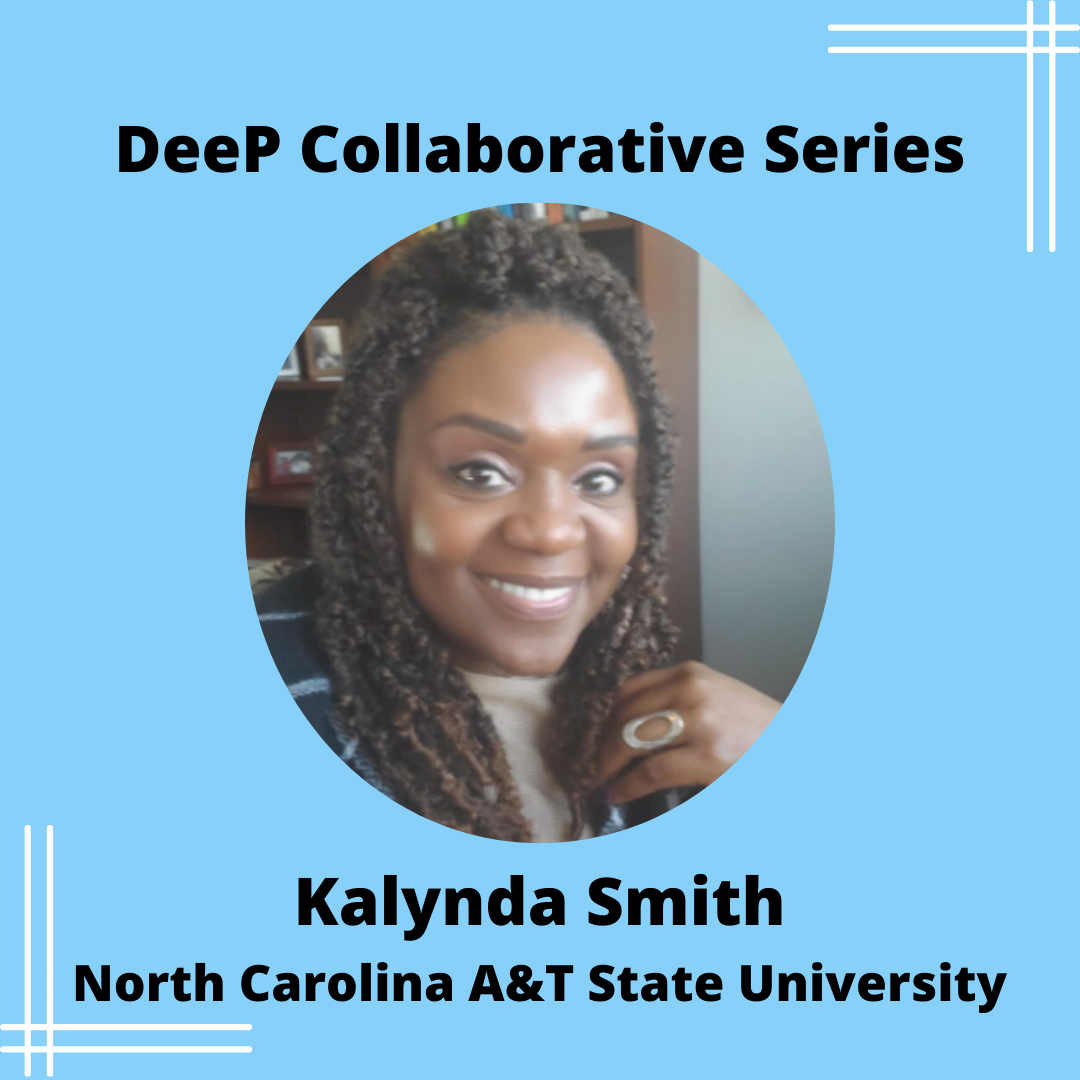
August 13, 2025 by Kalynda Smith

The Deliberative Pedagogy (DeeP) Faculty Collaborative consists of faculty from Davidson College and other higher education institutions who are committed to learning and implementing new ways to improve and deepen the quality of their class discussions. These faculty come from a wide array of disciplines and backgrounds to study and discuss deliberative pedagogy methods, share their ideas and questions with one another, and work to embed deliberation in their classrooms. In this special blog series, members of the Collaborative describe and reflect on their experiences developing and teaching their deliberation-involved courses.

By Kalynda Smith (2024-25 Deliberative Pedagogy Collaborative Faculty Fellow)

Aggies DO and Never Done is my university’s sometimes-less-than-encouraging slogan. It means that we are always working towards our mission, which is great! But sometimes it feels like the work – teaching, research, service, grading, analyzing data, meetings, etc. – never end. Spring 2025 was no different.

This spring was my first full semester of being the Interim Director of the Graduate Programs in the Department of Psychology. We interviewed for four positions, I mentored too many research students, while somehow neglecting my research, and this was my first go at deliberation in my classroom (after not having taught for a year). I will not get into my “additional duties as assigned,” but I’m attempting to set the stage. You may be thinking that I’m starting with my excuses to explain why this all crashed and burned, but I’m not, I promise. I cannot say that my first attempt at deliberation was a raging success. Absolutely not! What deliberation was in my Spring 2025 Social Psychology course was one of those things that define professors as lifelong learners.

Social Psychology

One of my most innovative assignments in my Social Psychology course is a blog post. I’ve been doing this assignment for about seven years, across two institutions. I ask students to pick a topic in the course and explain it through a current event. I started with instructions not too much longer with that explanation. Now, I have what would probably be two Word doc pages of instructions because both the creativity and the critical thinking seem harder and harder for students to grasp as time goes on. The lengthy instructions are to tell students “exactly” what to do as much as I possibly can, because that is very important to them, without actually telling them exactly what to do.

In their own voices, I want them to present a current event, much like you might see in a podcast or a social media reel, and explain why it happened according to social psychology. To remain somewhat uniform in the course assignments, I thought we could also do this with the deliberations in that I would provide the current event that students would explain using opposing theories or ideas in social psychology, which I also chose, with the end result being to try to agree on what students felt was the best social psychological explanation for the current event.

When this finally came together in my mind, I felt some relief that I’d figured out how I would proceed, but was still a bit unsure regarding whether the activity was really deliberation because there weren’t any real stakes. We weren’t necessarily going to discuss any pressing issues, because what I really wanted to do was make sure the students understood the content. So, there were layers to contend with.

Okay, there’s the setup, what were the assignments?

Deliberation One: Attitudes and Attitude Change: Influencing Thoughts and Feelings, Cognitive Dissonance 

The Social Psychological topic for this assignment was “Components of Attitudes.” The current event was Billboard 100’s top 10 Female Rappers, a first for Billboard. The students were told to answer the question, “Using our understanding of attitude components, how can we best increase support for female rappers?” The group that took Stance A was told to promote affective attitude formation and given the hint: Collect as much evidence as possible about existing affective attitudes about female rappers. The group given Stance B was told to promote behavioral and cognitive attitude formation, given the hint: Collect as much evidence as possible about existing behavioral and cognitive attitudes about female rappers.

Students were further instructed to read the relevant chapter to become an expert on attitude components. Each group should learn both sides of the argument to be able to challenge the other group, if possible: “You want to be able to present as much evidence as possible to come up with the strongest solution.” They were then to read the post from Billboard (they were provided a link), but add to that all the information they could find about female rappers, especially the ones on the list, keeping in mind the components that make up Billboard’s list: quality of records, chart success, buzz within the culture, notable business endeavors and partnerships, and touring success. With all of these factors in mind, they were to present all the evidence that supports the view that your stance is the right stance.

Deliberation Two: Group Processes: Influence in Social Groups

The Social Psychological topic for the second deliberation was “Group Cohesiveness and Group Diversity.” The current event was the 2024 presidential election (students were told they could find relevant articles online). Their prompt was to use their understanding of group dynamics and ignoring the actual outcome, explain what strategy should have been used to win the election. Stance A promoted group cohesiveness with the hint: Collect as much evidence as possible about the cohesiveness of each political party. Stance B promoted group diversity, with the hint: Collect as much evidence as possible about the diversity of each political party. The instructions to the students were to “read all the information you can find online about the political parties’ (leaders and constituents) activities related to group cohesiveness and group diversity.” Then, with concrete examples on hand, “present all the evidence you can that your stance is the right stance.” And finally…

Delibration Three: Attraction and Relationships: From Initial Impressions to Long-Term Intimacy

The third Social Psychological topic was Mate Selection as explained by Evolutionary Psychology versus Social Psychology, and the current event was the tradwife trend. Students were given a link to read about the tradwife trend. The question for the students was, “Using our understanding of mate selection, what best explains the “tradwife” trend? Does either perspective suggest the trend should persist for Gen Z women?” Stance A promoted Evolutionary Psychology theory regarding the tradwife trend and stance B promoted the Social Psychology theory. The hint was the same for both groups: Collect as much evidence as possible about what it means to be a trad wife (from social media, other media and historical sources) and compare Gen Z women to past generations.

Each assignment also came with the following instructions: “We will begin by flipping a coin to determine who goes first. The first group will explain the current event in detail. They will briefly explain the topic, but will focus on their stance. Then they will present their stance, with evidence from the current event to support their stance. The second group will then present their stance. The groups will then take turns rebutting the other groups points until both groups and the class decide which stance is the strongest. Dr. Smith will moderate while those in the audience take notes for their evaluation. When the groups have deliberated as much as possible, the audience will get to ask questions, and everyone will vote on the strongest stance.”

Before we began the deliberations, we spent class time discussing the format of deliberations during the first week of the semester and two weeks before the first deliberation, and I turned examples I would usually give of the content into deliberation examples. Students read, “Deliberative Pedagogy as Critical Connective: Building Democratic Mind-Sets and Skill Sets for Addressing Wicked Problems” during our research methods learning unit, and I dedicated a special section of my Assignments tab on Blackboard to the deliberation activities.

What Happened?

Even after the discussions in class and reminders via Blackboard, I was nervous! So, I took a breath, flipped a virtual coin, and we began…

The first deliberation was great! Not perfect, but great! Each group presented their argument, then they sparred. I added a few comments here and there clarifying the content, took notes on who said what, and although I had to check in with the audience halfway through because they were so quiet, they had questions at the end of the deliberation and seemed to enjoy participating in the final vote. The affective attitude component won. Speaking of the audience, they took notes and completed an evaluation of the activity while the groups spoke. I evaluated the groups according to whether each member added substantive information demonstrating they understood the social psychological topic and actively participated in the conversation by adding one or more comments beside their initial content blurb. The audience received points by turning in a complete evaluation.

This deliberation had me proud, and still a little jumpy once we finished, but we did it! I told the class, “We did it, and I expect the next one to be even better!” Here’s where the narrator comes in to tell us our heroine’s expectations were not met (insert eyerolling emoji here).

I actually had a bad feeling about the second deliberation early on, which by this point in the semester, class attendance had begun to wane. So, I began sending messages via Blackboard (and email) reminding the students (both the groups and audience) to prepare for the upcoming deliberation and get together with their randomly-assigned groups. Unfortunately the students assigned to deliberate in Deliberation Two, however, did not do so in a timely manner. This problem was compounded by some errors I made on Blackboard with adjusting deadlines and making the activity instructions available to the students.

Despite my efforts to send them the correct information in advance and remind them to not leave everything to the last minute, I still received emails at midnight before the deliberation that they could not access the assignment. To make a long story short, when we flipped the coin in class, there was silence from the group that was due to present. When I pivoted to the other group, more silence.

I was pretty livid, particularly since some suggested that it was my fault they were not prepared. I turned on my laptop and went back to lecturing, going through the points of the deliberation myself. We talked through the different stances, discussing which one made the most sense and why. I was satisfied with their engagement and understanding of the material, and we got through the class. When I had a chance to think it through, I assigned a paper to the groups who did not do the assignment. Because I led a semi-deliberation, the only work the groups had left was to provide evidence of their stances to demonstrated that they understood. Some students seemed fine with this arrangement, while others were not.

And finally, the third deliberation was pretty anti-climatic compared to the first. The main issue that came up was that one group could not grasp the stance assigned to them because they did not agree with it. Otherwise though, the entire class was really into the topic and current event (of course mate selection is sexy, no pun intended), so there was a ton of engagement and really thoughtful evaluations.

Evaluation

While the audience evaluated the deliberations they were not leading, each student also wrote a reflection paper on their deliberation experience as their final paper of the semester. Between the evaluations and the reflection paper, I found that I needed to be much more descriptive in the instructions. I had to revise the evaluations because students seemed very unclear about how the deliberations applied social psychology, and I fear the reflection papers got a little “help” from AI. The revised evaluations worked out much better, although unfortunately there was not much to be done about the AI issue, except explain in my feedback that reflections cannot actually be done by AI. Sigh.

As far as other missteps, I think I should have had students do a survey-like evaluation about leading the deliberations like the audience did of watching the deliberations. That would have helped keep the information fresh in their minds for their reflection papers (although the instructions for the papers were available from week 2 on). It would have also been nice to have a more structured rubric for their participation in the deliberations. I decided to be lenient in my grading, but I did not give them as much feedback as I think I should have. Finally, I did not assess their reading of the deliberation article, so, I’m pretty sure they did not read it. I had a bit of a time including the new assignments into my grading system, but I dropped the ball on that one. 

What’s Next?

This experience was a good one. The challenges will strengthen the future assignments, and I will continue these assignments. Even though this was a semester that had me barely hanging on at times, the emotional ups and downs of deliberation in my Social Psychology course had the creative juices flowing, and it was a crazy, aggravating, good time! I’ve decided to do an entire update of my course and a part of that will be adding smaller deliberation activities that are designed more to engage students in what we are discussing in the moment, and less this class presentation-type of assignment that sometimes sends the students into a tailspin. I can’t give you too many details just yet; this is a summer assignment that I’ve given myself, but I’m determined to strengthen their critical thinking skills through deliberation and I know I can, because Aggies DO!

Filed Under: Faculty Posts

  • « Go to Previous Page
  • Page 1
  • Interim pages omitted …
  • Page 15
  • Page 16
  • Page 17
  • Page 18
  • Page 19
  • Interim pages omitted …
  • Page 75
  • Go to Next Page »

Footer

Blog Post Categories

  • Announcements
  • Blog Posts
  • DCI Posts
  • Events
  • Faculty Posts
  • Fellow Posts
Image of a compass superimposed by the text "Deliberative Citizenship Initiative" and "Davidson College." Clicking on this image leads to the Initiative page.

Recent DCI Blog Posts

  • We Tried to Fix Jubilee’s “Middle Ground” – Here’s How It Went
  • A Case for Deliberation in the Natural Sciences
  • Welcoming New Staff to the DCI and DCN
  • Facebook
  • Twitter
  • Instagram
  • LinkedIn


Copyright © 2026 · Infinity Pro on Genesis Framework · WordPress · Log in