• Skip to main content
  • Skip to footer

Deliberative Citizenship Initiative

Building Democracy One Conversation at a Time

  • The Initiative
    • Programs
      • Deliberation Across the Curriculum
      • Deliberation on Campus
      • Deliberation in the Community
      • Research on Deliberation
    • Motivations
      • Why Deliberative Citizenship?
      • Why Davidson? Why Now?
    • Who’s Involved?
      • DCI Fellows Cohorts
        • 2025-2026 Fellows
        • 2024-2025 Fellows
        • 2023-2024 Fellows
        • 2022-2023 Fellows
        • 2021-2022 Fellows
        • 2020-2021 Fellows
      • DeeP Collaborative Cohorts
        • 2024-2025 DeeP Collaborative Faculty
        • 2023-2024 DeeP Collaborative Faculty
      • Advisory Council
    • History
      • What Sparked the Initiative?
    • Key Deliberative Dispositions
    • Frequently Asked Questions (FAQ)
    • Annual Report
  • Get Involved!
    • Participate in a Forum
    • Join a D Team
    • Become a Fellow
    • Take Courses
    • Get Training
    • Come to Guest Lectures
  • Events
    • Upcoming Events
      • 250th Anniversary Deliberative Forum Series on American Values
    • Past Events
  • Connections
    • The Deliberative Citizen: The DCI’s Monthly Newsletter
    • Efforts on Campus
    • Efforts in the Community
    • Efforts Elsewhere
    • Readings and Resources
      • DCI-Published Guides
      • DCI Guide to One-on-One Conversations
      • How to Disagree
      • Demonstration of Facilitation Styles
      • Deliberative Pedagogy Mini-Course
    • How We Can Help: DCI’s LET’S DELIBERATE! Partnership Opportunities
    • DCI in the News
  • DCI Blog Posts
    • Recent Blog Posts
    • All Blog Posts

The DCI Blog

The Value of a Second Facilitator

November 5, 2025 by Madeline Kleiner

Madeline Kleiner ’28 (DCI Fellow)

Starting my second semester of being a DCI Fellow, I felt more prepared. I had learned a lot from my first round of D Teams about including more people in the conversation, when to step in and when to let the conversation flow, and how to make people feel comfortable sharing their opinions. The second semester, though, a new measure was implemented that slightly changed how my facilitation occurred.

As anyone who was on a D Team this spring would know, there were two facilitators overseeing each session. One held the role of leading the conversation and making sure everyone gets a chance to speak, while the other took notes on the conversation and stepped in if another perspective was needed. Every DCI Fellow gets the chance to cover both roles, which is an interesting way to see both sides of a conversation.

The group I served as a secondary facilitator for was pretty varied in their perspectives so I didn’t feel the need to step in that way. Taking notes, though, was a very informative experience. I had never looked at the conversation before as having tangible outcomes, but the notes served as a physical output of the conversation. Taking the notes allowed me a chance to deeply listen to what every participant had to say and how that influenced their relationships and conversations with other deliberators. For my primary facilitation later in the week, it also gave me inspiration on how best to lead the conversation to make sure that every deliberator felt that they came away from the conversation with something.

As a primary facilitator, having a secondary facilitator in the room served as a support system. Yes, I knew that I was mainly supposed to be leading the discussion on my own, but having someone else in the room that could step in if I was struggling was comforting.

All this to say, in a deliberation it is totally okay to ask for help. Some conversations are really tricky and having another person in the room can be helpful for resolving conflict or if you’re nervous to cut off someone who’s been talking for a while. For conversations that are more one-sided in opinions, the secondary facilitator is also helpful for providing another perspective to the conversation.

Finally, this secondary facilitator is influential in providing a tangible output of the conversation. There are times, especially in longer conversations like D Team meetings that last for two hours, where it can feel like the group has been circling the same point for most of the conversation. Writing down and reading about the nuances and the specific opinions of each deliberator in a systematic way can help clarify the group’s main takeaways and areas where they both agreed and disagreed.

Filed Under: Fellow Posts

Paper Based on DCI Data Presented at American Political Science Association Annual Meeting

November 4, 2025 by Graham Bullock

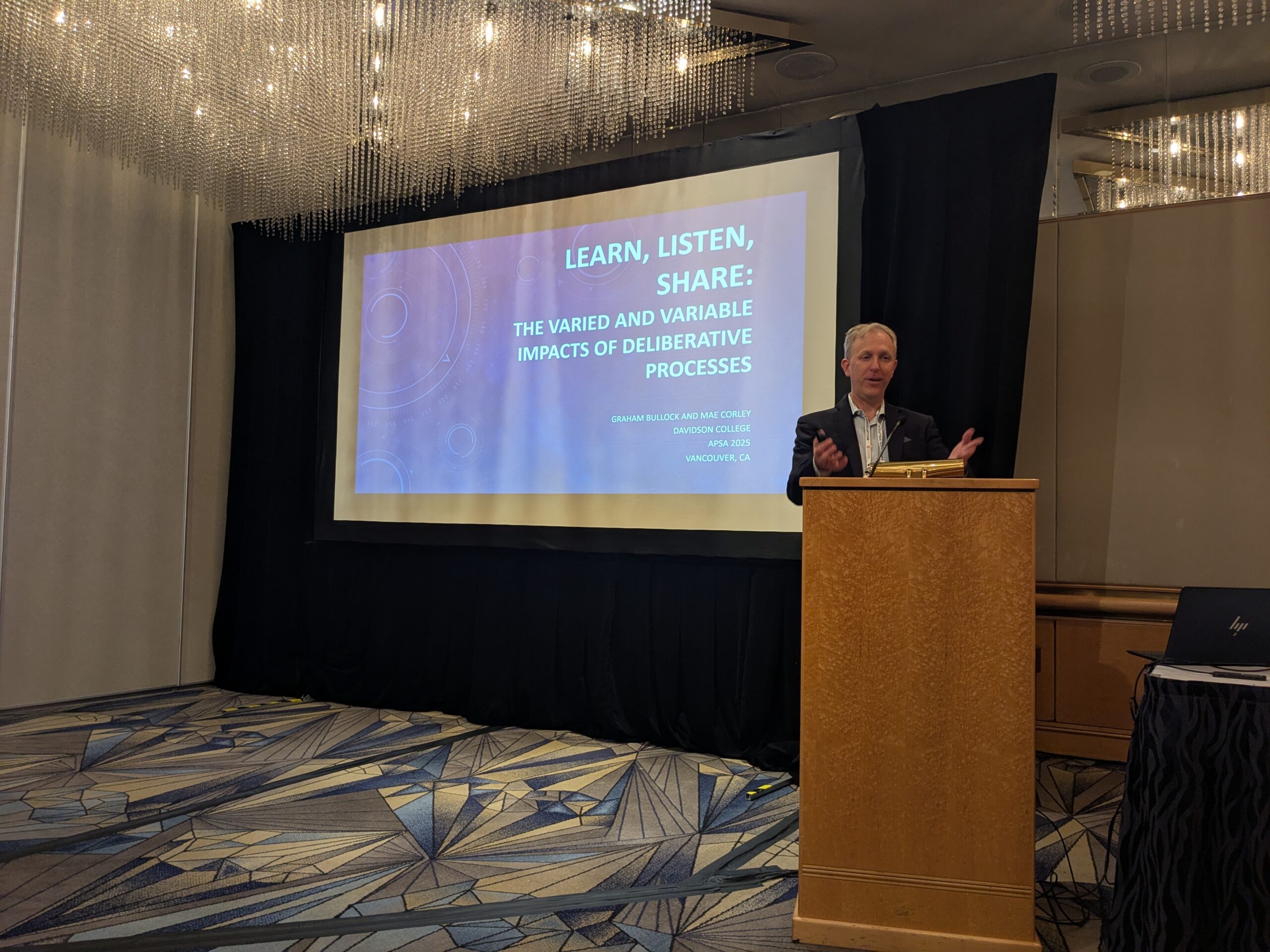
Graham Bullock presenting at APSA conference.

On September 11, 2025, DCI Faculty Director Graham Bullock presented a paper written in collaboration with Mae Corley ’25 on “Learn, Listen, Share: The Varied and Variable Impacts of Deliberative Processes” at the American Political Science Association (APSA) Annual Meeting in Vancouver, CA. The paper built on research conducted by Corley and Bullock in an independent study during the spring of 2025. Corley, who had served as a DCI Fellow, Senior Fellow, and Co-Convener as a student at Davidson, worked with Dr. Bullock on compiling and analyzing the pre- and post-survey data from 15 of the DCI’s Deliberative Forums.

This paper presents a comprehensive analysis of five years of data from forums that included both undergraduate students and community members. It examines the DCI’s forums as a structured communicative process designed to bring citizens together to discuss a wide range of global challenges. Topics explored in the forums covered by the paper included income and wealth disparities, climate change, religion in the public sphere, gun rights and regulations, the challenges for democracies, and more.

These deliberation-based forums rest on the idea that respectful dialogue can bridge divides and foster more considered opinions. But does this hold true for all participants? This paper examines the varied experiences of individuals who participated in this public discourse program, focusing on whether a participant’s identity—specifically their gender, race, age, and political ideology—shapes their perceptions of the forums they joined. Do participants with different backgrounds leave the forum with different perceptions and outcomes?

This question connects to a core theoretical tension in the literature. On the one hand, critical theorists suggest that participants from historically marginalized groups—such as non-white individuals, women, and young people—are likely to have less positive experiences in a deliberative setting than those from groups traditionally perceived as holding power. The fear is that dominant voices intentionally or unintentionally marginalize or silence others, leading to a less satisfying experience for some participants. Alternatively, those who believe these programs are intentionally and effectively designed to give disproportionate voice to the disempowered might assert the opposite effect. They would hypothesize that these groups will feel empowered and have more positive experiences than those who already hold significant power.

This paper uses survey data to explore these competing hypotheses. Its central research question is: How do a participant’s demographic characteristics, including gender, race, ideology, and age, correlate with their deliberative experiences and outcomes? The findings highlight the different types of impacts that deliberative processes can have and explore how these effects differ across topics and demographic groups. By focusing on how individuals engage with and interpret complex issues through deliberation, the study sheds light on the conditions under which public discourse fosters increased understanding, leads to shifts in attitudes and self-perceptions, and affects how participants engage with each other. It also explores how participants from different demographic backgrounds respond differently and similarly to the experience of engaging in deliberative processes.

Moreover, the analysis uncovers patterns of engagement that can inform strategies for enhancing the effectiveness of deliberative practices. The paper contributes to the field of political communication by offering empirical insights into the role of deliberation in enabling participants to engage with each other on complex social and political issues. By leveraging a sample of over 1400 participants who answered surveys before and after the hosted forums, it explores the potential and limits of deliberative processes to bridge divides, deepen understanding, and equip participants to engage with global threats. At the same time, it underscores the need to tailor these processes to the specific dynamics of the issues, audiences, and formats involved. These findings have implications for scholars and practitioners seeking to leverage public discourse as a tool for addressing the multifaceted challenges of our time.

Bullock and Corley will be incorporating the helpful feedback they received at the conference into their next version of the paper, which they hope to submit for publication soon. Stay tuned for updates!

Filed Under: DCI Posts

DCI Fellows Host Discussions after Senators Klobuchar and Tillis Conversation

November 3, 2025 by Stephen Walker

By Stephen Walker ’26 (Senior Fellow and DCI Co-Convener)

Following the inaugural Institute for Public Good October 13 event featuring a conversation between Senators Amy Klobachar, Thom Tillis, and Davidson College President Doug Hicks, Deliberative Citizenship Fellows hosted a discussion for those in attendance at the talk to debrief and continue pondering the nature of the “public good.” In their remarks, both President Hicks and Chris Marsicano, the Director of the Institute for Public Good, encouraged audience members to join the discussion after the event.

Fellows greeted and welcomed students to discuss the event over snacks in a classroom outside of the Duke Family Performance Hall, where the conversation took place, so that any interested attendees would have the opportunity to reflect and develop their own plans for promoting the public good in their own communities.

Two tables of deliberators with two facilitators standing

In a packed meeting room with extra chairs just outside the performance hall where some facilitators had to stand as they guided the discussions, a combination of reflections on the senators’ discussion and attempts to agree on their own definitions of the public good kept the students abuzz throughout their extended conversation.

The guiding questions for the discussion, provided by DCI Co-Convener Casey Scheiner and introduced to the participants by DCI Faculty Director Graham Bullock, focused the students on engaging with the Senators’ ideas and identifying their own perceived challenges to the public good and bipartisan action from government. Fueled by an assortment of desserts and beverages, they also discussed the ways government and citizens alike may all come together to promote the public good across a diverse array of sectors throughout society. Such questions enabled participants to focus their participation on defining and applying the public good to contexts that were relevant to their own lives so that they could take what they learned from their conversation with them into their own civic engagements in the future.

The enthusiasm of the students, passionately participating in a discussion of their own after listening to the Senators’ discussion shows the impact the work of the DCI has in providing an outlet for Davidson’s community to tackle our most pressing issues. It also shows how the DCI can complement the work of other organizations, like the Institute of Public Good (which the DCI is now a part), by creating structured yet informal contexts for participants at events they host to deliberate about ideas presented and apply them to Davidson’s own community.

See what the participants had to say for themselves after attending the event:

“[Our group] applied a lot of the things [the senators] talked about to real-world examples and talked about what we thought was a civil good […] and our duties as citizens. There was a wide array of opinions in our group; that was really interesting to get to hear people who had different opinions from myself.

“Every time we do a deliberation, I feel like I end up being able to [better] see the other side, which makes things become more complicated, which is a good thing because it helps all of us become more intentional but it’s also confusing because my opinions keep changing.”

Anna Kate Howell ’29

“I found [the discussion] very helpful to be able to process the information during the senators’ event; […] it was helpful to be able to reflect and to be asked questions that helped me put what they talked about in a proper context.”

“The facilitators were really helpful […] having guiding questions to push us to bring the conversation to different directions was super helpful, […] especially to see different perspectives and how you can apply [them] […] I now have a more nuanced answer for [what the Public Good means].”

Maggie Frampton ’29

deliberators around tables with two facilitators standing

Filed Under: Events

The Connection Between Emotion and Logic: Two Key Elements of a Deliberation

October 29, 2025 by Lily Ogawa

Lily Ogawa ’28 (DCI Fellow)

Which one is the most persuasive to use in a deliberation: emotion or logic?

When asked this question, most people’s gut instinct would be to say logic. People tend to believe you more when you cite data and evidence to back up a claim rather than explaining using your emotion. It may also seem easier to engage in a conversation when the person talking is using logic as you would be able to support or refute their claims using logic. When using emotion, it may seem harder to disagree with another person as we don’t want to hurt their feelings.

On the other hand, deliberations without any emotion can ignore a major part of the topic. Emotion plays a crucial role in topics such as on the government’s management on the COVID-19 pandemic, which was one of our recent DCI D Team topics. Participants may have lost loved ones or have lost their businesses due to the pandemic. To say that these participants cannot share their emotions and must only use hard logic can make the deliberations feel out of touch with reality. Emotion humanizes these participants and their perspectives and adds a unique value to the deliberation that logic cannot bring.

With these thoughts in mind, the questions then become “how to balance between the two?” and “which one is more important?” Despite the popular belief that logic and emotion are polar opposites, Leonard Mlodinow, author of the book “Emotional: How Feelings Shape Our Thinking,” argues that they are interconnected. Emotion guides people to choose what sensory information to pay attention to and what data to consider when making a decision.

In other words, emotions shape how we think. Paul Dirac, considered “one of the greatest physicists of the 20th century,” encouraged us to “be guided above all, by your emotions” (Mlodinow). Even in the field of physics, emotion influences how we make assumptions or what path of mathematics we study (Mlodinow). Emotions can subconsciously affect how we think and absorb information.

In deliberations, emotions can play a vital role in showing the diverse perspectives of participants. While emotion should not dominate the deliberation, both emotion and logic are essential ingredients in having an effective deliberation. In my D Team meetings, participants often shared what they felt during the COVID-19 pandemic, for instance, and what they feel now. They also shared data or factual evidence they came across. In other words, they used both emotion and logic to have a sincere and meaningful deliberation. Perhaps there may not be a perfect formula to balance between emotion and logic, but both emotion and logic can play an important role in bringing about fruitful conversations on difficult topics.

Work Cited

McDermott-Murphy, Caitlin. “Logic or Emotion: Which Is More Valuable?” Harvard Gazette, 31 Jan. 2022, news.harvard.edu/gazette/story/2022/01/logic-or-emotion-which-is-more-valuable/.

Mlodinow, Leonard. “Emotional: How Feelings Shape Our Thinking.” Next Big Idea Club, nextbigideaclub.com/magazine/emotional-feelings-shape-thinking-bookbite/31632/. Accessed 26 Mar. 2025.

Filed Under: Fellow Posts

Critical Points and Critical Thinking: Discernment Through Multivariable Calculus

October 28, 2025 by May Mei

The Deliberative Pedagogy (DeeP) Faculty Collaborative consists of faculty from Davidson College and other higher education institutions who are committed to learning and implementing new ways to improve and deepen the quality of their class discussions. These faculty come from a wide array of disciplines and backgrounds to study and discuss deliberative pedagogy methods, share their ideas and questions with one another, and work to embed deliberation in their classrooms. In this special blog series, members of the Collaborative describe and reflect on their experiences developing and teaching their deliberation-involved courses.

By May Mei (2024-25 Deliberative Pedagogy Collaborative Faculty Fellow)

I think every mathematician cringes when approached with the sentiment that “Math is great because there’s one correct answer so you’ll know when you get there and you’re either right or you’re wrong.” Nothing could be further from the truth! Some processes might be imitable, but mathematics is about truth and beauty, creativity and rigor. Especially in the age of generative AI, I wanted to tell students: You have more answers than you know what to do with. This class isn’t about finding answers, it’s about deciding which of the many answers in front of you is better.

My multivariable calculus class met an hour/day for four days/week. Every Monday was dedicated to deliberation. In the first half of class, students started with a quiz. This consisted of two standard questions in multivariable calculus with solutions (either former student solutions or answers from ChatGPT). The prompt was “You have received two problems with solutions. They might be completely accurate or wildly false. Your task is to evaluate these solutions. Are they mathematically correct? Are claims supported by evidence? Is the writing cogent and persuasive? Is notation used appropriately?” Students submitted a written assessment about the strengths and weaknesses of each of the two solutions. In the second half of class, there was a deliberation on their proposed responses.

I will confess, the students had a hard time deliberating. Because the solutions they were engaging with weren’t embodied by someone in the class, it was hard to get them to feel like they were in dialogue with an answer. After trying out a few different models in the first few weeks of class, we settled on a popcorn reading of the solution with each student responding to that part in particular. This is perhaps closer to a discussion than a deliberation, but it is where the class settled.

A learning outcome of the course was to “Engage students in the act of discernment: Deciding which of many answers in front of you is better and mounting a convincing argument as to why that is the case.” I started the class off with the first chapter of Why We Argue (And How We Should). There, the standard philosophical definition of knowledge as a justified, true belief was presented. Students weren’t confused about what it meant to believe something. And when they were asked for justifications, they said things like “it’s in the book” or “you said it.” But when it came to what it meant for something to be true, they once again said “it’s in the book” or “you said it.” They had a hard time with the notion that I, their professor, or even the entire community of mathematicians could be wrong.

Over the course of the semester, I saw my students engage deeply with their relationship with authority and to develop their own voice and confidence in their assessment. Here are two sample student responses on a reflection that asked for self-assessment of progress towards the learning outcome of discernment:

Student 1: “I definitely improved on this aspect. When I first took my first quiz, I never said anything was wrong because I wanted to believe it was right because it was put in front of me. But I have definitely gotten better at understanding why there is a correct answer and not believing everything in front of me.”

Student 2: “This is difficult for me because there are many ways to work through problems so it’s hard not to believe someone else’s work/explanation even if it’s done in a different way than I would do it. I did get better at this and learned how to back up my argument.”

Filed Under: Faculty Posts

  • « Go to Previous Page
  • Page 1
  • Interim pages omitted …
  • Page 11
  • Page 12
  • Page 13
  • Page 14
  • Page 15
  • Interim pages omitted …
  • Page 75
  • Go to Next Page »

Footer

Blog Post Categories

  • Announcements
  • Blog Posts
  • DCI Posts
  • Events
  • Faculty Posts
  • Fellow Posts
Image of a compass superimposed by the text "Deliberative Citizenship Initiative" and "Davidson College." Clicking on this image leads to the Initiative page.

Recent DCI Blog Posts

  • We Tried to Fix Jubilee’s “Middle Ground” – Here’s How It Went
  • A Case for Deliberation in the Natural Sciences
  • Welcoming New Staff to the DCI and DCN
  • Facebook
  • Twitter
  • Instagram
  • LinkedIn


Copyright © 2026 · Infinity Pro on Genesis Framework · WordPress · Log in