• Skip to main content
  • Skip to footer

Deliberative Citizenship Initiative

Building Democracy One Conversation at a Time

  • The Initiative
    • Programs
      • Deliberation Across the Curriculum
      • Deliberation on Campus
      • Deliberation in the Community
      • Research on Deliberation
    • Motivations
      • Why Deliberative Citizenship?
      • Why Davidson? Why Now?
    • Who’s Involved?
      • DCI Fellows Cohorts
        • 2025-2026 Fellows
        • 2024-2025 Fellows
        • 2023-2024 Fellows
        • 2022-2023 Fellows
        • 2021-2022 Fellows
        • 2020-2021 Fellows
      • DeeP Collaborative Cohorts
        • 2024-2025 DeeP Collaborative Faculty
        • 2023-2024 DeeP Collaborative Faculty
      • Advisory Council
    • History
      • What Sparked the Initiative?
    • Key Deliberative Dispositions
    • Frequently Asked Questions (FAQ)
    • Annual Report
  • Get Involved!
    • Participate in a Forum
    • Join a D Team
    • Become a Fellow
    • Take Courses
    • Get Training
    • Come to Guest Lectures
  • Events
    • Upcoming Events
      • 250th Anniversary Deliberative Forum Series on American Values
    • Past Events
  • Connections
    • The Deliberative Citizen: The DCI’s Monthly Newsletter
    • Efforts on Campus
    • Efforts in the Community
    • Efforts Elsewhere
    • Readings and Resources
      • DCI-Published Guides
      • DCI Guide to One-on-One Conversations
      • How to Disagree
      • Demonstration of Facilitation Styles
      • Deliberative Pedagogy Mini-Course
    • How We Can Help: DCI’s LET’S DELIBERATE! Partnership Opportunities
    • DCI in the News
  • DCI Blog Posts
    • Recent Blog Posts
    • All Blog Posts

The DCI Blog

How Davidson College Came Together to Discuss the Election Results

November 15, 2024 by Willow Paul

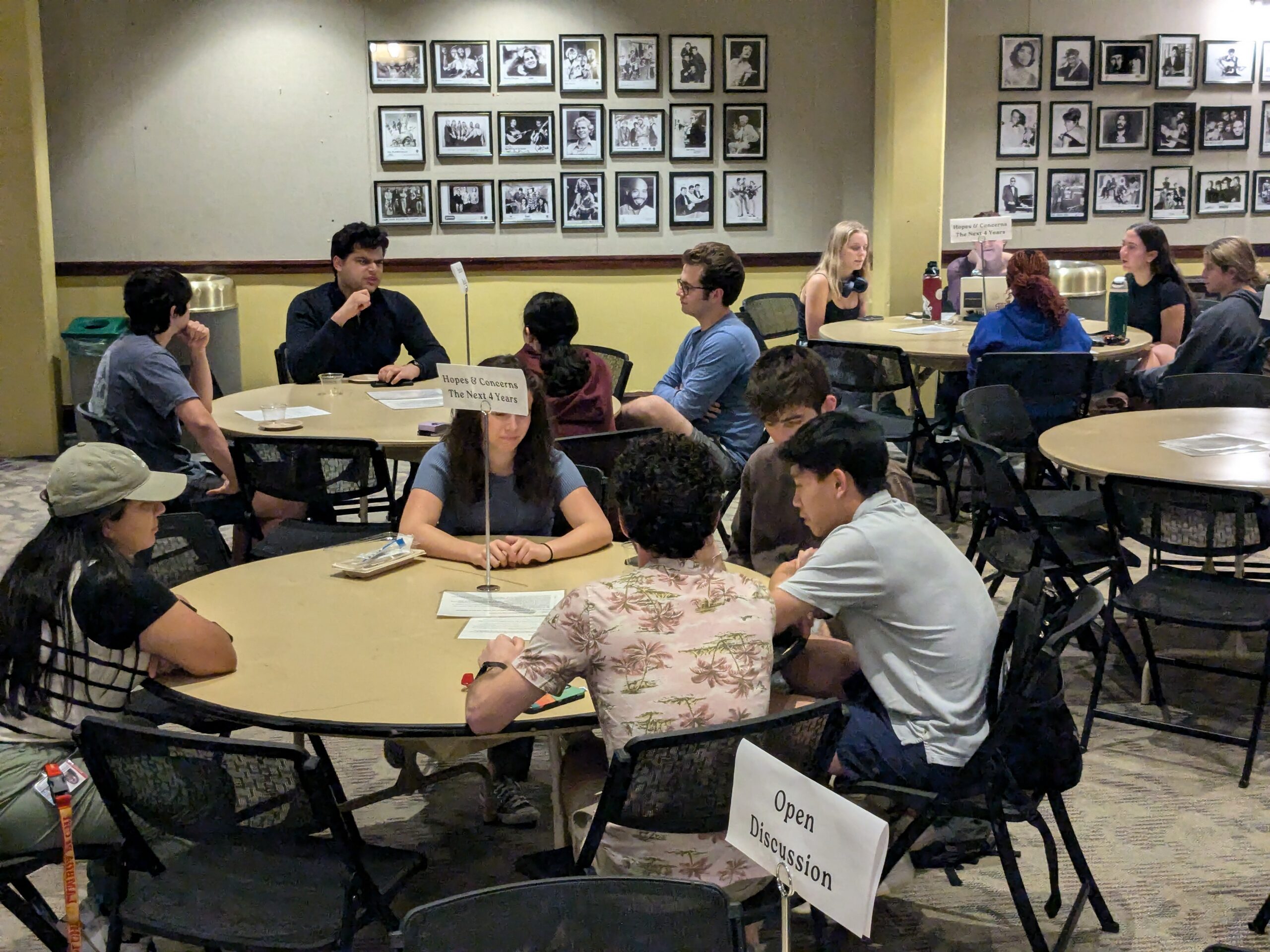
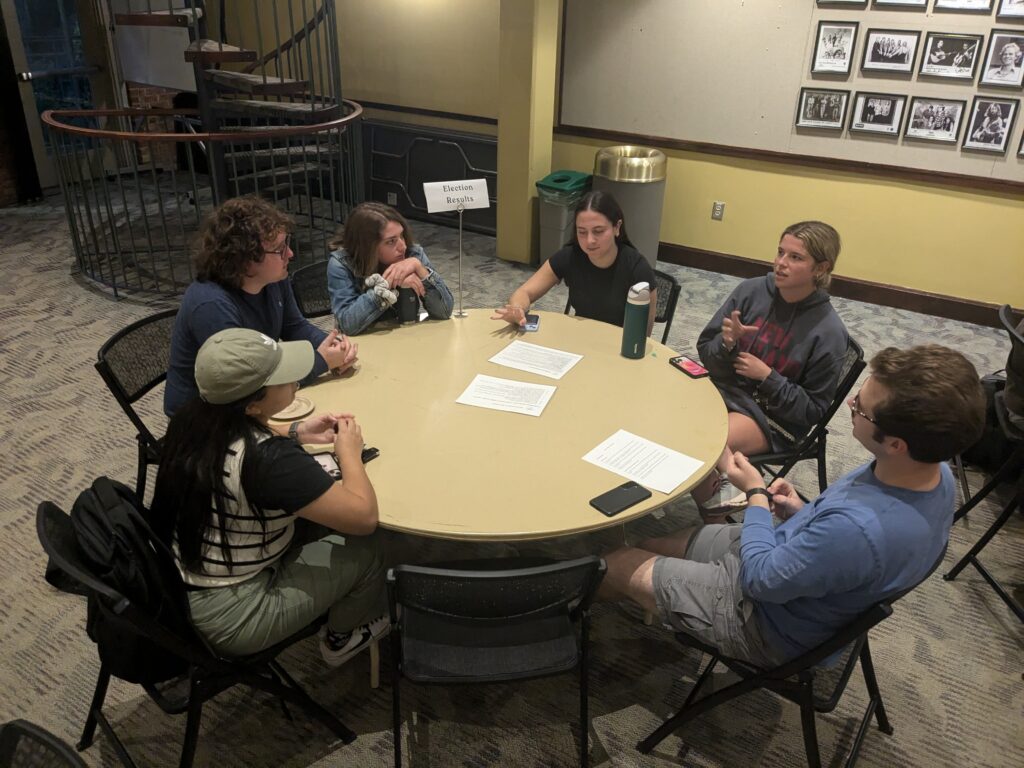
Students discussing around tables

The day after the 2024 Presidential election, the Deliberative Citizenship Initiative (DCI), in collaboration with the Dean of Students Office, the Communication Studies Department, the Political Science Department, and the Center for Political Engagement, hosted an event aimed at helping students process the election results in a constructive and thoughtful way. The goal was simple: to create a welcoming, open space for students to voice their reactions, questions, and hopes and concerns for the future, no matter the outcome of the election.

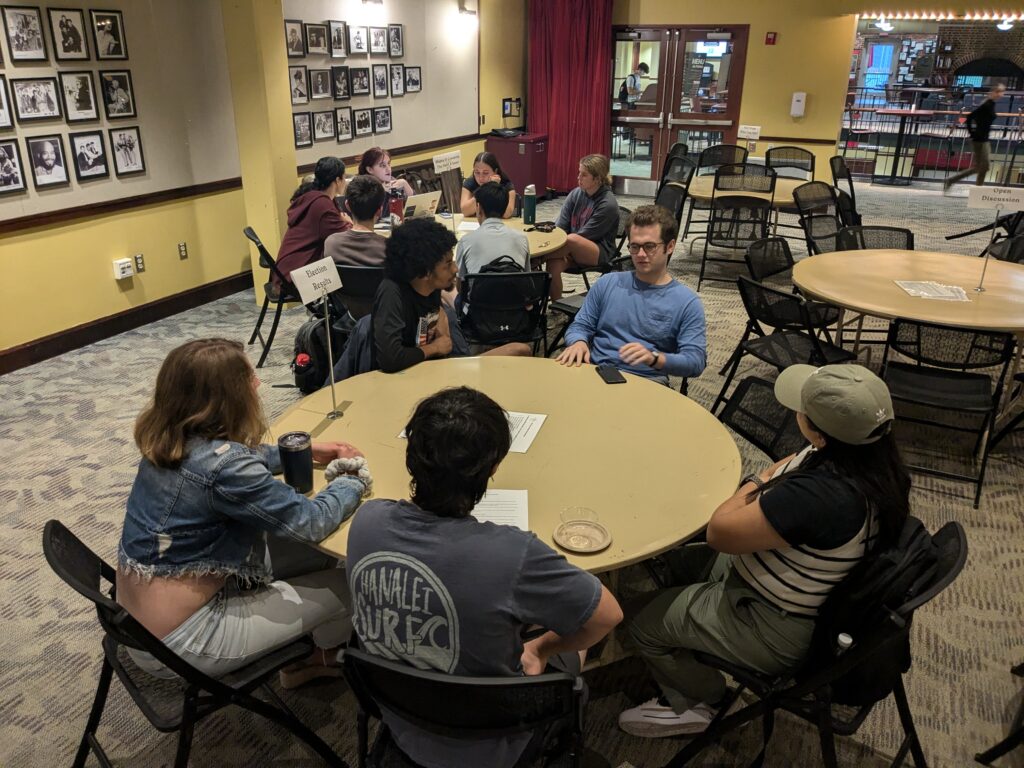
The event took place in the Union, where around 25 students from across the political spectrum gathered in Room 900 to engage in a conversation about the election results and what the next four years might hold. At one table, the Presidents of the College Republicans and College Democrats — who had worked together to organize the Eu-Phi Debate — engaged in a respectful discussion of the results with each other and other students. At other tables, both American and international students also shared their different perspectives on the election together. As the results were still fresh, emotions were running high, and there was an understandable need to come together to reflect, discuss, and strategize for the future. What made this event wasn’t just the opportunity to talk about politics—it was the semi-structured, deliberative approach to the conversation that allowed students to engage in meaningful dialogue, no matter where they stood politically.
The Process: Creating a Productive Space for Dialogue

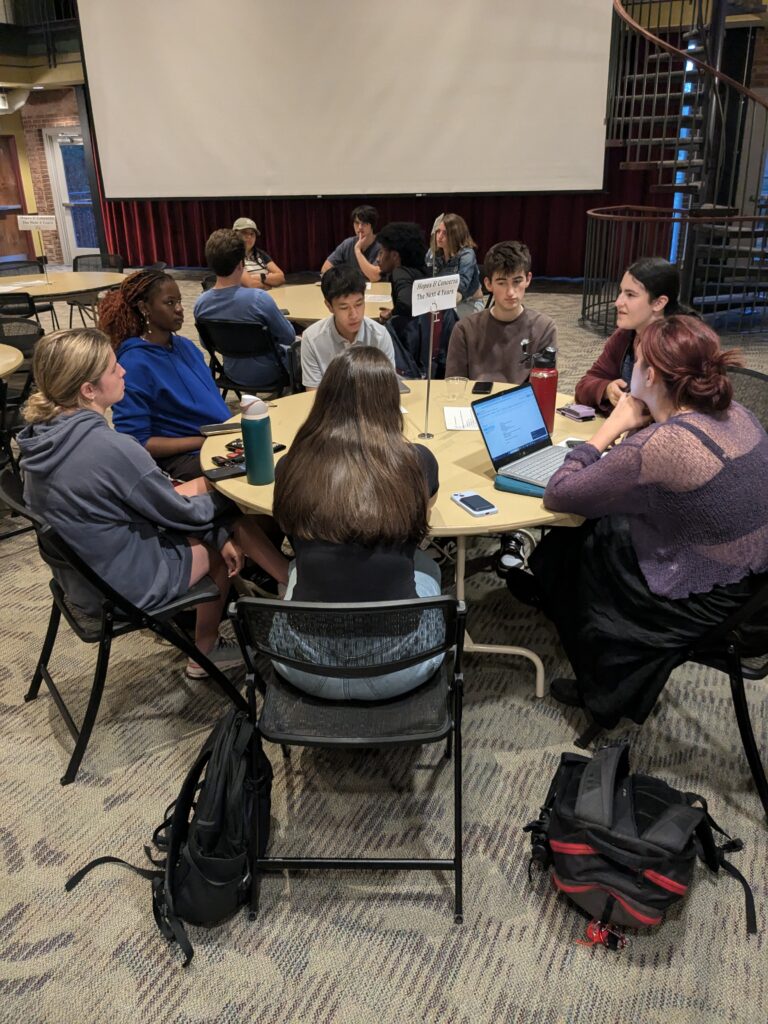
To ensure that the event was both inviting and productive, the organizers used a structured approach to facilitate conversation. Each table in the room was dedicated to a specific theme or topic, such as election results, hopes and concerns for the next four years, next steps – what can I do?, and an open discussion table. Facilitators, trained by the DCI, were present at each table with guiding questions and ground rules to keep conversations on track and ensure that everyone’s voice was heard. 

The event was designed to allow participants the freedom to either stay in their current group and continue discussing the topic at their table, or to move to another table and explore a new theme with fresh faces. Some chose to stay, diving deeper into their original conversations, while others embraced the opportunity to engage with different perspectives, expanding their understanding of the broader issues at play.

The idea for the event came out of conversations between Graham Bullock, Associate Professor of Political Science and Faculty Director of the DCI, and Ike Bailey, Professor of the Practice in Communication Studies. Professor Bullock and Professor Bailey both agreed that it would be helpful to provide a space the day after the election for members of the Davidson community to reflect on the results and status of the election, whatever they might be.

At the event, Professor Bailey participated in conversations with the students while Professor Bullock provided guidance and time checks for the participants, ensuring that they were able to engage in ways that were most meaningful to them. More specifically, participants had the option to stay at their current table for each round or explore other topics with new people. This flexibility in format—where participants could both continue conversations or seek new ones—allowed for diverse and dynamic exchanges, reflecting the range of emotions and thoughts people experienced following the election.
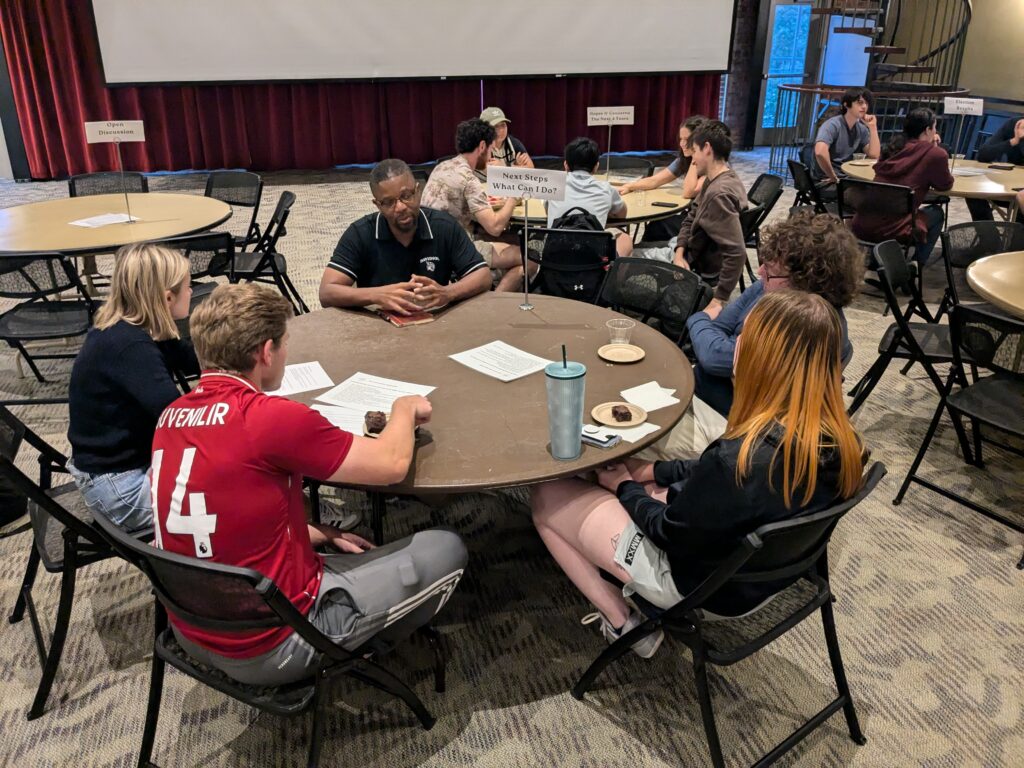
Students and Professor Bailey discussing around tables

Creating Space for Reflection and Action

In the days following any election, particularly a contentious one, it’s common for individuals or groups to feel anxious, fearful, or even hopeless about the state of American democracy. These emotions can be amplified by the divisiveness of modern political discourse, leaving many feeling uncertain about the future. Our event aimed to provide a space for students to both express those feelings as well as explore how they might act on them. The goal wasn’t just to reflect on the election results, but to help participants channel their emotions into constructive conversations about next steps, once they felt ready to do so.

Research on deliberation has shown that such deliberative discussions can strengthen political efficacy, meaning that people feel more empowered to act within the political system (Fishkin, 2009). With this in mind, the event provided participants not only with the opportunity to express their hopes and concerns, but also a space to consider concrete ways to get involved and make a difference in their communities in the aftermath of the election. Whether it was through volunteering, participating in local governance, or engaging in grassroots activism, the conversation enabled participants to turn toward practical steps for fostering the change they want to see in the world. This allowed participants to focus on ways they could contribute to shaping a future they could feel proud of, regardless of their political beliefs.

In many ways, the event echoed the core values of deliberative democracy: a belief in the power of informed, respectful dialogue to create a more engaged, empowered citizenry. Our hope was to help participants leave with a renewed sense of agency—no matter their political leanings or the outcome of the election. 
Building a Stronger Democracy, One Conversation at a Time

The day after the 2024 election, the DCI event succeeded in its goal to create a space for students to engage in thoughtful, reflective, and productive conversation. By offering both a space for thoughtful discussion and clear paths forward for those eager to take action, the event highlighted the importance of staying engaged in civic life—beyond just voting—especially during times of political uncertainty. It reminded us that democracy thrives when we actively participate, discuss, and contribute to shaping the future.

In the days following an election, it is easy to feel disheartened or disconnected from the democratic process. While it is important to give everyone space and time to either celebrate or grieve the results of hard-fought elections, events like this one can also remind us that democracy is not just about casting a vote—it requires us to stay engaged, have difficult conversations, and take steps, however small, to contribute to the well-being of our communities and society. Whether students left the event feeling heard, understood, motivated, or more informed, the most important takeaway was that they had a chance to participate in a meaningful dialogue that reaffirmed their role in shaping the future.

Thank you to all who attended, and we look forward to continuing important conversations about the challenges and opportunities we all face in the months ahead.
Resources

Fishkin, J. (2009). When people speak: Deliberative democracy and public consultation.Oxford University Press. 
Filed Under: DCI Posts, Events

Using Deliberation to Foster Critical Thinking in the Classroom 

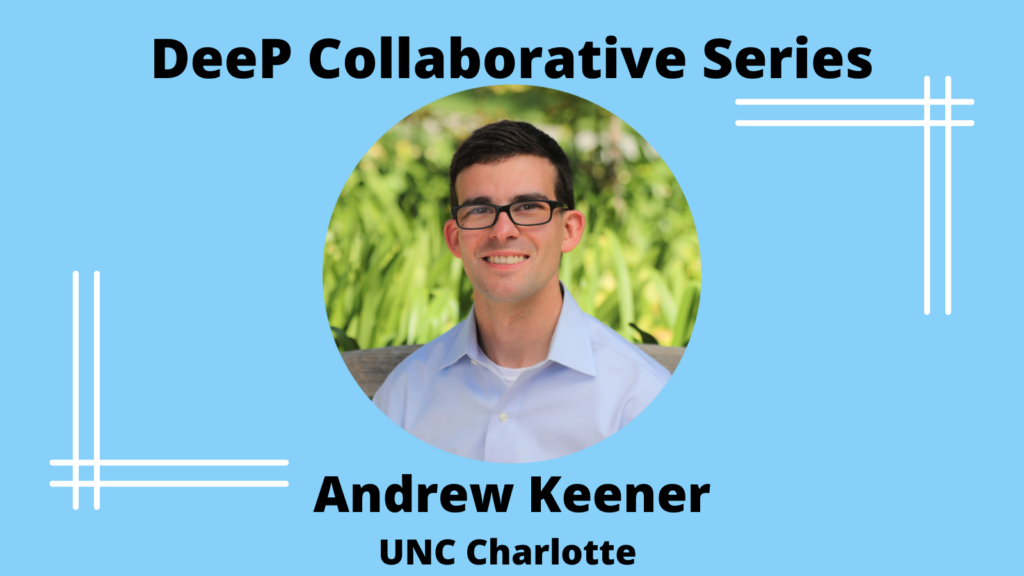
November 1, 2024 by Andrew Keener

One course I teach at UNC Charlotte is a lower-division general education course, “Critical Thinking and Communication,” specifically offered for students in the University Honors Program. The class size typically ranges between 15 and 20 students, and the variety of life experiences and racial, gendered, cultural, and religious identities in the room offer rich opportunities for students to engage and learn from each other across difference. Because I come from a humanities background (English literature), I have typically taught college writing seminars and critical thinking courses with a set of short, thought-provoking readings and other materials to stimulate new ways of thinking and writing. While I kept this practice for a part of the course this semester, I also incorporated an emphasis on the notion of public discourse and deliberation, with support from the DeeP Collaborative colleagues – particularly through our “G2” subgroup and discussions with my partner, Rebecca Alt. 

Although facilitating class discussion is something I have experience with, deliberation was a new topic to me as a teacher. While making that reality clear to my students, I also introduced them to the purposes and elements of deliberative engagement with readings, diagrams, and concepts I learned from and alongside the DeeP Collaborative. This material, which included essays such as Scott Aikin and Robert Talisse’s chapter on “Why We Argue,” and Martin Carcasson’s writings on “wicked problems,” offered a view of the stakes and techniques we were setting out to examine, and practice. My students were exposed to the Kaner model and deliberative dispositions; then, they began to connect their own prospective inquiry topics together as they assembled, midway through the course, into “D-Teams.” These D Teams are similar to but distinct from the Deliberative Citizenship Initiative’s D Teams, which are groups of students and non-students that meet outside of class to discuss different topics.  

Composed of four students apiece, the D-Teams in my class addressed the following thorny questions: What role should taxpayers have in municipal decisions about large-scale sports and entertainment events? How can public health be made more accessible? How can the government best represent the local people it serves? How can AI and other technological innovations be reconciled with environmental sustainability? And, what should 21st century parenting look like in the United States?  

Each of these questions emerged from four or more peers’ independently researched inquiry projects (a campus requirement for this general education course). What I noticed, and did not plan, was that the choice of a fruitful topic for deliberation itself was, in this context, a first occasion for deliberation. The Community Agreements collectively established by the class during the first week of the semester helped arrange some ground rules relevant to all of our deliberations, and my students also were able to watch a video of a practice deliberation.  

Here, I was grateful to have the chance to collaborate with four DeeP Collaborative colleagues: my fellow Honors College staff member Mindy Adnot, and three College of Education faculty: Danyeal Morrison, Michelle Stephan, and Nick Triplett. Our practice deliberation (on the subject of poverty and meritocracy) was not perfect by any means – in fact, we all agree that it left a lot of room for improvement. However, it provided a good chance for my students to observe a deliberation in action and offered a picture of several “moves” that students could employ in deliberations of their own making. 

As their deliberation dates approached, each D-Team assembled from their inquiry projects a set of relevant discussions that developed into their official Deliberation Guide. This three-purpose document provided a training ground for the D-Team, an overview of the stakes and relevant subtopics for the audience (the rest of the class), and an array of provocative questions for the facilitator.  

To permit me to evaluate deliberations as a more detached observer, I recruited and trained two bright students – who were not in the class – during a short session that featured Steve Kalisky’s video demonstration of facilitation styles, clips from the practice deliberation with my DeeP colleagues, and a set of recommended readings (Carcasson, etc.). When the time for deliberations took place, participants were evaluated on three areas: 1) their sustained support for a particular stance on the issue; 2) their respectful, concise, and relevant responses to peers’ comments; and 3) their recruitment of material in their group’s deliberation guide. A fourth area for evaluation consisted of a written reflection on the experience: opportunities, challenges, and take-aways. 

Altogether, the implementation of deliberative pedagogy in this honors course made good sense and gained traction among students through the readings, exercises, and ultimately the deliberative sessions themselves. I’ll be doing my own reflections and listening to and reading over my DeeP Collaborative peers’ experiences to inform some fine-tuning ahead of the next time I teach the course, and as I share my own experience with colleagues across campus. 

Filed Under: Blog Posts, Faculty Posts

Bridging Theory and Practice: Reflections from the Fall DeeP Collaborative Panel

October 25, 2024 by Willow Paul

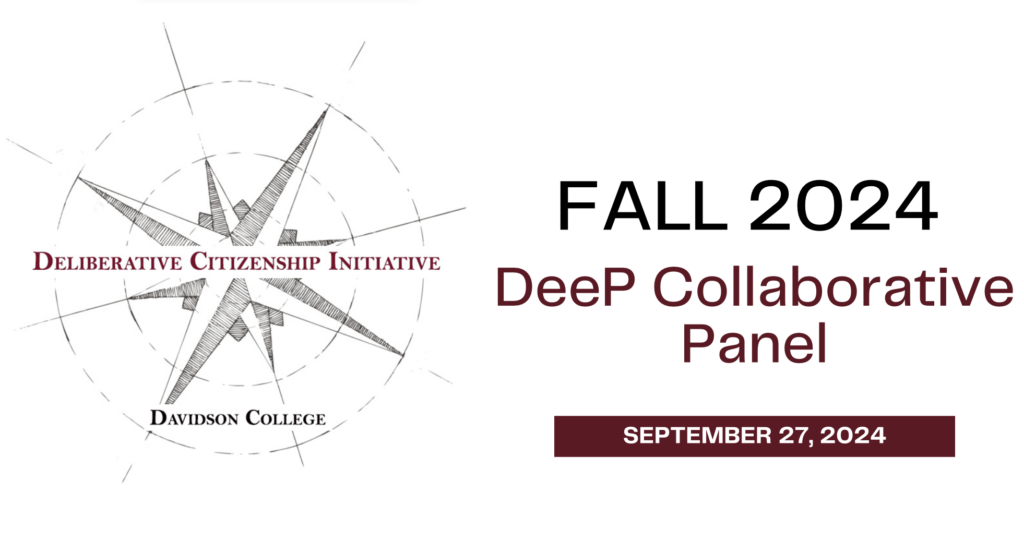
On Friday, September 27, an engaged group of 20 faculty members, professional staff, and community members from various universities and colleges gathered for the Fall 2024 DeeP Collaborative Panel to explore the integration of deliberation into higher education classrooms. Professors Jason Blum (Davidson), Yingling Liu (North Central College), and Mindy Adnot (UNC Charlotte) shared their insights and experiences as part of the Deliberative Pedagogy (DeeP) Collaborative. 

These educators are not only experts in their fields—Writing, Sociology, and Honors Program Leadership—but they also bring a wealth of experience in fostering discussions around complex topics in their classrooms. Each panelist discussed their unique approaches in courses such as Religion in the Public Square, Introduction to Sociology, and Labor, Leisure, Learning, and a Good Life.

To start off the event, Graham Bullock, Faculty Director of the Deliberative Citizenship Initiative, provided a brief overview of what constitutes a “deliberative classroom.” Attendees also engaged in discussions on how to implement these strategies in their own teaching practices.

Here is what our panelists had to say about their involvement in the DeeP Collaborative: 

“[The] DeeP Collaborative is really great for bringing new stuff into the classroom.  No matter where you are, in disciplinary terms, I think it can be super useful.” – Jason Blum

“The training, the reading, the materials were great, the cohort, and the exposure to other people’s pedagogical ideas and innovations. It was all wonderful.”  – Mindy Adnot

“I will say my experience was very rewarding and given that I wasn’t sure  how it was going to play out with my school situation. I think it all worked out well. I would definitely recommend to others.”  – Yingling Liu

Are you a faculty or professional staff member eager to enhance deliberative practices within your courses? We invite you to explore our DeeP Collaborative program, designed to empower educators like you to cultivate meaningful discussions and engagement among students. This is a fantastic opportunity to deepen your skills and transform your teaching methods. Be sure to keep an eye out for next year’s application process; we would love to have you join us in this initiative. Your involvement can play a crucial role in fostering a more interactive and thoughtful learning environment that benefits both you and your students.

Due to inclement weather associated with Hurricane Helene, the panel was held online over Zoom. You are welcome to check out the recording of the event below.

Filed Under: DCI Posts, Events

Respect Matters: Why Being Right Isn’t Enough

October 16, 2024 by Grace Zagoria

“Harvard is the best university in the United States.”

“Derek Jeter was a great baseball player.”

These words echoed through the Davidson College Philanthropic Hall while a crowd of DCI Fellows adjusted their chairs and focused their attention on their guest speaker of the day: Associate Professor of Philosophy Dan Layman. 

As part of the Fellows’ weekly meeting, we typically dive into topics related to public discourse and deliberative citizenship. This week Dr. Layman introduced two key types of respect for us to consider: appraisal respect and recognition respect.

So, what are these concepts, and what do they have to do with Harvard University and a former shortstop for the New York Yankees?

First, let’s talk about appraisal respect, which is rooted in admiration for someone’s prowess and ability. We’ll take the case of Derek Jeter, and the quote from above. Saying Jeter was a great baseball player is a form of appraisal respect: the speaker is taking the shortstop’s accomplishments – 5 World Series Titles, 14 All-Star Selections, 5 Gold Gloves, and the list goes on – and assessing them based on their apparent value. For this speaker, Jeter’s accomplishments are impressive enough to designate him as a ‘great’ player. The speaker, then, judges the skills and abilities Jeter has demonstrated on the field as things worth celebrating. 

The same thought process applies to the Harvard case. The speaker – after some thought, we’d presume – comes to the conclusion that Harvard is the best university in the U.S. Their exact reasoning here we may not know – it could have something to do with the University having the biggest endowment in the world, its having produced 8 U.S. presidents, or its close association with more than 160 Nobel laureates – but, regardless, the speaker is affording the same type of high regard for the University’s achievements as the previous one did with respect to Derek Jeter. 

Both of these examples are forms of appraisal respect if the speaker is basing them on specific reasons or criteria that justify their appraisal. Such claims do not have to be about institutions or professional athletes; they could also be about ordinary people. One could say “Martina is a good person” and that could also qualify as appraisal respect. If someone asked the speaker to explain their reasoning, they could explain their statement with a response like, “Well, Martina carried my groceries up the stairs for me last week, and then she lent Oskars a textbook for math class, so she meets my criteria for being a good person.” The underlying point is that, especially in deliberative contexts, a speaker should be able to formulate grounds for their appraisals and be ready to share those with others when prompted. 

Here’s the caveat, though. 

What if the speaker were to instead say “Martina is a horrible person. Truly, the absolute worst?”

In that case, it would be pretty clear that the speaker doesn’t have a huge amount of appraisal respect for Martina. But that doesn’t mean they have zero respect for Martina.

That’s where recognition respect – or the notion of respecting another being because, like us, they are another being – comes into play. 

Recognition respect suggests that even if the speaker thinks Martina is a horrible person, they shouldn’t go around and treat her disrespectfully. This is because we recognize Martina as a fellow human being and must afford her a decent amount of consideration, despite whatever failings she may have.

Let’s say Martina is walking down the hall with a slew of books in her arms. There’s a heavy door about to slam in her face, and instead of assisting her, you let it close on her. In the process, she drops all of her things to the floor. 

If she’s gathering her books from the ground and says, “Hey! Why did you let that door slam on me?” and in response you shrug and tell her it is because she hasn’t yet earned your respect, then you’d come out of the situation looking like a complete jerk. Why? Because you haven’t shown the proper degree of recognition respect to Martina. 

Martina actually didn’t need to earn your respect in order for you to hold the door open for her: your recognition that Martina, like you, is another being who deserves consideration –  regardless of how you assess her words or her actions – should be sufficient for you to do so. 

Simple enough, right?

So, what does this have to do with DCI?

Here’s what I’d say: given that D Teams are filled with participants and facilitators who don’t know each other, the idea of appraisal respect may be less relevant in this context. After all, can you truly appraise someone if you met them just minutes ago? Should we judge them on the few words they say as they introduce themselves and share their thoughts on the topic that they may or may not have had a lot of time to think about?

Nevertheless, even if we know nothing about someone’s character, or their achievements, or their background, we do know that this person – like ourselves – is a free and sentient being whose reasons and judgments merit our recognition and, consequently, our fair and careful consideration. 

And, in the context of DCI, such recognition respect is crucially important, and it is why egalitarianism is one of the key deliberative dispositions it encourages participants to adapt. In our meetings we explore some very sensitive subjects – topics that can range from immigration law to reproductive rights – and many participants have perspectives that differ vastly from their counterparts. Even still, the notion of approaching your fellow deliberators with respect and maintaining this consideration – including when the discussion gets heated – is a cornerstone of DCI, and it’s what helps keep difficult conversations going. 

Filed Under: Blog Posts, Fellow Posts

The Philosophy Classroom as Deliberative Classroom 

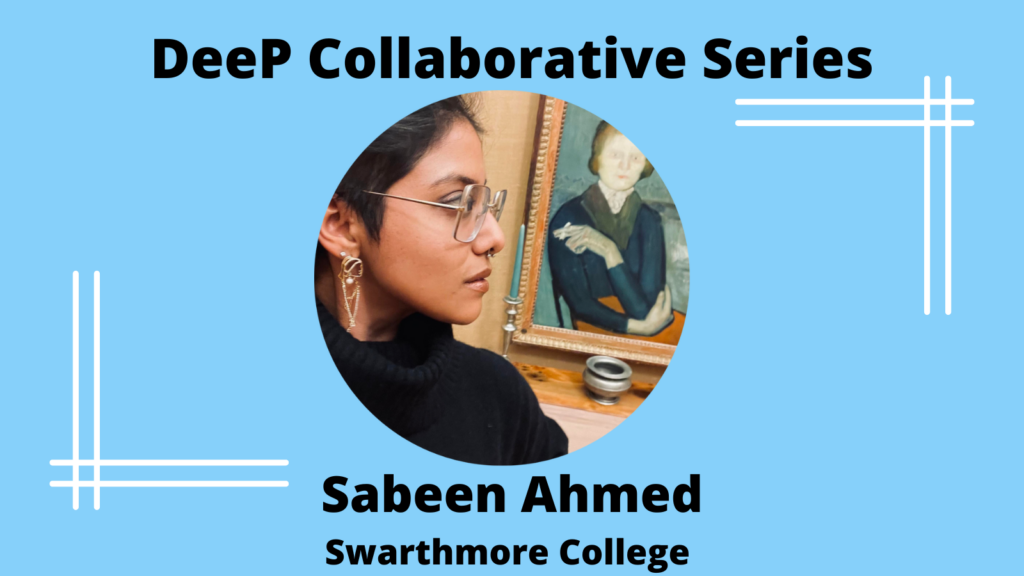
October 16, 2024 by Sabeen Ahmed

Though I did not always have the language to describe it as such, I have long relied on deliberative pedagogy as a framework both for modeling philosophical inquiry inside the classroom and for imparting the critical, interrogative, and evaluative skills required for responsible and reciprocal civic engagement. My approach to teaching has always been shaped by a commitment to foster a space of shared inquiry in which all perspectives and social positionalities are avenues rather than barriers to understanding. It is critical that my students recognize themselves as participants and co-creators of our collective learning experience, and that they approach the study of philosophy as an invitation into an ongoing dialogue of which we are all a part. 

To this end, I encourage my students to engage with philosophy deliberatively, as an always-unfinished, critical enterprise that is open to a constant questioning of the norms, assumptions, and premises of that which we have long taken for granted. By approaching philosophy this way, we are reminded that we are limited in our capacity to know, and that reciprocal engagement with others—and especially those whose lived experiences are far different from our own—is what enables us to see the blind spots in our thinking, brings to light questions that we may not have considered, and opens up avenues for new modes of knowing. This kind of critical, philosophical ethos is one that is genuinely self-reflective, governed by intellectual humility, and attentive to the historicity of the present. 

This approach to philosophy has served me and my students well in this last academic year. As a social and political philosopher, all of my courses—no matter the topic—engage with issues of power, and therefore with issues at the forefront of our concern as social and political beings. My responsibility, as I understand it, is to provide the tools and cultivate the space that enables my students to take on these issues with care. I do not set aside class days for formal, deliberative exercises, but incorporate them into every aspect of our classroom experience: we deliberate over the meaning of the text, giving reasons for why we interpret certain passages in certain ways; we deliberate over the tenability of arguments, both on their own terms and in relation to the lived present; we deliberate over how an author’s framework of analysis can help us make sense of the crises of our day, and where they cannot. The Deliberative Pedagogy Collaborative has enabled me to better articulate these dimensions of my pedagogy.

By way of example, one new strategy that I employed for the first time this semester was to include specific “discussion questions” in my syllabus as a means of guiding students as they did the readings for our class. In my freshman-level course entitled “Aesthetics and Political Resistance,” which met once a week for three hours, I devised a series of inquiries under each set of readings that were intended to give students specific themes to focus on and which they would be expected to deliberate about during our meetings. Inevitably, however, students would take our conversations beyond those I imagined us to have, and I understood my responsibility in those moments to explore how our readings could shed light on their concerns. As the semester progressed, some of my students connected our themes—which included the aesthetic reproduction of the status quo, the role of aesthetic feelings in destabilizing social norms, and so forth—to the events unfolding around us, both abroad as well as on our campus. 

Given the extremely polarized nature of these events, disagreements were unavoidable—and for this reason, several of my colleagues preferred to shut down such conversations entirely. Yet in an era where the rhetoric of “civility” is increasingly deployed to censor critical speech, these moments of disagreement are perhaps the most significant for us as pedagogues. They have reminded me that responsible deliberative pedagogy demands that we understand where our students are coming from, so that we can better put competing viewpoints into constructive dialogue and translate disagreements into learning opportunities. In other words, it requires that we cultivate a critical ethos in ourselves just as much as we try to cultivate it in our students. I am grateful to the Deliberative Pedagogy Collaborative for giving me the space to deeply reflect on this responsibility.

Filed Under: Blog Posts, Faculty Posts

  • « Go to Previous Page
  • Page 1
  • Interim pages omitted …
  • Page 31
  • Page 32
  • Page 33
  • Page 34
  • Page 35
  • Interim pages omitted …
  • Page 75
  • Go to Next Page »

Footer

Blog Post Categories

  • Announcements
  • Blog Posts
  • DCI Posts
  • Events
  • Faculty Posts
  • Fellow Posts
Image of a compass superimposed by the text "Deliberative Citizenship Initiative" and "Davidson College." Clicking on this image leads to the Initiative page.

Recent DCI Blog Posts

  • We Tried to Fix Jubilee’s “Middle Ground” – Here’s How It Went
  • A Case for Deliberation in the Natural Sciences
  • Welcoming New Staff to the DCI and DCN
  • Facebook
  • Twitter
  • Instagram
  • LinkedIn


Copyright © 2026 · Infinity Pro on Genesis Framework · WordPress · Log in