• Skip to main content
  • Skip to footer

Deliberative Citizenship Initiative

Building Democracy One Conversation at a Time

  • The Initiative
    • Programs
      • Deliberation Across the Curriculum
      • Deliberation on Campus
      • Deliberation in the Community
      • Research on Deliberation
    • Motivations
      • Why Deliberative Citizenship?
      • Why Davidson? Why Now?
    • Who’s Involved?
      • DCI Fellows Cohorts
        • 2025-2026 Fellows
        • 2024-2025 Fellows
        • 2023-2024 Fellows
        • 2022-2023 Fellows
        • 2021-2022 Fellows
        • 2020-2021 Fellows
      • DeeP Collaborative Cohorts
        • 2024-2025 DeeP Collaborative Faculty
        • 2023-2024 DeeP Collaborative Faculty
      • Advisory Council
    • History
      • What Sparked the Initiative?
    • Key Deliberative Dispositions
    • Frequently Asked Questions (FAQ)
    • Annual Report
  • Get Involved!
    • Participate in a Forum
    • Join a D Team
    • Become a Fellow
    • Take Courses
    • Get Training
    • Come to Guest Lectures
  • Events
    • Upcoming Events
      • 250th Anniversary Deliberative Forum Series on American Values
    • Past Events
  • Connections
    • The Deliberative Citizen: The DCI’s Monthly Newsletter
    • Efforts on Campus
    • Efforts in the Community
    • Efforts Elsewhere
    • Readings and Resources
      • DCI-Published Guides
      • DCI Guide to One-on-One Conversations
      • How to Disagree
      • Demonstration of Facilitation Styles
      • Deliberative Pedagogy Mini-Course
    • How We Can Help: DCI’s LET’S DELIBERATE! Partnership Opportunities
    • DCI in the News
  • DCI Blog Posts
    • Recent Blog Posts
    • All Blog Posts

The DCI Blog

Four Professors, Four Paths to a More Deliberative Classroom: The Spring 2025 DeeP Panel and Lunch

March 4, 2025 by Graham Bullock Leave a Comment

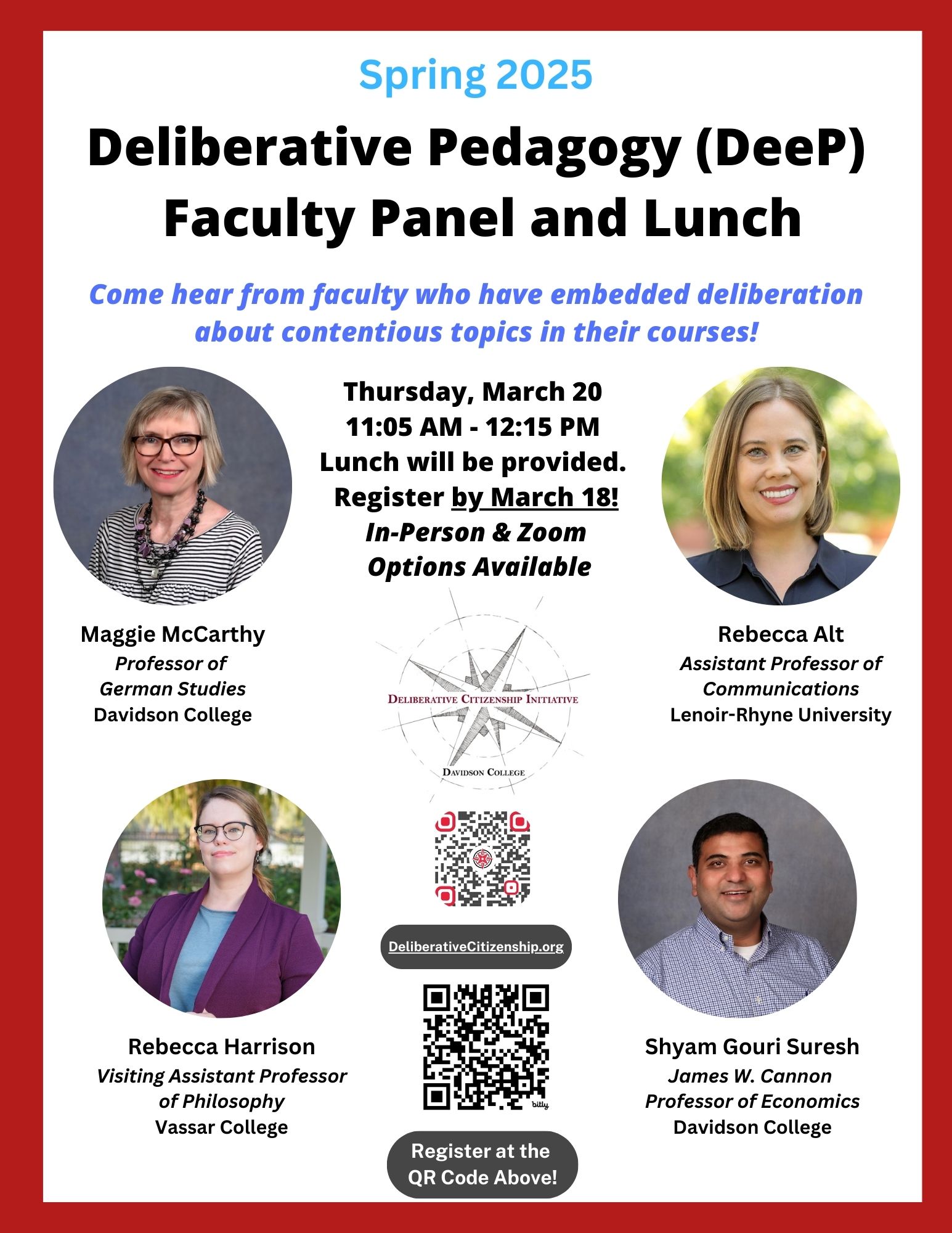
DeeP panel flyer.

What do four different courses on contemporary economic issues, sports communication, the philosophy of love and sex, and race on film have in common? In each one, the professors intentionally worked to embed more open, constructive, and authentic discussions about difficult and contentious topics related to the course’s content.

Curious about what they did, and how they did it? Then join us on Thursday, March 20 from 11:05 am to 12:15 pm to hear from these four professors at a Faculty Panel and Lunch hosted by the Deliberative Citizenship Initiative. The discussion will be held in the Davidson College Library’s Large Group Tutor Room.

Professors Maggie McCarthy (German Studies, Davidson College), Rebecca Alt (Communications, Lenoir-Rhyne College), Rebecca Harrison (Philosophy, Vassar College), and Shyam Gouri Suresh (Economics, Davidson College) will be sharing their work as members of the Deliberative Pedagogy (DeeP) Collaborative. Over 60 faculty members from 18 different institutions have participated in the Collaborative, which enables professors from across the humanities, natural sciences, and social sciences to work together on developing and implementing innovative ways to stimulate deeper discussions in their courses. 

Are you a faculty member who is interested in exploring how you might do something similar in your classroom? Or perhaps you already do, and are interested in picking up some new ideas? Then come out for this amazing panel and conversation! You can participate either in-person or virtually. Lunch will be provided for all in-person participants, but seats are limited so sign up here today!

To learn more about the Deliberative Pedagogy Collaborative, the DCI’s Deliberation Across the Curriculum Program, and the upcoming panel, check out the attached flyer, this webpage, and these blog posts by faculty members who have participated in the Collaborative over the past two years.

We hope you can join us!
Register Here Today!

Filed Under: Events

Deliberative Roleplaying in a Course on American Political Thought

March 3, 2025 by Kim Maslin

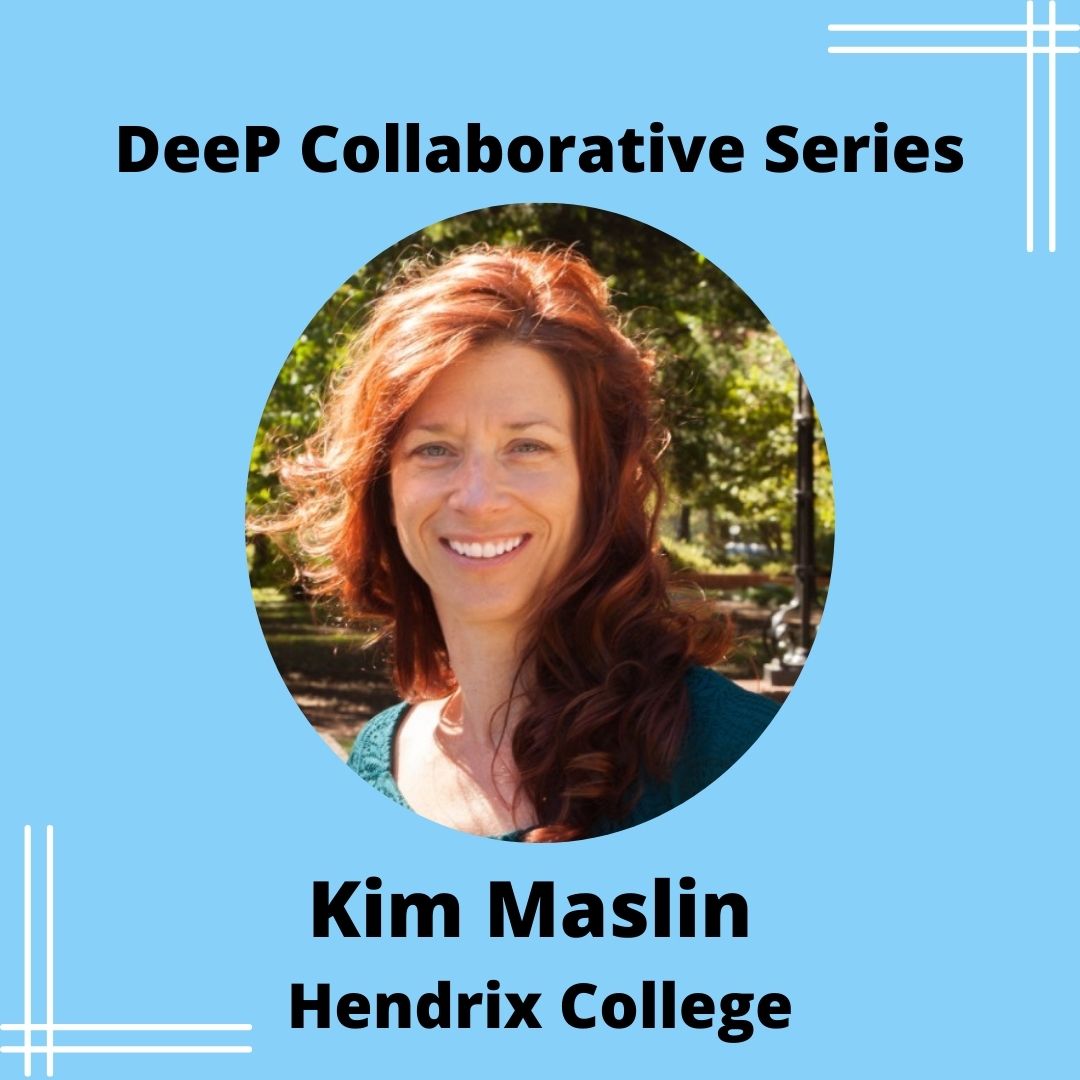
Kim Maslin poster

During the COVID years, class participation became more and more of a struggle in the classroom while student engagement with political issues increased. Students clearly see politics as relevant to their lives though they are less and less likely to engage with it in meaningful ways in the classroom. This observation, along with the realization that the problem lies in the way I was structuring engagement in my courses, led me to join the Deliberative Pedagogy (DeeP) Collaborative. I wanted to restructure my American Political Thought class as a series of exercises in democratic deliberation, combined with reflections and discussions about the necessary components of meaningful engagement.

Our first engagement activity was a roleplay of the Constitutional Convention. In preparation we read John Locke, Thomas Paine, John and Samuel Adams among others to lay some of the groundwork. Across a period of 4 weeks, students took on the roles of James Madison, Alexander Hamilton, Elbridge Gerry, etc. They debated the merits of direct election by the people, representation, and the length of presidential terms of office. They dug into a character, prepared and delivered speeches, questioned each other’s reasoning, and ultimately reconfigured their speeches into the form of essays.

They got to know each other, first, in character, as colleagues, to some extent opponents and supporters, but also as complex characters, working hard to ensure a sustainable system of governance. In other words, they developed bonds through the process of taking on positions and arguing points they didn’t necessarily accept or believe in. Moreover, they developed the ability to pose questions in the nomenclature of “my right, honorable colleague from, [insert state].”

The second engagement activity was a deliberation about originalism. With the experience of debating the Constitutional Convention fresh in their minds, they knew that the delegates to the convention had agreed to a text, though not necessarily to its meaning. They also knew that some of the delegates refused to sign the document in the end. Finally, they knew that interpretation was not something the delegates had ever debated.

In preparation to engage substantively the issue of originalism, they read several articles by Scalia, Meese, and others on originalism, living constitutionalism, and their varieties. In preparing to deliberate with peers as themselves, they read Monica Guzman on cultivating curiosity, Jean-Luc Nancy on listening, and Adriana Caverero’s The Stork. They practiced the roles of weaving and devil’s advocacy. They posed questions to each other about their experiences.

In the end, several students offered that regardless of which deliberative technique came most naturally, the most difficult part of the deliberation was to approach the conversation with humility. Almost all the students indicated at one point or another that while they were vaguely familiar with the term originalism, they were not aware either of the intent or public meaning varieties, nor could they identify any varieties of living constitutionalism, though most placed themselves in that camp. The class concluded with a robust conversation about the purpose of and guidelines for the campus protests that occupied so much of our national attention throughout April 2024 and the early part of May 2024.

In this iteration, students took on an ideologically charged topic. They had a good and productive conversation in which most of them acknowledged at least one weakness associated with their own position, as well as a strength associated with the opposing perspective. Virtually everyone said that they learned something about originalism and a few students actually changed their minds about how the Supreme Court should make decisions.

Moving forward, I will attempt to improve upon three things. First, there was a lot of variety in what the students understood devil’s advocacy to be. I need to do a better job of recognizing that while nearly all students are familiar with the phrase, they do not share a conceptual understanding of what it means.

Second, internalizing fallibility is a high hurdle, which we probably do not model well in academia. Two out of thirteen students signaled that their comments were provisional during the deliberation. I need to think through the ways that I model humility, as well as exercises for practicing provisional thinking. In keeping with this goal, one of my summer reading goals is Kathryn Schulz’s Being Wrong: Adventures in the Margin of Error.

Finally, in terms of assessment, the only thing that I had time to do during the deliberation was to check boxes. The rubric for the actual deliberation needs to be both simple and it needs to reveal my observations about the roles that students are actually playing.

Filed Under: Blog Posts, Faculty Posts

DCI and Town of Davidson Host Community Conversation about a Future Red Line Station

March 3, 2025 by Graham Bullock

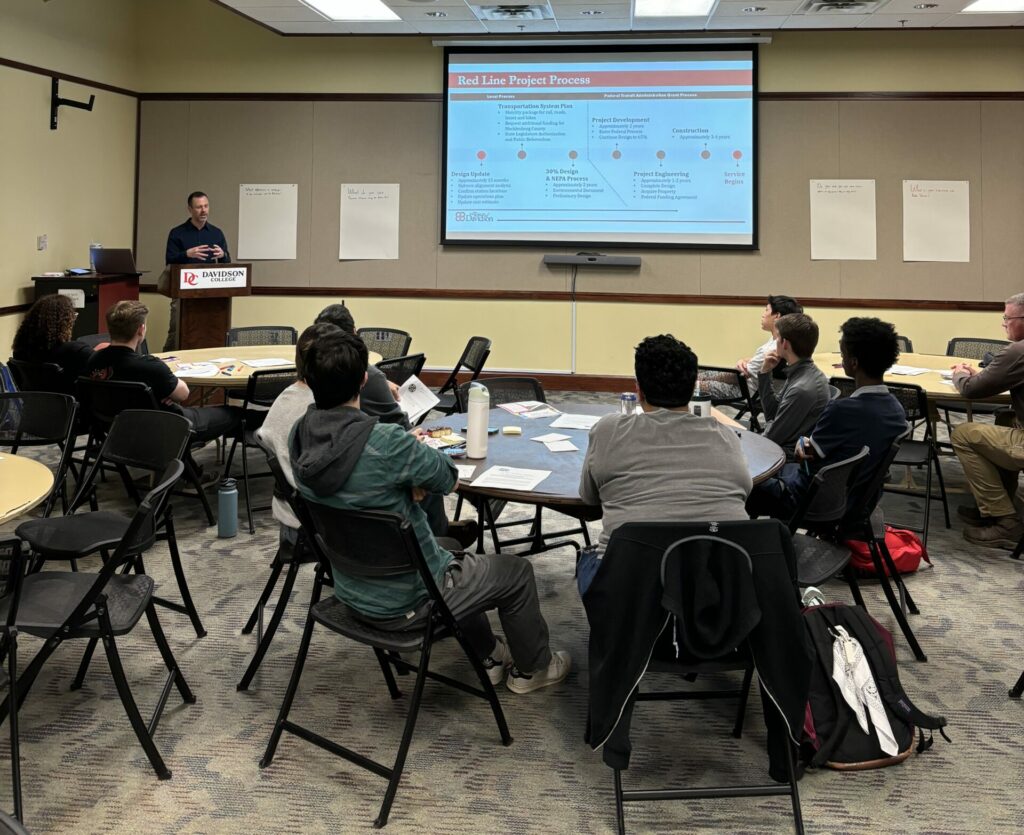
Photo of Red Line conversation

Last week, DCI fellows Garratt Rothberg ’27 and Zak Abdulahi ’27 hosted an insightful Community Conversation on the Red Line station in Davidson. The Planning Director of the Town of Davidson, Jason Burdette, delivered an informative presentation on the project plan and its expected benefits to Davidson to a diverse group of students, college faculty, and community members. Then, participants shared their thoughts and questions through an interactive activity, which segued into an engaging deliberation about the benefits of public transit to the community. All in all, participants were excited to discuss their thoughts on the Red Line and walked out of the event with a deeper understanding of the project at hand. 

Filed Under: Events

The Bridges We Build

March 1, 2025 by Cavan Klein Leave a Comment

By Cavan Klein ’27 (DCI Fellow)

In today’s polarized world, conversations across generational and cultural divides can feel daunting or futile. Different age groups and cultural backgrounds often approach the same issues with vastly different experiences and priorities, creating barriers that seem insurmountable. Yet, it is precisely in these moments of difference that opportunities for growth, understanding, and collaboration emerge.

One of the greatest benefits of connecting across divides is the ability to harness the unique strengths of diverse perspectives. At the risk of making sweeping generalizations, older generations often bring invaluable historical context and long-term insights, drawing on lessons from events they’ve witnessed or participated in. For example, during the deliberation on campus protests in my D Team, a community member shared their childhood memory of the Vietnam War demonstrations. Their story illustrated both the similarities and differences between youth-led movements of the 1960s and those of today, such as protests related to the Israel-Hamas conflict. This perspective reminded younger participants, including myself, that the protests we see today are part of a larger historical arc of activism.

Meanwhile, younger generations bring energy, innovation, and urgency to the table. Growing up in an era defined by rapid technological advances and immediate access to information, they often view problems like climate change, social justice, or inequality as crises that require immediate action. These differences in approach can sometimes create tension, but when generations come together to deliberate, their strengths often complement each other. Older participants can provide the wisdom of experience, while younger participants drive forward momentum and fresh ideas.

All my life, I’ve admired how much experience older generations have and have tried to remind myself that whatever challenges I face, they likely have valuable wisdom to share. However, through this experience, I’ve realized that such an understanding, while respectful, can also oversimplify and limit the value of wisdom to those with more years behind them. Wisdom, I’ve learned, can emerge from anyone willing to listen, reflect, and contribute.

Indeed, before my first D Team meeting that I would facilitate, I was dreading the possibility that the student participants would need excessive coaxing to come out of their shells to participate. I also assumed the community members would steer the conversation. However, to my pleasant surprise, neither of these things came true. 

Yes, everyone took some time to warm up in the first meeting and there were a couple people that initially led the conversation, but by the end of the first meeting and especially in the later meetings, we had created complex metaphorical structures: a series of multilayered and interweaving bridges. A series of metaphorical bridges spanning the divides of polarization, argumentation, and misunderstanding.

These bridges stemmed from every single person in my group. The student from a small, like-minded town. The counselor who had lived on the other side of the country. The community member navigating life with a young child. So many different perspectives and experiences, but somehow it all came together – not for the purpose of generating agreement but for the purpose of sharing understanding. 

When people from different generations and cultures engage in meaningful dialogue, they create connections that extend beyond the discussion at hand. These relationships are crucial in a world where differences threaten to erode trust and cooperation. They remind us that our diversity is not a weakness but a source of strength—a foundation for understanding and collaboration that transcends the divides we so often face.

Filed Under: Blog Posts, Fellow Posts

The Power of Disagreement Within Deliberation

March 1, 2025 by Garratt Rothberg

abstract representation of disagreement

By Garratt Rothberg ’27 (DCI Fellow)

The students and community members shyly strolled into the room, sitting down around the table and exchanging nervous glances. The clock had struck 6:30 PM, and my group was ready for our deliberation. As the conversation started, the participants were clearly apprehensive. For most of the participants, this was their first time taking part in a deliberation, and many aspects felt uncomfortable at first.

At one point, a participant apologized before disagreeing with someone else, as if it was something to shy away from. As the facilitator, I jumped in and reminded the group that providing space for respectful disagreement is a key feature of deliberation. At the DCI, we strive to adopt 10 key deliberative dispositions in our sessions. One of the most valuable dispositions is open-mindedness, as the honest consideration of other perspectives and ideas leads us to grow intellectually. The framework of D Teams encourages the exchange of ideas and a willingness to listen, which builds a sense of mutual understanding.

At the beginning of the deliberation, the participants were actively listening but responding to each other with a sense of hesitancy. The participant’s first statement of disagreement seemed to break the ice in my group, as the conversation continued with new vigor as participants were no longer afraid to question the ideas of others. This brought another of our dispositions to the foreground: humility. Too often, people perceive disagreement as a challenge and become upset, stemming from the reluctance to consider other perspectives and the possibility that one’s belief is wrong. In our D Teams, respectful disagreement is the goal, which forces people to consider the ideas of others and thus recognize that one may be wrong. Humility is important to maintaining a respectful atmosphere when engaging in charged conversations and is essential in our D Teams and in society.

In states of disagreement, my D Team participants quickly began to adopt another important disposition: charity. When someone said something that didn’t make complete sense, participants would ask follow-up questions and truly attempt to understand their peer’s point of view. In a deliberation, participants must assume the best about the intentions of others. After all, it is clear the participants are motivated to share their thoughts and gain new perspectives by simply signing up for the D Team. When we assume the best about each other, we gain a more complete understanding of our peers’ perspectives and more profound takeaways from the deliberation.

A question that came up repeatedly in my final D Team session was, “What comes next?” Three sessions of deliberating brought fruitful discussions, but participants were wondering what the larger impact of their work was. In truth, D Teams are just a starting point for the work of deliberation. Implementing aspects of a deliberative democracy on a larger scale is difficult, but there are numerous places to look to for guidance. Ireland has a Citizens’ Assembly program in which a randomly selected group of 100 Irish citizens deliberate on key political issues, and the Irish government considers the resolutions they come up with in the policymaking process. This would be logistically much more difficult in the larger United States, but it is nonetheless an important experiment in deliberative democracy. While deliberation can be both uncomfortable and difficult, it is a necessary and rewarding process for our democracy to live up to its promise as a nation in which every voice is heard, respected, and appreciated.

Filed Under: Blog Posts, Fellow Posts

  • « Go to Previous Page
  • Page 1
  • Interim pages omitted …
  • Page 25
  • Page 26
  • Page 27
  • Page 28
  • Page 29
  • Interim pages omitted …
  • Page 75
  • Go to Next Page »

Footer

Blog Post Categories

  • Announcements
  • Blog Posts
  • DCI Posts
  • Events
  • Faculty Posts
  • Fellow Posts
Image of a compass superimposed by the text "Deliberative Citizenship Initiative" and "Davidson College." Clicking on this image leads to the Initiative page.

Recent DCI Blog Posts

  • We Tried to Fix Jubilee’s “Middle Ground” – Here’s How It Went
  • A Case for Deliberation in the Natural Sciences
  • Welcoming New Staff to the DCI and DCN
  • Facebook
  • Twitter
  • Instagram
  • LinkedIn


Copyright © 2026 · Infinity Pro on Genesis Framework · WordPress · Log in