• Skip to main content
  • Skip to footer

Deliberative Citizenship Initiative

Building Democracy One Conversation at a Time

  • The Initiative
    • Programs
      • Deliberation Across the Curriculum
      • Deliberation on Campus
      • Deliberation in the Community
      • Research on Deliberation
    • Motivations
      • Why Deliberative Citizenship?
      • Why Davidson? Why Now?
    • Who’s Involved?
      • DCI Fellows Cohorts
        • 2025-2026 Fellows
        • 2024-2025 Fellows
        • 2023-2024 Fellows
        • 2022-2023 Fellows
        • 2021-2022 Fellows
        • 2020-2021 Fellows
      • DeeP Collaborative Cohorts
        • 2024-2025 DeeP Collaborative Faculty
        • 2023-2024 DeeP Collaborative Faculty
      • Advisory Council
    • History
      • What Sparked the Initiative?
    • Key Deliberative Dispositions
    • Frequently Asked Questions (FAQ)
    • Annual Report
  • Get Involved!
    • Participate in a Forum
    • Join a D Team
    • Become a Fellow
    • Take Courses
    • Get Training
    • Come to Guest Lectures
  • Events
    • Upcoming Events
      • 250th Anniversary Deliberative Forum Series on American Values
    • Past Events
  • Connections
    • The Deliberative Citizen: The DCI’s Monthly Newsletter
    • Efforts on Campus
    • Efforts in the Community
    • Efforts Elsewhere
    • Readings and Resources
      • DCI-Published Guides
      • DCI Guide to One-on-One Conversations
      • How to Disagree
      • Demonstration of Facilitation Styles
      • Deliberative Pedagogy Mini-Course
    • How We Can Help: DCI’s LET’S DELIBERATE! Partnership Opportunities
    • DCI in the News
  • DCI Blog Posts
    • Recent Blog Posts
    • All Blog Posts

The DCI Blog

Event Recap: Campus Conversation on the Honor Code

April 6, 2025 by Graham Bullock

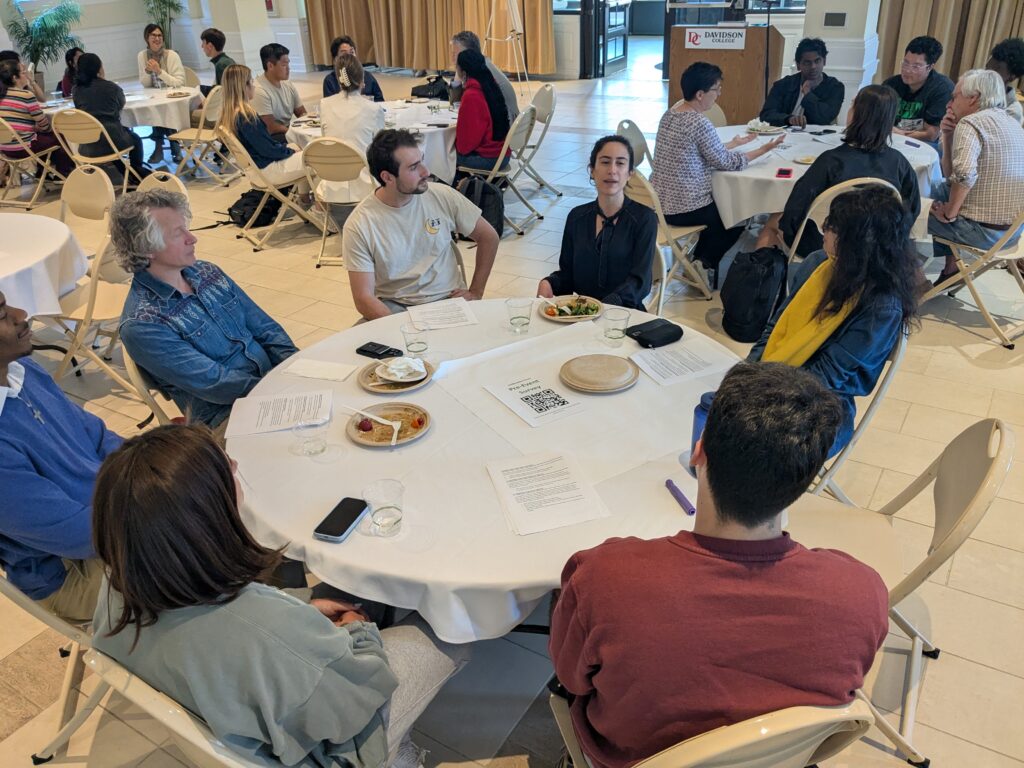
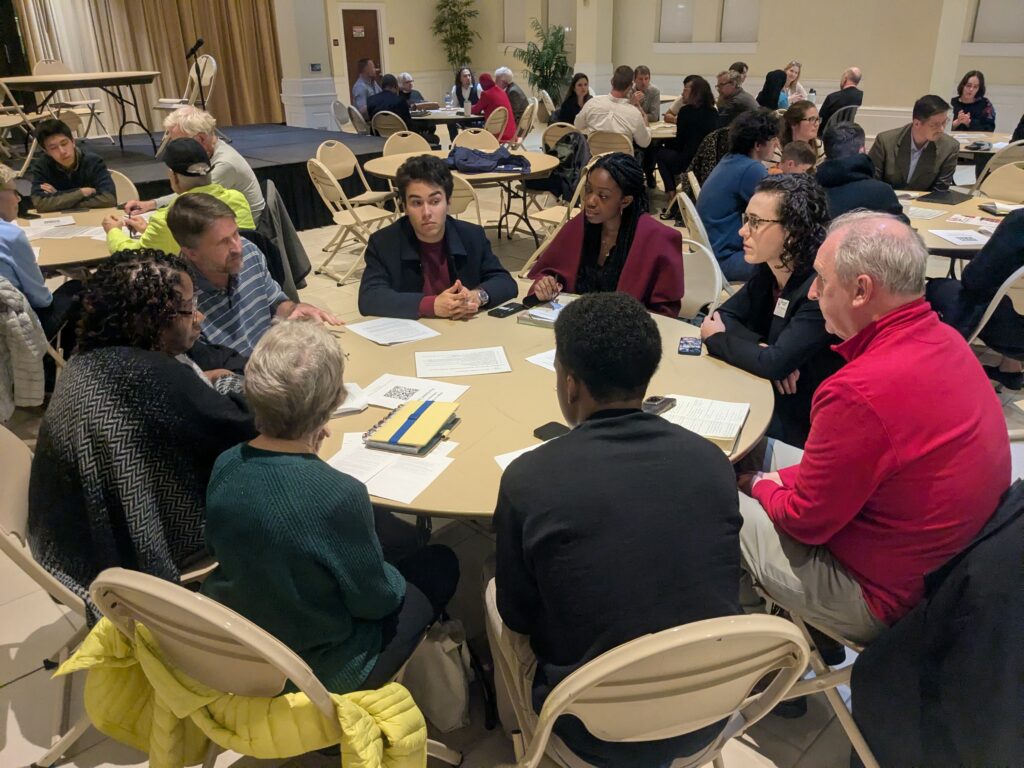
discussion tables at event

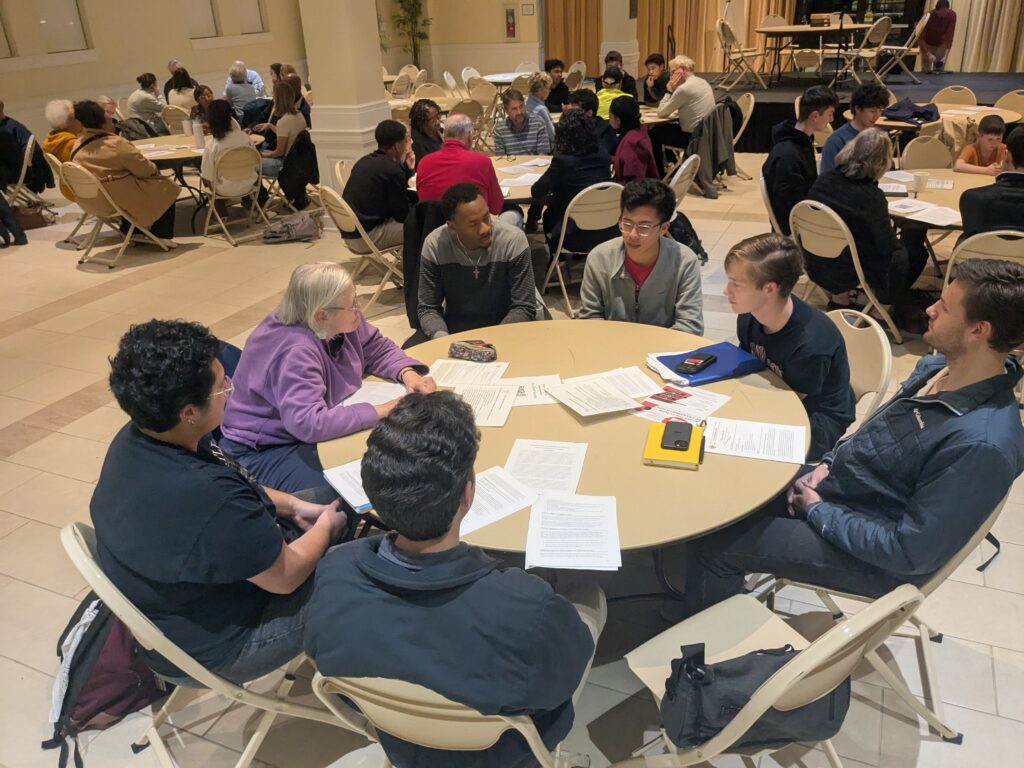
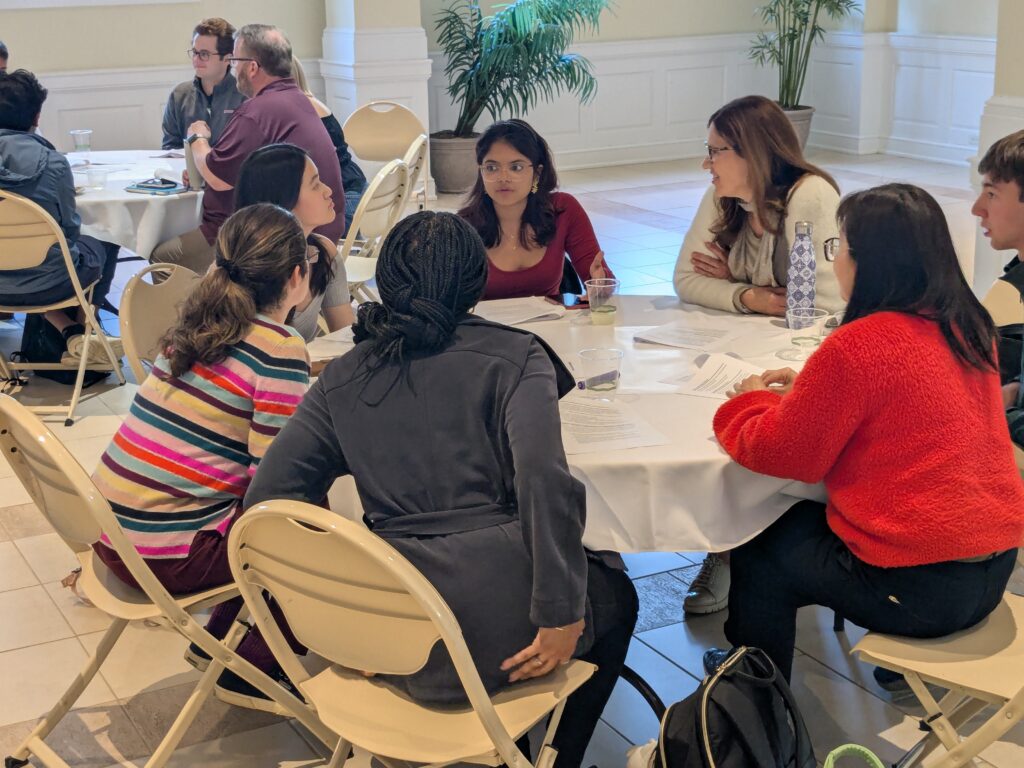
Honor and academic integrity were the focus of a campus conversation co-hosted by the Deliberative Citizenship Initiative (DCI), Honor Council, Student Government Association (SGA), and the Office of the Vice President of Student Life. Over 50 students, faculty, and staff gathered to deliberate about how a more robust culture of academic integrity can be created at Davidson. Held on Thursday, March 27 from 5:00 to 7:00 PM in the Lilly Gallery, the event complemented the Celebration of Honor held earlier in the month.
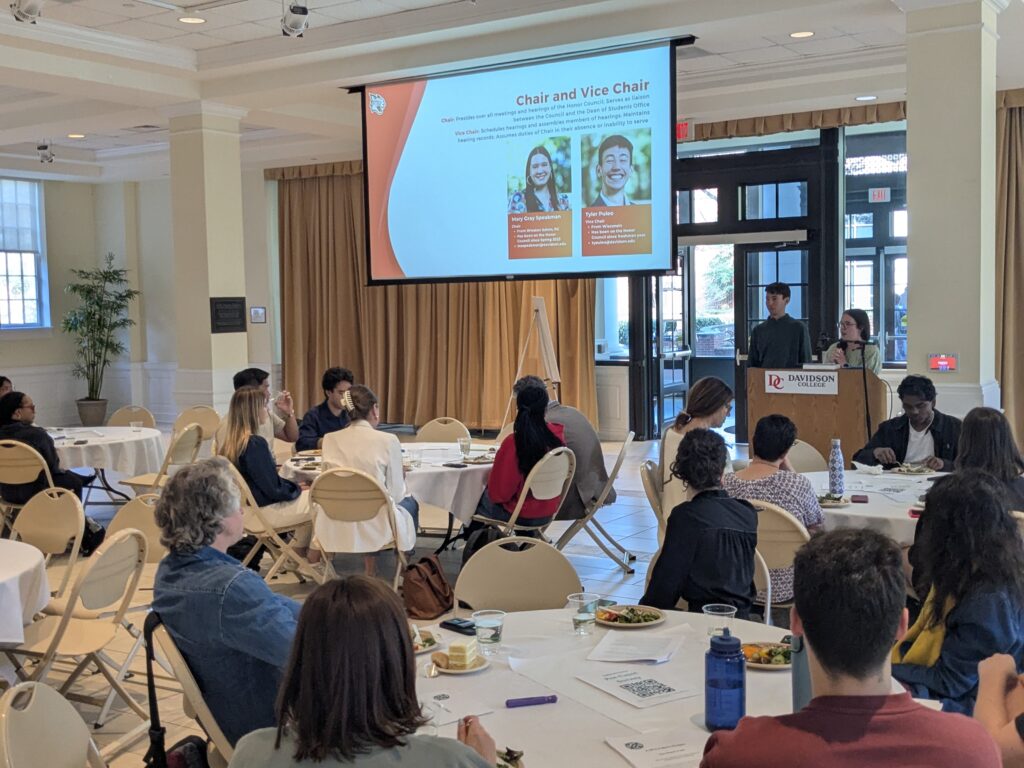
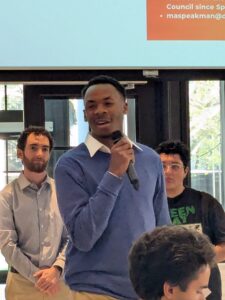
As participants got their plates of food provided by Much Ado Catering, the forum began with a presentation about the honor code from the Chair and Vice Chair of the Honor Council. Participants were quickly invited to dive into roundtable discussions guided by the DCI’s fellows and a deliberation guide written by the event’s student organizers, DCI Senior Fellow and Co-Convener LJ Phillips ’25 and DCI Fellows Isabella Neri ’27 and Cavan Klein ’27 (shown left).

You can check out the deliberation guide below, which provides some useful background about the nature of academic integrity, Davidson’s Honor Code, current perceptions of campus academic culture, and ideas for improving that culture in the future.

Honor-Code-Deliberation-Guide

Check out some more photos of the event below…
Filed Under: DCI Posts, Events

Event Recap: Deliberating about the Legacies of War

April 6, 2025 by Luna Noguchi

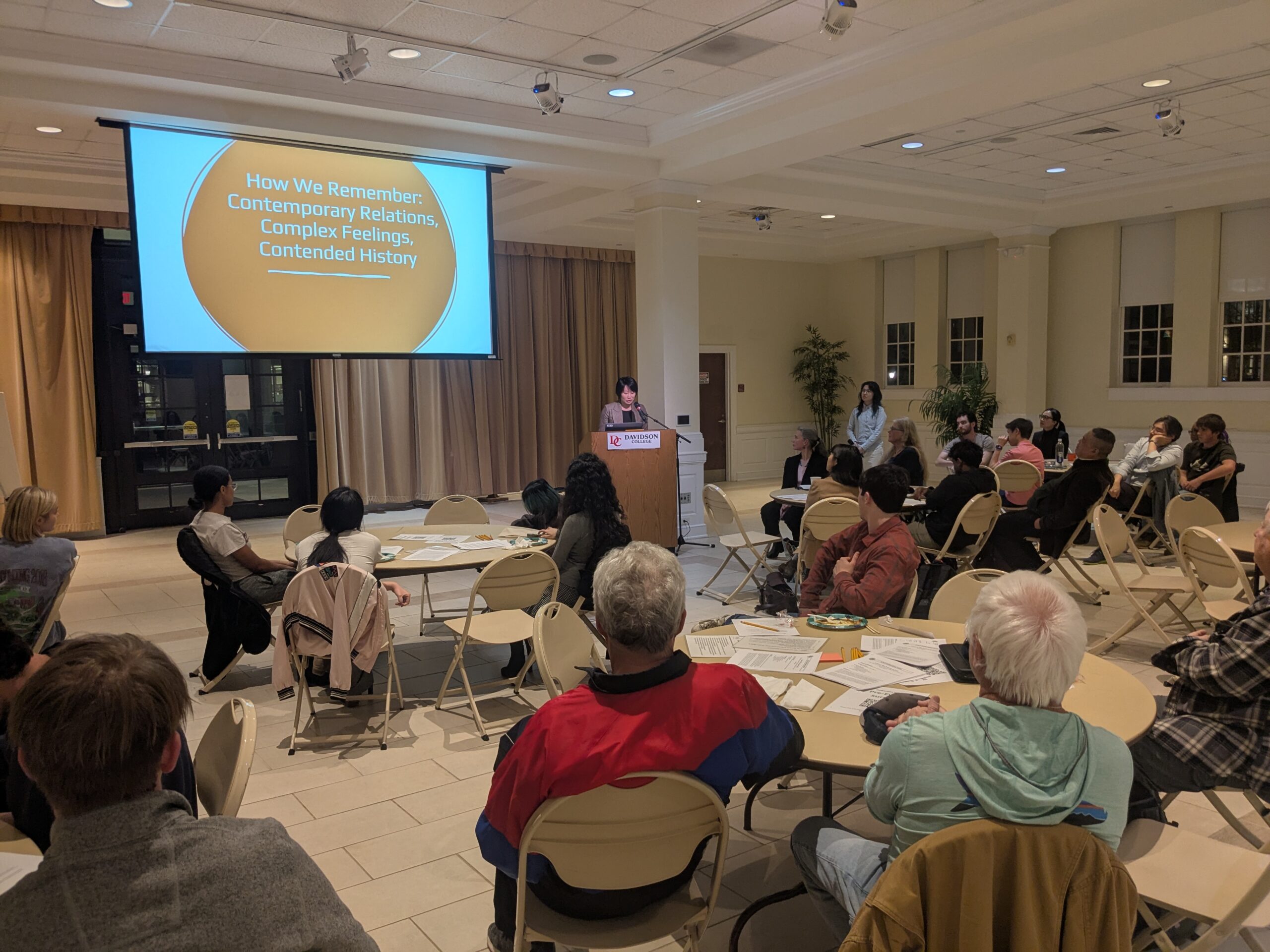
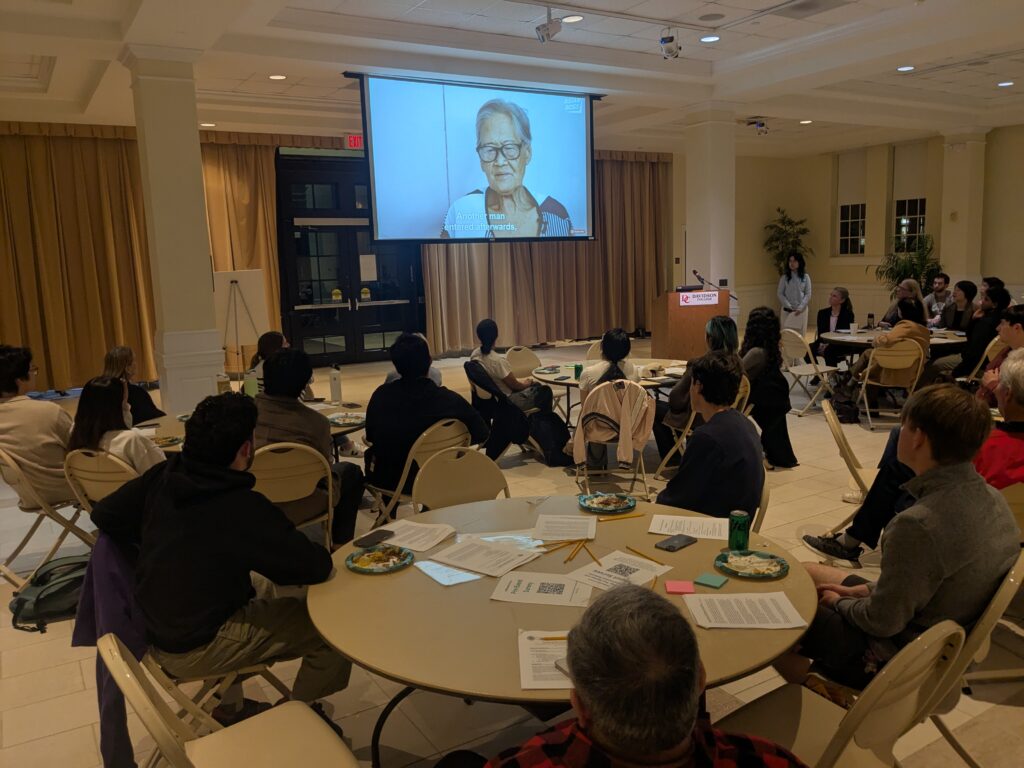
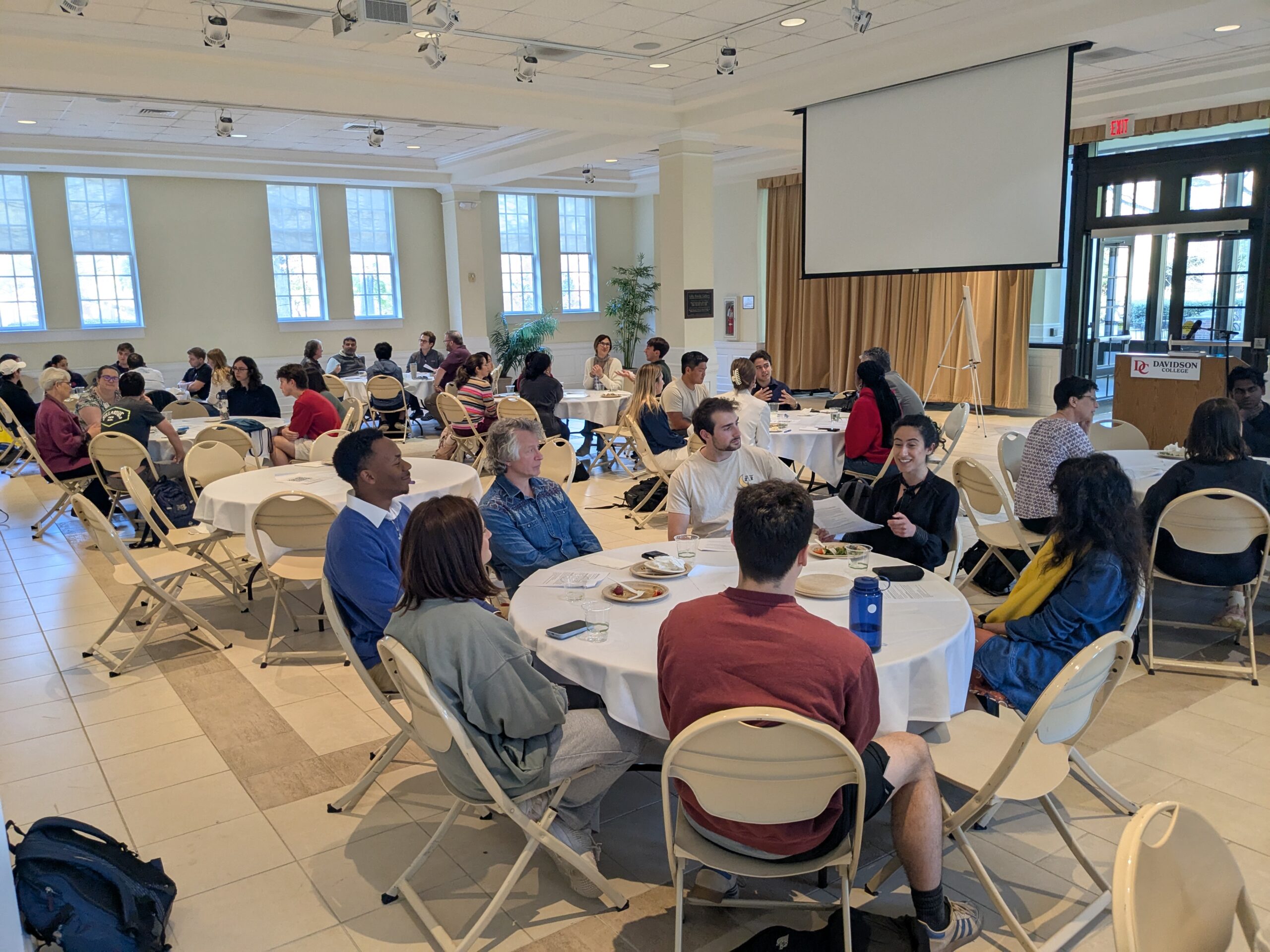
photo of deliberative event with screen in the background

Luna Noguchi ’25 (DCI Fellow)

On March 5, the DCI invited students, faculty, and staff together to a forum entitled “Lessons of War, Prospects for Peace: What should we say about the legacies of World War II in the Asia-Pacific region?” It served to provide some historical background for the Ginkgo trees planted in Spring 2024 between Chambers, Wall, and the Library. Co-sponsored with the History Department, East Asian Studies Department, Political Science Department, and the Office of the Vice President of Academic Affairs (VPAA), the event presented the history of World War II in the Asia Pacific with attention to historical controversies, while encouraging reflection on the universal human cost of war beyond regional or political divisions. 

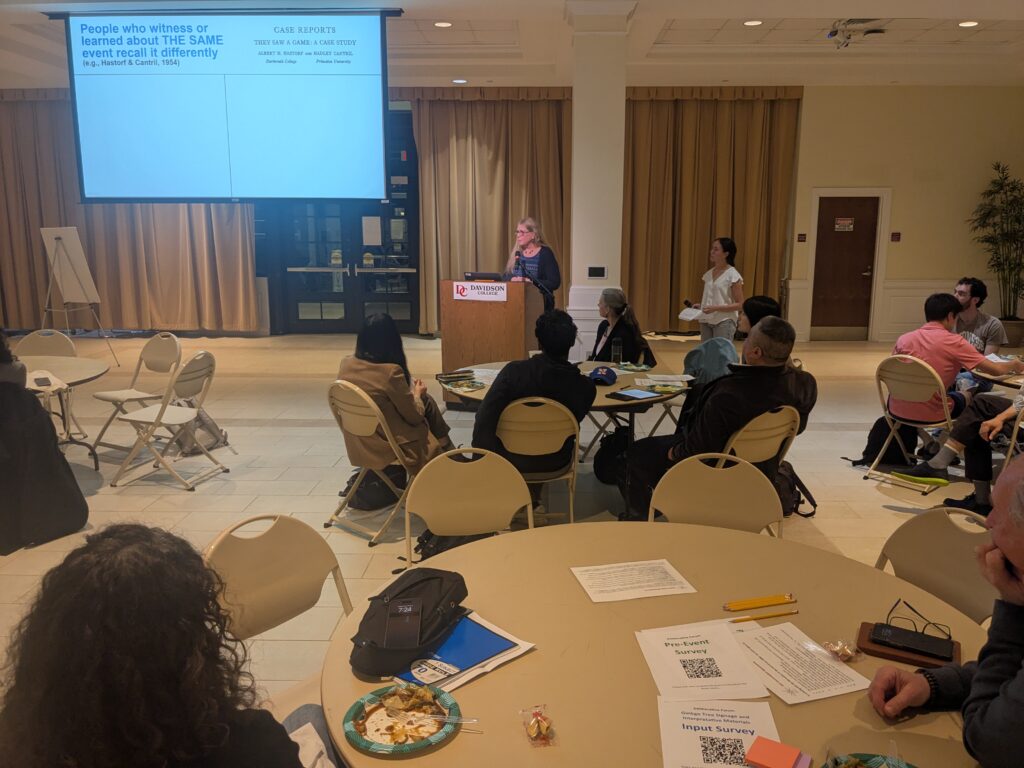
photo of Dr. Multhaup presenting

The Ginkgo trees were contextualized with informative presentations from Dr. Kristi Multhaup, Dr. Dáša Mortensen, and Dr. Keren Zhu. Dr. Multhaup, whose research focuses on memory, outlined the lasting memory of WWII in the Asia Pacific and her initiative to bring the Ginkgo trees to campus during her participation in the ASIANetwork in Japan in 2016. Dr. Mortensen provided a broad historical perspective of the war in the region, shedding light on the atrocities that occurred. Dr. Zhu gave a presentation on the causes and consequences of war through an international relations perspective. The presentations provided participants with a nuanced and inclusive understanding of the complexities of war. Participants also had the opportunity to watch a compilation of testimonials provided by survivors of WWII from across the Asia-Pacific region in a video created by Keya Zhou ’25, one of the event’s organizers.

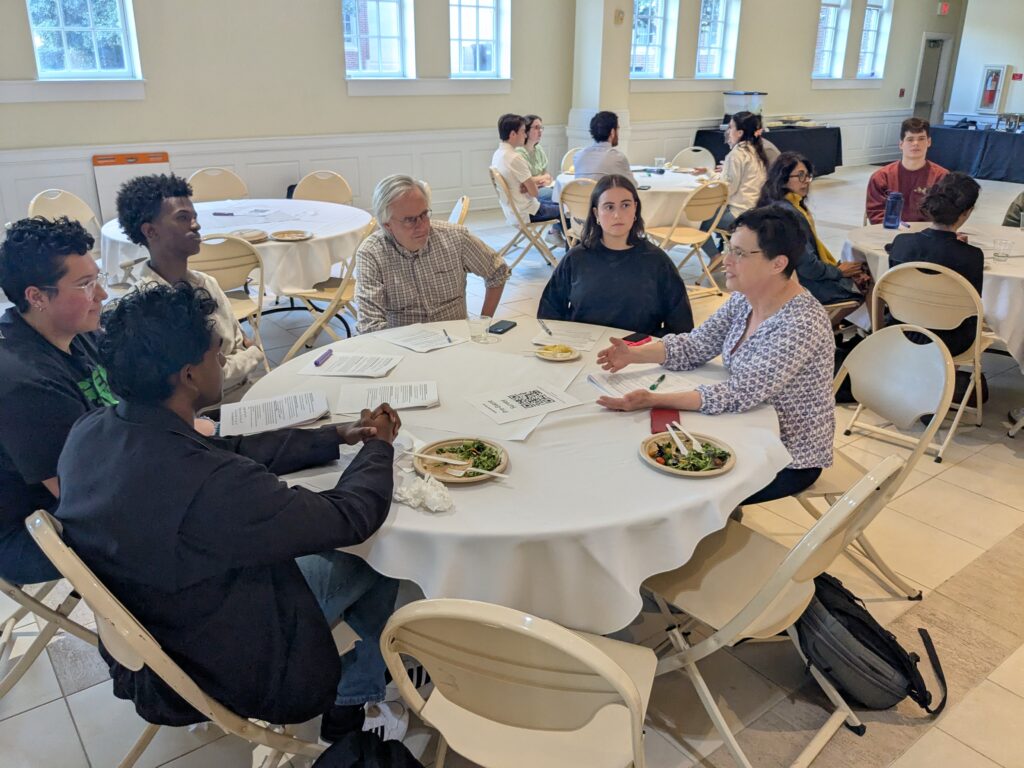
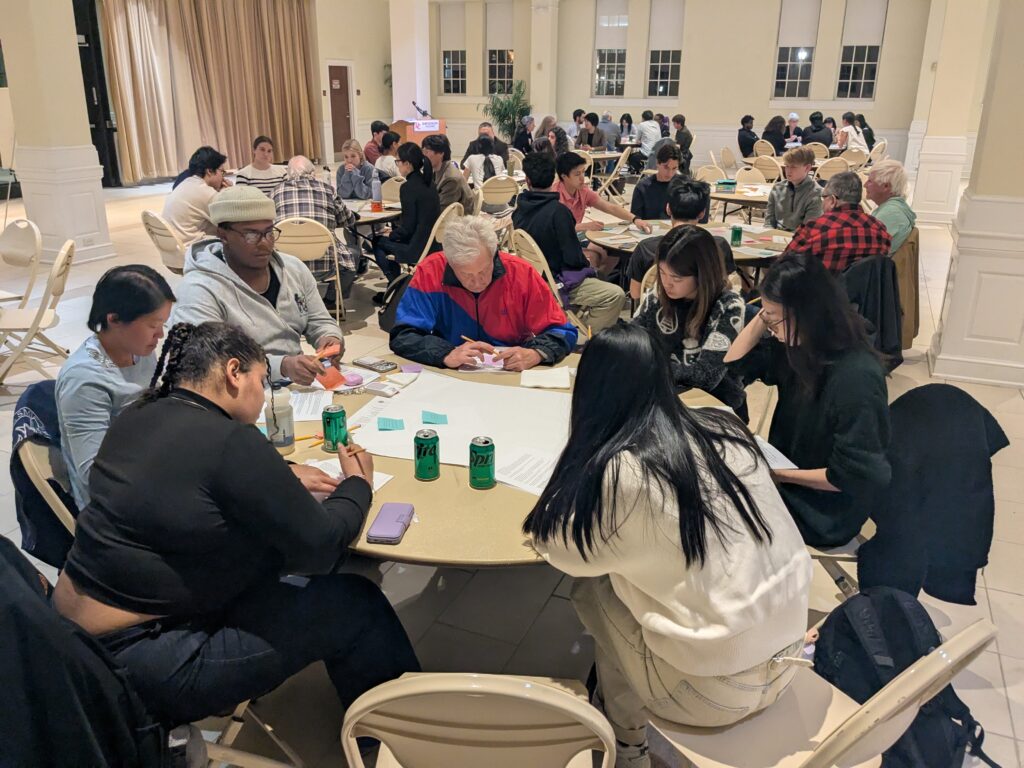
photo of tables at event

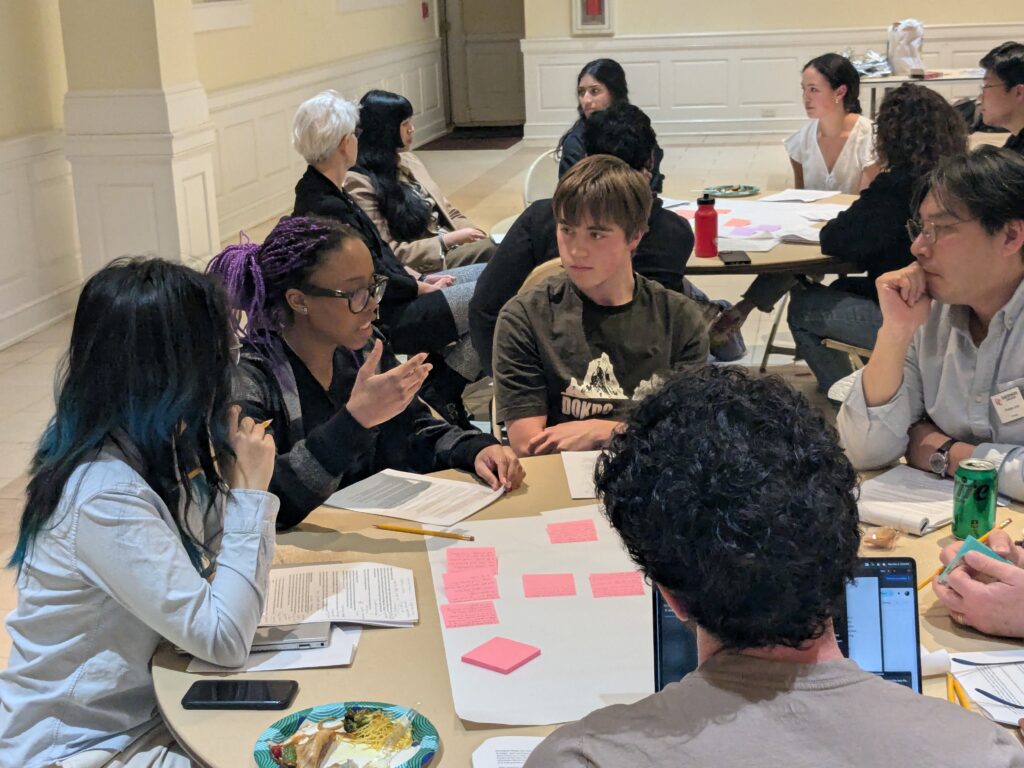
In the second half of the event, participants — over dinner provided by local pan-Asian restaurant Sabi with support from the VPAA’s office — engaged in deliberations facilitated by DCI Fellows and guided by a deliberation guide (see below) developed by the event’s organizing team. The goal was to discuss the legacies of WWII in the Asia Pacific and foster meaningful conversation about the inhumanity of war’s moral atrocities. The forum was also intended to generate ideas for interpretive materials for the Ginkgo trees. As the discussions proceeded, fellows asked participants to write their ideas on post-it notes, stick them to a large sheet of paper, and explain their thought processes. Fellows made notes on the paper and moved the post-it notes around to indicate shared conclusions. Online participants shared their thoughts using Zoom’s whiteboard function in their breakout rooms.

Over 35 Davidson students, faculty, staff, community members, and alumni attended the event (24 in person and 14 online), and they included participants who had ties to countries throughout the region. The organizing team, which consists of Keya Zhou ’25, Luna Noguchi ’25, Flo Moser ’26, Romeo Norris ’27, Casey Scheiner ’28, Lily Ogawa ’28, and Dr. Graham Bullock, is currently in the process of collating and synthesizing the comments and ideas from both the post-it notes and submissions made to an anonymous online form that was shared with the participants. They will incorporate this input from the Davidson community into a proposal for how to introduce and contextualize the Ginkgo trees that have been planted on campus. Stay tuned for more info coming soon!

DCI-WWII-in-the-Asia-Pacific-Deliberation-Guide

Filed Under: DCI Posts, Events, Fellow Posts

A Deliberative History Forum: The Power of Historical Narratives and Contested Histories

April 4, 2025 by TBC Takougnadi

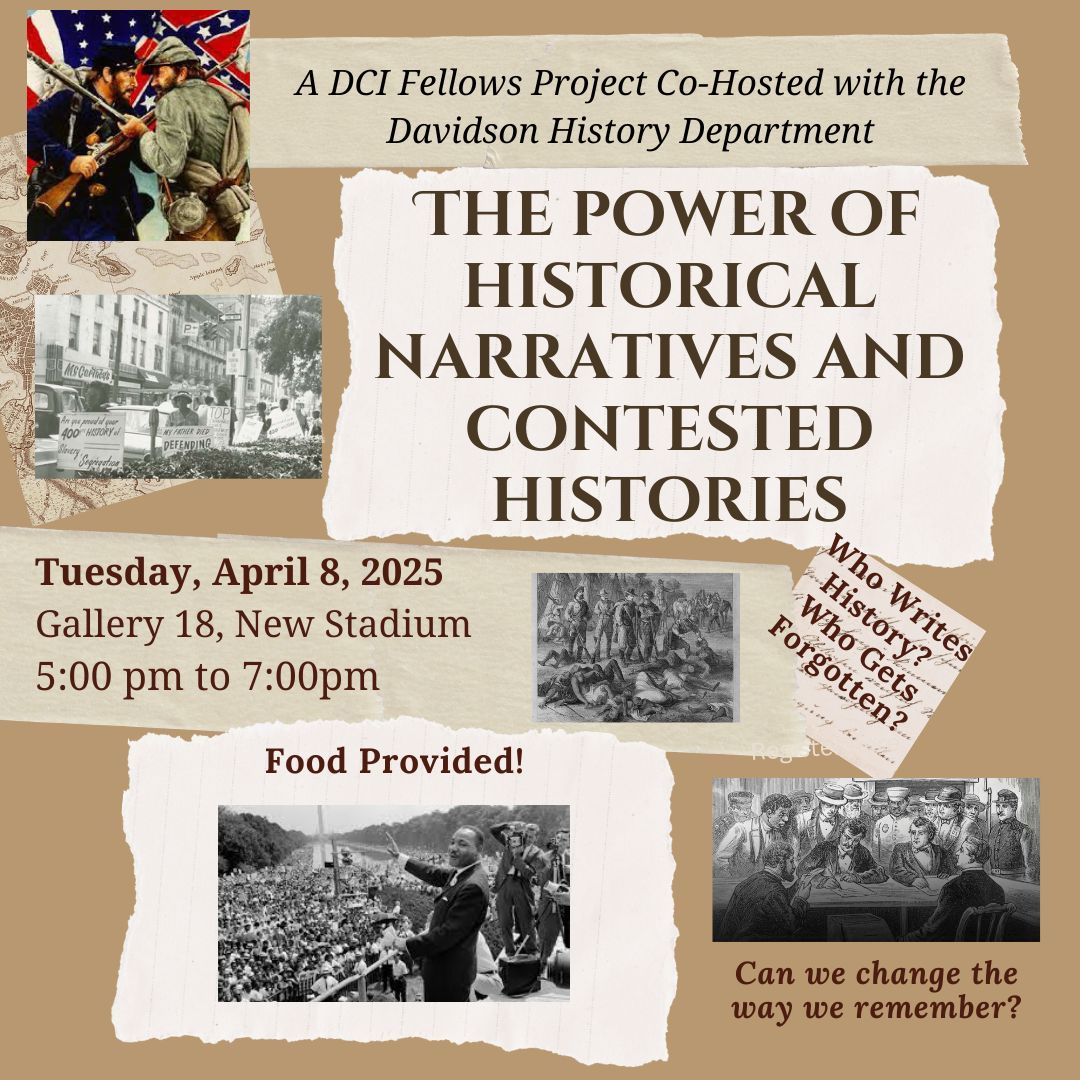
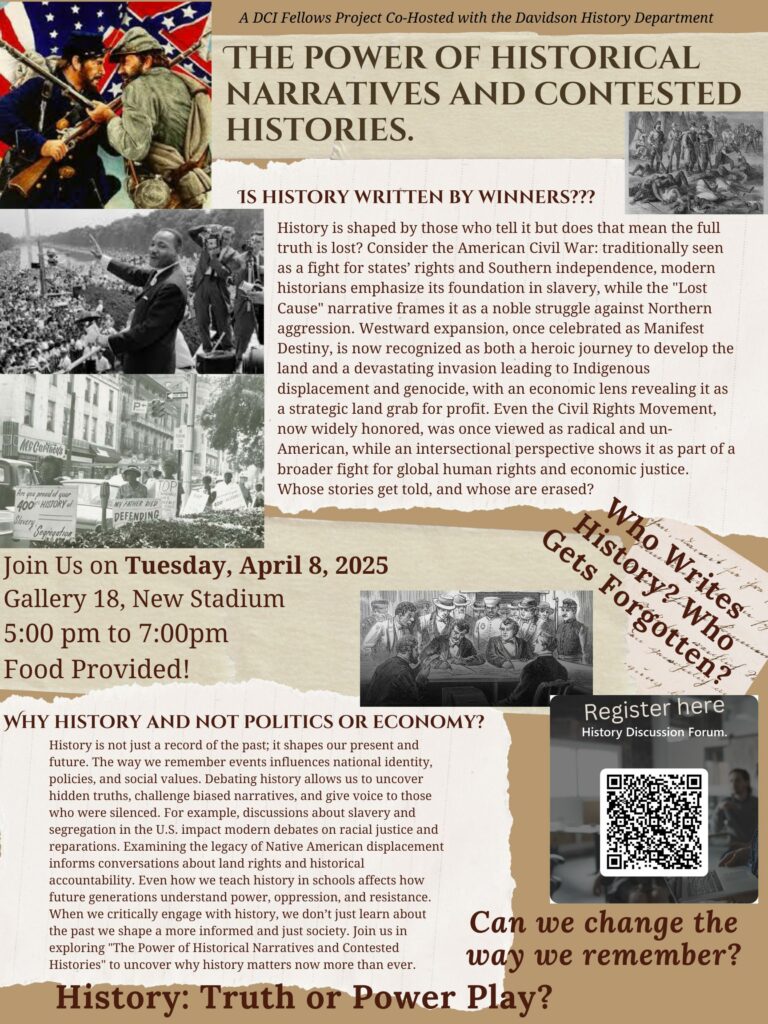
Poster for Deliberative History Forum

DCI Fellow Bosisso Charles Takougnadi ’27 (TBC)

History is not just a record of the past, it is a battleground of memory, identity, and power. The stories we tell about where we come from shape who we are, how we understand justice, and what kind of future we imagine. Yet history is rarely a singular, uncontested truth. Different communities, scholars, and political forces often clash over whose narratives are centered, whose voices are amplified, and whose experiences are erased. 

At Davidson College, we have a unique opportunity to engage in this vital conversation. On April 8, 2025 from 5 pm to 7 pm in the New Davidson Stadium’s Gallery 18, we invite students, faculty, and community members to join a critical discussion titled “The Power of Historical Narratives and Contested Histories.” This event is a deliberation project being organized by DCI Fellow Bosisso Charles Takougnadi ’27 (TBC) in collaboration with the History Department and the Deliberative Citizenship Initiative. It will feature insights from distinguished professors Jonathan Berkey, Jakub Kabala, Hilary Green, Dáša Mortensen, and John Wertheimer, who will explore how historical narratives are constructed, challenged, and reclaimed. You can register here.

 Why Does This Conversation Matter? 

 1. History Shapes Our Present and Our Future 

History is more than the past; it actively informs our laws, policies, and social structures. When certain narratives dominate while others are suppressed, the consequences are real. Consider: 

How do textbooks frame (or omit) slavery, colonialism, or Indigenous displacement? Why do some historical figures become national heroes while others are forgotten? What happens when marginalized communities reclaim their own histories? 

These questions matter because they determine whose struggles are acknowledged, whose grievances are legitimized, and whose futures are prioritized. 

 2. Contested Histories Reveal Power Dynamics 

As Professor John Wertheimer will discuss, the old saying that “history is written by the victors” is only partly true. While dominant groups often control official narratives, marginalized communities have always resisted, reinterpreted, and rewritten history. Professor Wertheimer will draw from U.S. legal history to show how contested narratives don’t just reflect power they can create it, shaping legal decisions, public memory, and even the outcomes of social movements. 

 3. Silenced Histories Can Be Reclaimed but Not Without Struggle 

One of the most powerful acts of resistance is the recovery of erased histories. Professor Hilary Green will examine how African American communities developed communal archival practices to counter the intentional silencing of their past. Even after the Civil Rights Movement, recovery efforts were faced and still face fierce opposition. Today, projects uncovering suppressed histories (from Tulsa’s Black Wall Street to Indigenous land dispossession) are met with political backlash, proving that historical narratives remain deeply contested. 

 4. Global Perspectives Enrich the Conversation 

This discussion is not limited to U.S. history. Professors Jonathan Berkey, Jakub Kabala, and Dáša Mortensen will bring transnational perspectives, exploring how historical narratives are constructed, weaponized, and reinterpreted across different cultures and eras. From colonial legacies to post-war memory politics, these comparisons remind us that the struggle over history is a global phenomenon. 

Why Should You Participate? 

This is not just an academic exercise. Whether you are a student, educator, or community member, history affects you. Here’s why your voice matters in this discussion: 

Students: You are inheriting a world shaped by these narratives. Engaging critically with history empowers you to question, challenge, and rewrite dominant stories. 

Educators: How we teach history influences the next generation’s understanding of justice and identity. 

Community Members: Local histories from Davidson’s own past (like slavery) to national debates are part of this conversation. Your perspective is essential. 

 Join Us 

We need diverse voices in this discussion. Come listen, learn, and contribute as we explore the following existential questions: 

How do historical narratives reinforce or challenge power? 

What does it mean to “reclaim” silenced histories? 

Why are some histories still so fiercely contested today? 

How do historical narratives of victimhood shape political legitimacy and moral authority in the Israel-Palestine conflict, and in what ways does the comparison to the Holocaust influence global perceptions and policy responses?

Event Details: 

📅 Date: April 8, 2025

📍 Location: Gallery 18, new football stadium.

🕒 Time: 5 pm to 7 pm

Food will be provided!

This is more than a lecture, it’s a dialogue. Let’s confront the past to better understand the present and shape a more just future. 

Help us with our planning by registering in advance at the link below. Once you register, we will send you a deliberation guide that will provide useful background for the discussion.

Deliberative History Forum Registration Link

And see the poster below for more information:

Full poster for History Forum

Filed Under: Announcements, Fellow Posts

Deliberation vs. Debate: How Our Forms of Discourse Shape How We Engage

March 4, 2025 by Lily Ogawa

Lily Ogawa ’28 (DCI Fellow)

As someone who has participated in debate tournaments in high school, I had signed up to the DCI in college with the expectation that I would be able to hear people’s diverse perspectives and see them debate about current events. The more I learned about deliberation, however, I realized how different it is from debate. Deliberation is more applicable to our society now in so far as that deliberation seeks to find a solution while debates aim at finding a winner. In the deliberations I have led as a facilitator on free speech and college campus protests, oftentimes, people shared different views and there seemed to be no one “real” winner.

In high school, I debated a wide range of topics from U.S. aid to the Yemen crisis to the cost and benefits of building a high-speed rail in the U.S. In all of the debates, however, there were only two sides: for and against. While there were still different angles in which you could debate for one side, there was no side arguing for a middle-ground. This made it easier to research and frame my arguments, but as I researched, I realized that by eliminating the middle ground, it removed the nuance of the topic. Many of the articles I had read highlighted how, for instance, the U.S. should send aid to a certain area and not in weapons, which was hard to defend against if I could only argue for the “against” side in the topic of whether the U.S. should aid countries. It was unrealistic to frame the whole debate in two sides when in reality, many had moderate views that did not fully align with one particular side.

Debates are often entertaining because there is a winner. While it can be beneficial to weigh the pros and cons to determine what side you are more persuaded by, having one winner can also simplify the complexity of the issue. There is the added pressure that there must be a winner when in reality, both sides can have valid arguments and can be right depending on the specific context. This is not to say that debates are a harmful sport and that the competitive nature of it is not good. In fact, I still enjoy watching debates and there are benefits to debates that other activities do not provide, but it is important to also remember the pitfalls that can come with solely relying on debates to solve the issues in our society.

Deliberation allows people to share their own views without the restriction of having to choose a particular side. In one of my D Team meetings, for example, I facilitated a deliberation about campus protests. I was able to hear the participants’ background with college protests, and many of them had a view that was in the middle between for and against college protests. They explained that their view can change depending on the situation. Some argued that they cannot condone violent protests, but peaceful ones can bring about good change. Because of the fair and peaceful format of the deliberation, these nuanced answers were able to be captured. There was no pressure for a person to only respond to the topic with a yes or no answer.

Deliberation can change the way people engage in current issues and allow people to reach a solution without determining a specific winner. While debate has its own benefits of engaging people and training people to come up with different arguments, there are certain perspectives that cannot be captured in a debate. This is when deliberation comes into the picture and creates a space where people can constructively share their thoughts.

Filed Under: Blog Posts, Fellow Posts

“A Thought-Provoking Experience:” The DCI’s Deliberative Forum on Religion in Public Life

March 4, 2025 by Graham Bullock

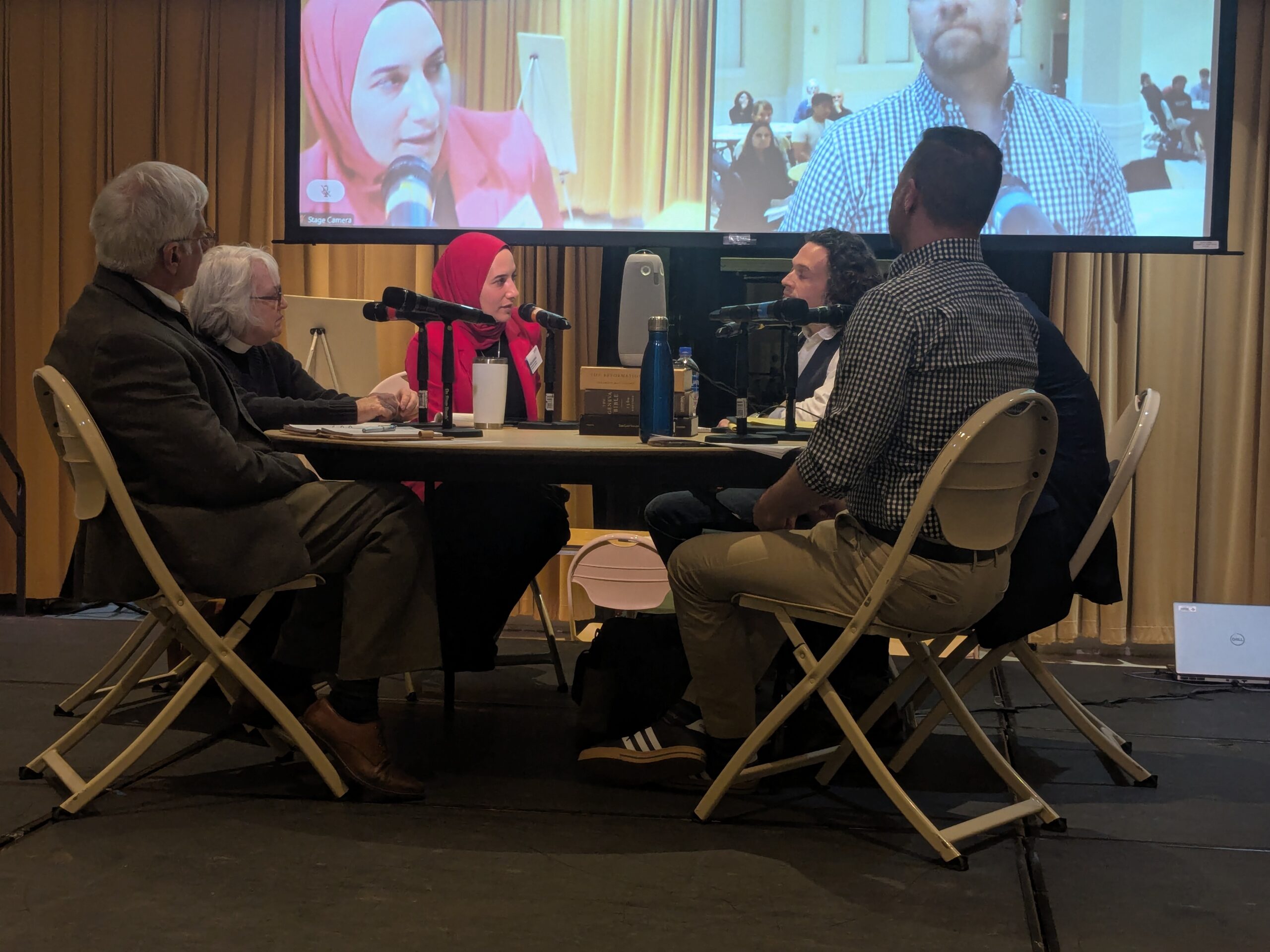
photo of panelists sitting around a table with a screen in the background.

On February 13, 2025, in collaboration with Davidson College’s Chaplain’s Office and Religious Studies and Political Science Department, the Deliberative Citizenship Initiative hosted a Deliberative Forum on Religion in Public Life. Attended by over 150 people, approximately half in person and half online, the event began with a roundtable discussion of five panelists with a diverse set of experiences and perspectives related to the topic at hand. They included Robert Destro, Professor of Law at Catholic University; William McKenith, Pastor at Reeves Temple A.M.E. Zion Church; Hadia Mubarak, Associate Professor of Religion at Queens University; Nancy Petty, Pullen Memorial Baptist Church; and Brian Silva, VP of Outreach at Americans United for Separation of Church and State.

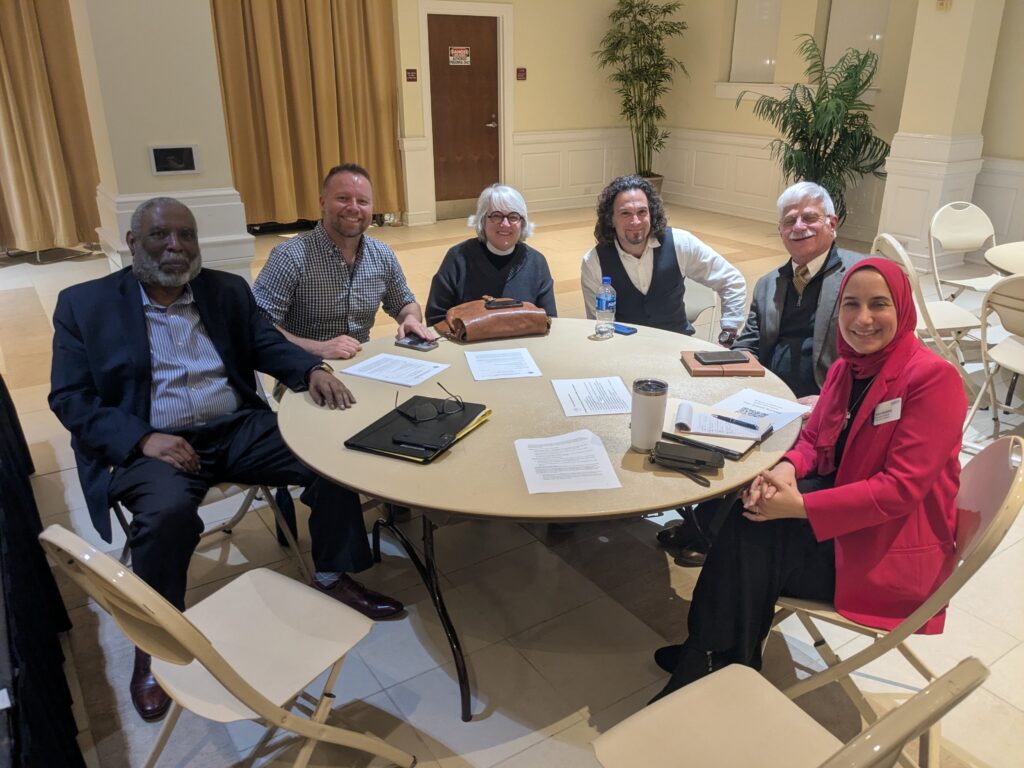
panelists smiling for the camera

Moderated by Davidson College Associate Professor of Writing Jason Blum, the panelists covered a wide range of questions, including whether religion should have special legal status and the tensions between religious autonomy, equality, and anti-discrimination efforts. Following the panel, DCI-trained facilitators guided audience members through small group discussions that explored the topic further, building on the deliberation guide that was shared beforehand and at the event.

Participants sitting around a table talking

Feedback about the forum was very positive — nearly 90% stated in a post-event survey that they were very satisfied or satisfied with their small group discussion and would recommend the experience to a friend. As one participant wrote:

I left the discussion on Religion in Public Life with an appreciation for the ways in which religion intersects with public life and a greater understanding of the challenges and opportunities that arise when trying to maintain respect for religious diversity in the public square. It was a thought-provoking experience that not only broadened my understanding but also fostered a sense of community and mutual respect among participants.

participants sitting around a table talking

Check out the deliberation guide and recording of the panel discussion below:

DCI-Religion-in-Public-Life-Deliberation-Guide-2025

Filed Under: Events

  • « Go to Previous Page
  • Page 1
  • Interim pages omitted …
  • Page 24
  • Page 25
  • Page 26
  • Page 27
  • Page 28
  • Interim pages omitted …
  • Page 75
  • Go to Next Page »

Footer

Blog Post Categories

  • Announcements
  • Blog Posts
  • DCI Posts
  • Events
  • Faculty Posts
  • Fellow Posts
Image of a compass superimposed by the text "Deliberative Citizenship Initiative" and "Davidson College." Clicking on this image leads to the Initiative page.

Recent DCI Blog Posts

  • We Tried to Fix Jubilee’s “Middle Ground” – Here’s How It Went
  • A Case for Deliberation in the Natural Sciences
  • Welcoming New Staff to the DCI and DCN
  • Facebook
  • Twitter
  • Instagram
  • LinkedIn


Copyright © 2026 · Infinity Pro on Genesis Framework · WordPress · Log in