• Skip to main content
  • Skip to footer

Deliberative Citizenship Initiative

Building Democracy One Conversation at a Time

  • The Initiative
    • Programs
      • Deliberation Across the Curriculum
      • Deliberation on Campus
      • Deliberation in the Community
      • Research on Deliberation
    • Motivations
      • Why Deliberative Citizenship?
      • Why Davidson? Why Now?
    • Who’s Involved?
      • DCI Fellows Cohorts
        • 2025-2026 Fellows
        • 2024-2025 Fellows
        • 2023-2024 Fellows
        • 2022-2023 Fellows
        • 2021-2022 Fellows
        • 2020-2021 Fellows
      • DeeP Collaborative Cohorts
        • 2024-2025 DeeP Collaborative Faculty
        • 2023-2024 DeeP Collaborative Faculty
      • Advisory Council
    • History
      • What Sparked the Initiative?
    • Key Deliberative Dispositions
    • Frequently Asked Questions (FAQ)
    • Annual Report
  • Get Involved!
    • Participate in a Forum
    • Join a D Team
    • Become a Fellow
    • Take Courses
    • Get Training
    • Come to Guest Lectures
  • Events
    • Upcoming Events
      • 250th Anniversary Deliberative Forum Series on American Values
    • Past Events
  • Connections
    • The Deliberative Citizen: The DCI’s Monthly Newsletter
    • Efforts on Campus
    • Efforts in the Community
    • Efforts Elsewhere
    • Readings and Resources
      • DCI-Published Guides
      • DCI Guide to One-on-One Conversations
      • How to Disagree
      • Demonstration of Facilitation Styles
      • Deliberative Pedagogy Mini-Course
    • How We Can Help: DCI’s LET’S DELIBERATE! Partnership Opportunities
    • DCI in the News
  • DCI Blog Posts
    • Recent Blog Posts
    • All Blog Posts

The DCI Blog

DCI Deliberation Facilitator Training Kicks Off Hurt Hub Innovation Week

August 18, 2022 by Carla Cole Leave a Comment

The DCI’s Deliberation Facilitator Training Program will kick off Innovation Week for the Jay Hurt Hub for Innovation and Entrepreneurship at Davidson College. This year’s theme is “Watt Makes You Come Alive?” and events will take place all week beginning September 11th.

Innovation Week will include events, curiosity pop-up booths, programming, and opportunities designed to promote and celebrate innovation and entrepreneurship. The week will end with a community block party. The Hurt Hub brings together innovators and entrepreneurs in the Davidson College community and Lake Norman area. Visit the Hurt Hub’s website to register for events!

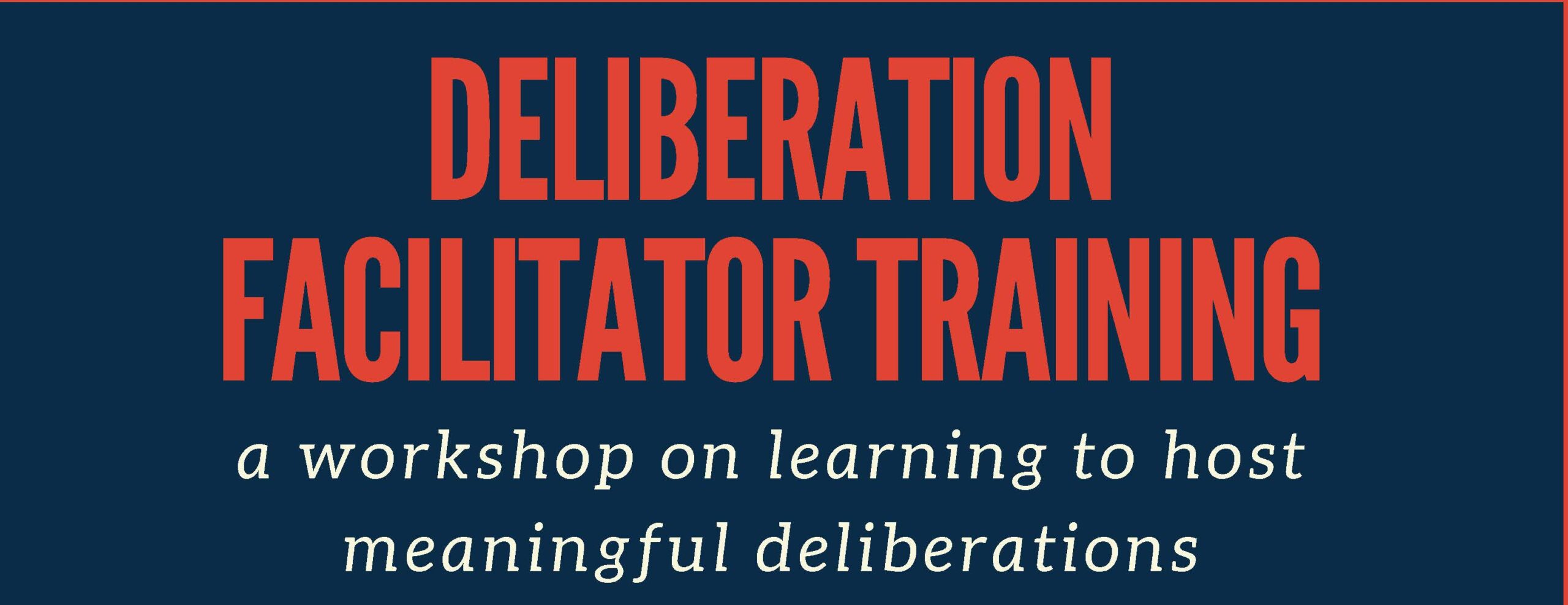
The DCI’s Deliberation Facilitator Training Program will equip participants with the knowledge and skills to facilitate difficult conversations across difference. The training will help participants host more vibrant, meaningful, and constructive interactions in their organizations, with their friends and family, and in their communities. The two-part training takes place Sept. 11 and Sept. 17 from 1:30-5:30 pm (both sessions required). Please register here by Sept. 6.

This hands-on, interactive workshop will train participants in innovative techniques that will improve their ability to facilitate difficult discussions about political and social issues among people who may have very different backgrounds, values, and opinions. Although such facilitation can be challenging, it is increasingly needed in a world that is facing a host of immense challenges that require people to come together to solve issues collaboratively. Well-trained facilitators can help us honestly, respectively, and productively engage with these challenges and seek out innovative solutions.
Filed Under: Events Tagged With: facilitation

Join a Fall D Team!

July 26, 2022 by Carla Cole Leave a Comment

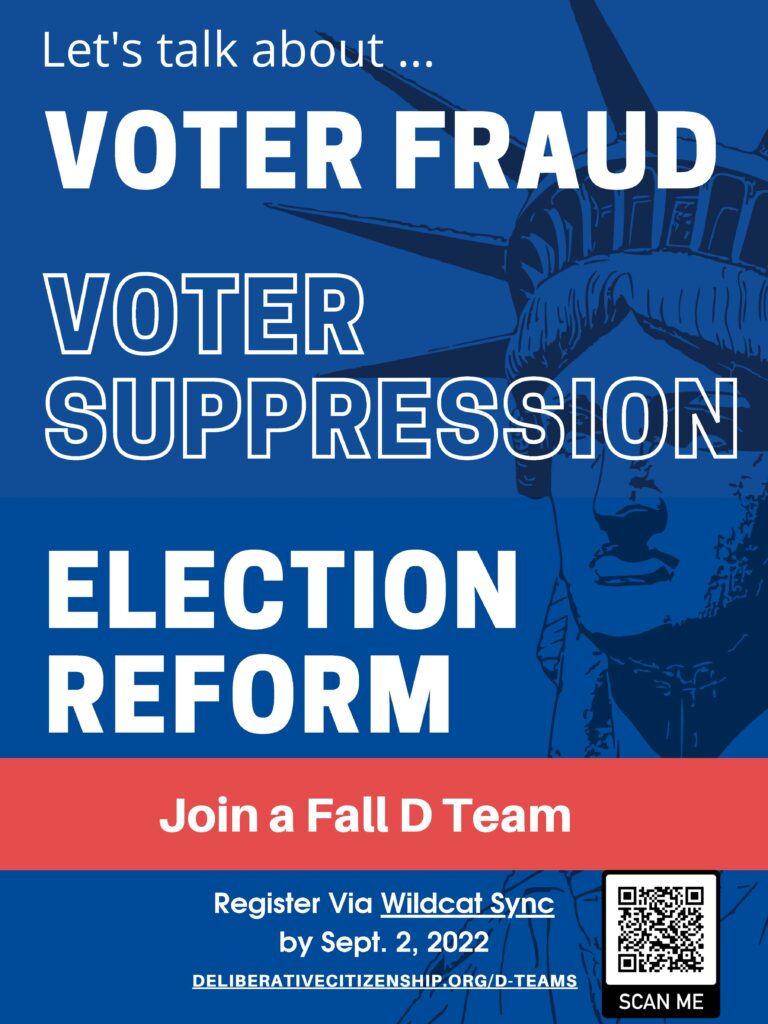
The Deliberative Citizenship Initiative is committed to enhancing the quality of our political discourse with one another through deliberative efforts that span the Davidson community and beyond. One of the ways the DCI aims to achieve this goal is through its Deliberative “D” Teams. D Teams are small groups of 6 to 10 people who meet regularly to discuss important but difficult issues facing society.

Concerns surrounding elections have heightened in recent years as Americans worry about voter fraud and suppression, election security and accessibility, and the fairness and inclusivity of the American electoral system. Various states have enacted stricter voting laws while other have attempted to expand access to the ballot box. As the 2022 elections approach this fall, the DCI’s D Teams will focus on the issues, pressing challenges, and possible solutions related to voting and elections in America.

Over three sessions, D Teams will deliberate about how we can make voting more accessible, more secure, and more fair. The first session will focus on whether we should make voting more accessible through early voting, voting by mail, an increased number of polling places, and more. The second D Team meeting will examine election security and whether we should reduce concerns about voter fraud through poll watching, use of better technology, voter ID laws, and other strategies. The third and final session will address whether we should improve our elections by implementing reforms such as ranked choice voting, proportional representation, and the abolition of the electoral college.

voter d teams

The DCI seeks individuals with diverse perspectives to participate in D Teams to share their thoughts and ideas for broadening our understanding of one another’s opinions and addressing the challenges we face – everyone’s voice is welcome and needed! Teams will meet either online or in person every three weeks from September to November, for a total of three meetings during the fall semester. In order to build and maintain a sense of community and trust within each team, we ask that participants commit to attending all three sessions.

To learn more about this opportunity, visit the DCI website. To register, please sign up here by Sept. 2, 2022. And feel free to share this information with your family, friends, colleagues, and neighbors — anyone who you think might be interested in joining!

Filed Under: Announcements Tagged With: D Teams

“What does the Bible Say?” Deliberating Across Difference in a Course on the Bible and Modern Moral Issues

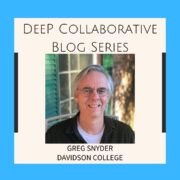
July 19, 2022 by Greg Snyder Leave a Comment

The Deliberative Pedagogy (DeeP) Faculty Collaborative consists of 15 faculty from Davidson College and five other Associated Colleges of the South institutions who are committed to learning and implementing new ways to improve and deepen the quality of their class discussions. Throughout the 2021-22 academic year, these faculty, who come from a wide array of disciplines, studied and discussed different deliberative pedagogy methods, shared their ideas and questions with one another, and worked to embed deliberation in their classrooms. In this special blog series, members of the Collaborative describe and reflect on their experiences developing and teaching their deliberation-involved courses.

Having participated in the DCI program since it was launched here at Davidson, I looked forward to putting lessons learned into practice in a classroom setting. I’ve done theatrical, debate-like experiments in the past, but with the deliberative model brings with it a whole toolkit of methods and approaches.  A good opportunity presented itself with REL 236 The Bible and Modern Moral Issues, which is by nature more topical and contemporary than any of my other courses, which tend to be historical in nature. 

The course began by looking at some issues that we think of as non-controversial: the practice of human enslavement and colonialism. Of course, back in the day, these issues were hotly debated and the Bible was brought in on both sides. We looked at the arguments pro and con, the goal being to show students that the Bible doesn’t deliver any simple message on most ethical issues, and that the phrase, “the Bible says…” is quite problematic from a hermeneutical standpoint. 

We then looked at the Bible and homosexuality.  I decided to put this at the front end of the course because I did not want to treat it as a controversial issue. If there was an LGBTQ student in the course, they shouldn’t be made to feel as if their identity was being debated. This turned out to be somewhat complicated. There were a good number of conservative Christian students in the course for whom the issue was not settled at all. For them, it was just obvious that homosexuality was wrong and that the Bible condemned it. Even ten years ago, when I last taught the course, I hadn’t encountered this dynamic and it came as a surprise. I found this illuminating: the basic facts on the ground were not as expected when it came to this issue.

I was aided in thinking about this by the chapter, “Framing and Selecting Issues,” in The Political Classroom, one of the supplementary texts for the course that members of the DeeP Collaborative also read and discussed together. That chapter gives no simple guidance, but it does provide useful concepts and examples for thinking through the decision of whether to approach an issue as controversial or not.

We spent three and a half weeks learning about and practicing the process of deliberation, focused on three issues: 1) the Bible and Judaism, 2) the Bible and the environment, and 3) the Bible and abortion. We imagined ourselves as students at the Fictional Liberal Arts Bible College of the South (FLABCOS) confronting problems and policy questions as they arose. 

For purposes of illustration, here’s the first prompt. 

A group of students at FLABCOS has started a chapter of Jews for Jesus. They’ve taken to hanging around the local synagogue on the Sabbath passing out literature and trying to engage people in conversation about Jesus. Rabbi Schneerson confronts one of the students and asks them to stop. The student responds by saying that their faith requires them to do this, quoting Acts 4:12: “There is salvation in no one else, for there is no other name under heaven given among men by which we must be saved.” Another student brings up John 3:16: “God so loved the world that he gave his only Son, so that everyone who believes in him may not perish but may have eternal life.” A third student sounds a more ominous note: “it says right here in the Gospel of Matthew (27:25) that when Pilate was willing to let Jesus go, the crowd of Jews insisted that he be crucified, saying “let his blood be on us and our children!” (Mt. 27:25). But it also says in the Book of Acts (4:10-12) that God has graciously offered Jews forgiveness as long as they confess faith in Jesus. They end by referring the Rabbi to the Jews for Jesus website.  

The Rabbi sends a note to the President of FLABCOS, objecting to this student group and their aggressive approach to his congregation. He claims that FLABCOS should not be underwriting such a group (like student orgs at Davidson, the FLABCOS JFJ branch receives school money). The President of FLABCOS, Bob Johnson III, turns the issue over to the WDBS (What Does the Bible Say) Task Force.  

Your report to the president should include arguments on both sides of the issue, together with references to scripture and a policy recommendation. 

This last piece—the policy move—was one of the most helpful things tactics from the DCI experience. Ending with a joint statement or policy recommendation forces compromise and convergence. 

I conjured up a similar scenario with FLABCOS for the deliberation on environmentalism and that seemed to go well.

The deliberation on abortion coincided almost exactly with the leaked draft of the Supreme Court ruling on Hobbs and that raised the stakes considerably on that discussion. The fun fiction of FLABCOS seemed ill-suited to the gravity of the situation. We took some extra time to do additional readings to those listed in the syllabus. This deliberation was more fraught.  

At the end of the course, I had originally planned for students to take up a moral/ethical issue of their own choice, but I changed plans on hearing about an incident here on the Davidson campus. A Christian group had invited an assistant coach to address one of their meetings, but when it became clear that the coach was gay, the invitation was rescinded, because the national group of which the Davidson group was a chapter had a policy on the books that explicitly denounced same-sex sexual relations.  This led to a split within the group, with some students splitting off to form an alternative group. We took the opportunity to use this incident as the final occasion for deliberation. 

For their final project, I had students revisit the biblical materials and secondary readings we had consulted earlier in the semester and imagine themselves as a member of the Campus Community and Religious Life Committee, writing up a description of the event along with their recommendations for action, addressed to incoming president Doug Hicks. 

In general, we achieved a high level of frankness and fellow-feeling in this course, more than probably any other than I’ve taught here at Davidson in 23 years. I will definitely integrate deliberative elements into future courses.

Filed Under: Blog Posts, Faculty Posts

The Political Classroom in Practice: Roleplaying Deliberations in a Political Ecology Course

July 14, 2022 by Jessica Worl Leave a Comment


The Deliberative Pedagogy (DeeP) Faculty Collaborative consists of 15 faculty from Davidson College and five other Associated Colleges of the South institutions who are committed to learning and implementing new ways to improve and deepen the quality of their class discussions. Throughout the 2021-22 academic year, these faculty, who come from a wide array of disciplines, studied and discussed different deliberative pedagogy methods, shared their ideas and questions with one another, and worked to embed deliberation in their classrooms. In this special blog series, members of the Collaborative describe and reflect on their experiences developing and teaching their deliberation-involved courses.

One of the main aspects of deliberation in the classroom that I have returned to and explored throughout the process of adapting Political Ecology into a deliberation course and reflecting on this process in small and large group sessions with other ACS faculty, is an embedded tension in the idea of the political classroom. This tension rests, on the one hand, on the theoretical ideal of the political classroom as a deliberative space where students can voice all perspectives—as though each is equal and valid to one another. The readings we did for our deliberative pedagogy workshop emphasized the classroom as a “political” space, one that operates in service of producing citizens who can participate in democratic life by contemplating questions about how we should, or ought, to live.

My own research, and therefore the classes that I teach, grapple with how race, gender, and class shape what gets marked and classified as “other” and in so doing can produce a myriad of oppressions and marginal communities. I focus on how expert knowledge supports and justifies the categorization of legal or criminal practice in relation to the environment, and how colonial categorizations produced environmental and social struggles with which we now grapple. 

Classrooms, as one of many spaces of knowledge transmission, are inherently political spaces, because not only do they implicitly or explicitly assert what is normal, or standard, but they do so in service of maintaining order and disciplining bodies and practices in service of the state. Answering questions of should or ought therefore requires an implicit definition of what should not or what ought not, which tends to exclude those who are from specific groups and/or practice particular actions, denying them the necessary precondition of personhood so that they cannot participate in democratic processes.

To treat a classroom as a political space where questions of how we should or ought to live are weighed in a neutral manner seemed, initially, incongruent with the understanding that “Othered” people continue to be harmed both in the classroom and in institutions of higher learning, as well as in the political sphere where they might attempt to participate in the democratic life of citizens, and therefore requires a breakdown of neutrality—at least from one of my perspectives as a scholar-activist. 

From the very beginning of DeeP, I was anxious about how I would balance and navigate this tension, how my decisions might shape the classroom deliberations, and how they might affect whether and/or how students feel included, safe, and comfortable enough to actively participate and engage with opposing, and perhaps even dehumanizing, ideas. I was committed to DeeP, however, because I do strongly believe that deliberation can serve as a means for instilling, if nothing else, a sense of empathy, connection, and care for others and therefore, it has the potential to further inclusivity and engagement in the classroom, while also producing individuals who can participate better in democratic processes. 

I attempted to address my concerns by choosing case studies that were written by scholars who were trained to understand the operations and manifestations of power, as they are shaped by and as they shape race, class, and gender and sexuality. I also did a lot of reverse engineering so that I focused on the objectives of the assignments, rather than just on the content of the case studies themselves. 

In so doing, I decided that I needed students to do the following: 1) examine and apply the theories we were learning in class that would allow them to understand processes of marginalization; 2) understand how processes of marginalization are implicated in the production of environmental harms or poor resource management practices; 3) how practices designed to bolster community participation can result in either better representation or worse representation, depending on who is “at the table”; and 4) develop well-researched stakeholder positions that are supported by the published literature, challenge their personal perspectives, and respect the complexity and nuance of stakeholder groups. 

Throughout the semester, my students consistently remarked that the deliberation role playing exercises were their favorite activities. Their engagement with the course increased significantly during these weeks and they also played their stakeholder positions out to their most logical conclusions, while also engaging with more nuanced and complex perspectives. Rather than treat their stakeholders as a homogenous block with a single perspective, they explored the at-times contradictory positions of those who might be grouped into a single stakeholder group and had to negotiate outcomes accordingly. What does it mean for an elected leader of an indigenous group to have to navigate different factions within their constituent group that are advocating for different policy options? How does one resolve the tensions between poaching and legal hunting given the colonial and racialized legacies embedded within historical and contemporary conservation practice? How might access to potable water be a human right and governed as a commodity within a market system?

Overall, I think it was a success. I still have some reservations about these tensions, but insofar as I am clear about the objectives of the assignments, as well as the specific skillsets that I want students to walk away from the class having developed, I was pleased with their progress, demonstrated learning, and engagement. I will continue to develop deliberative role-playing exercises in Political Ecology, creating a “bank” of case studies that I can draw on from year to year, and potentially, even begin to co-produce with students. I may also begin to utilize them more in my introductory core course, Environmental Social Science, as a way to begin to bridge environmental studies, policy, and critical race, class, feminist, and gender and sexuality theory.


Filed Under: Blog Posts, Faculty Posts

DCI Offers Deliberation Facilitator Training!

July 13, 2022 by Carla Cole Leave a Comment

Want to learn how to have productive, meaningful conversations about difficult topics and help others to do the same? The Deliberative Citizenship Initiative is excited to host a two-part Deliberation Facilitator Training to help participants learn specific deliberation and facilitation skills. It is open to all Davidson students, faculty, staff, and members of the wider community.

The training will take place at Davidson College on Sept. 11th and Sept. 17th from 1:30 to 5:30 pm, and both sessions are required for completion of the program. Upon completion of the program, participants will be certified DCI Facilitators and eligible to facilitate DCI deliberations (and be paid for doing so).

This hands-on, interactive workshop will train participants in techniques that will improve their ability to facilitate difficult discussions about political and social issues among people who may have very different backgrounds, values, and opinions. Although such facilitation can be challenging, it is increasingly needed in a world that is facing a host of immense challenges that require people to come together to solve issues collaboratively. Well-trained facilitators can help us honestly, respectively, and productively engage with these challenges and seek out innovative solutions.
This 8-hour training, spread across 2 days, will equip participants with skills and knowledge to:

  • Facilitate difficult discussions
  • Organize and host deliberations
  • Encourage deliberative dispositions and humane instincts
  • Build community through productive discourse

This free training opportunity will take place in-person at Davidson College, but a limited number of off-site individuals may participate virtually. Given the limited space, please only sign up if you are able to attend both sessions. Learn more about this program on the DCI website and in the information flyer below, and please register here by Sept. 6th!

Deliberation Facilitator Training Poster


Filed Under: Blog Posts, Events Tagged With: facilitation

  • « Go to Previous Page
  • Page 1
  • Interim pages omitted …
  • Page 60
  • Page 61
  • Page 62
  • Page 63
  • Page 64
  • Interim pages omitted …
  • Page 75
  • Go to Next Page »

Footer

Blog Post Categories

  • Announcements
  • Blog Posts
  • DCI Posts
  • Events
  • Faculty Posts
  • Fellow Posts
Image of a compass superimposed by the text "Deliberative Citizenship Initiative" and "Davidson College." Clicking on this image leads to the Initiative page.

Recent DCI Blog Posts

  • We Tried to Fix Jubilee’s “Middle Ground” – Here’s How It Went
  • A Case for Deliberation in the Natural Sciences
  • Welcoming New Staff to the DCI and DCN
  • Facebook
  • Twitter
  • Instagram
  • LinkedIn


Copyright © 2026 · Infinity Pro on Genesis Framework · WordPress · Log in