• Skip to main content
  • Skip to footer

Deliberative Citizenship Initiative

Building Democracy One Conversation at a Time

  • The Initiative
    • Programs
      • Deliberation Across the Curriculum
      • Deliberation on Campus
      • Deliberation in the Community
      • Research on Deliberation
    • Motivations
      • Why Deliberative Citizenship?
      • Why Davidson? Why Now?
    • Who’s Involved?
      • DCI Fellows Cohorts
        • 2025-2026 Fellows
        • 2024-2025 Fellows
        • 2023-2024 Fellows
        • 2022-2023 Fellows
        • 2021-2022 Fellows
        • 2020-2021 Fellows
      • DeeP Collaborative Cohorts
        • 2024-2025 DeeP Collaborative Faculty
        • 2023-2024 DeeP Collaborative Faculty
      • Advisory Council
    • History
      • What Sparked the Initiative?
    • Key Deliberative Dispositions
    • Frequently Asked Questions (FAQ)
    • Annual Report
  • Get Involved!
    • Participate in a Forum
    • Join a D Team
    • Become a Fellow
    • Take Courses
    • Get Training
    • Come to Guest Lectures
  • Events
    • Upcoming Events
      • 250th Anniversary Deliberative Forum Series on American Values
    • Past Events
  • Connections
    • The Deliberative Citizen: The DCI’s Monthly Newsletter
    • Efforts on Campus
    • Efforts in the Community
    • Efforts Elsewhere
    • Readings and Resources
      • DCI-Published Guides
      • DCI Guide to One-on-One Conversations
      • How to Disagree
      • Demonstration of Facilitation Styles
      • Deliberative Pedagogy Mini-Course
    • How We Can Help: DCI’s LET’S DELIBERATE! Partnership Opportunities
    • DCI in the News
  • DCI Blog Posts
    • Recent Blog Posts
    • All Blog Posts

The DCI Blog

Mapping Arguments and Weighing Values in an Economics Seminar

June 23, 2022 by Caleb Stroup Leave a Comment

The Deliberative Pedagogy (DeeP) Faculty Collaborative consists of 15 faculty from Davidson College and five other Associated Colleges of the South institutions who are committed to learning and implementing new ways to improve and deepen the quality of their class discussions. Throughout the 2021-22 academic year, these faculty, who come from a wide array of disciplines, studied and discussed different deliberative pedagogy methods, shared their ideas and questions with one another, and worked to embed deliberation in their classrooms. In this special blog series, members of the Collaborative describe and reflect on their experiences developing and teaching their deliberation-involved courses.

As a participant in the DCI’s Deliberative Pedagogy (DeeP) Collaborative, I was eager to implement deliberative discourse into a senior-level seminar. The DeeP program introduced five types of discourse, demarcated, for example, by the presence of an agreement orientation and by whether the discourse is collaborative or adversarial. 

The deliberation I hoped to introduce was both agreement-oriented and collaborative, and my seminar this spring on the economics of foreign direct investment at Davidson College offered an excellent opportunity to do so. The course emphasized student discussion of scientific research. The new course plan introduced an educational component with students being introduced to the idea of deliberative discourse and “wicked” problems, and to the distinction between debate and discourse.

The class discourses were split into two parts: the first was discourse aimed at argument analysis. The agreement outcome was an argument map, based on the idea that students should first understand an argument’s structure before assessing its implication. The argument map exercise was split into two deliberations: the first was aimed at identifying and phrasing a scientist’s main conclusion, often a difficult task given researchers tend to frame empirical results as speaking to multiple possible conclusions. Students grappled with the problem of identifying the “main” conclusion and putting it in written form. 

I was surprised to observe students’ abilities to anticipate argument analysis when developing written conclusions: students anticipated premises that would be difficult to defend, then shaped their conclusion into a more defensible form. 

Next, students mapped the strongest argument that would defend the conclusion they designed. Premises were defended by evidence, reasons, or both. In economics, reasons tend to be based on economic logic embedded in formal mathematical models, while evidence tends to be factual, statistical, or reference to findings from prior scholarly work. 

Having agreed on a written main conclusion and developed the strongest possible explicit argument in its favor, students next engaged in deliberation about the broader implications of the argument. In economic terms, factual research conclusions bear on broader economic and social policymaking decisions entailing cost-benefit analysis. Measures of costs and benefits typically entail value judgments when social problems are considered. Thus, the second level of deliberation required students to weigh competing values to agree with cost-benefit analysis, and thus policy prescriptions.

Looking back, the students in this seminar appeared much more eager to construct and critique arguments than to deliberate about competing values implicated in cost-benefit analysis. Going forward, I will consider devoting more class time toward discussions involving values tradeoffs, and less to argument mapping. I plan to do this using a handout that presents an argument map and conclusion, next asking students to identify and weigh their strongest and weakest points. This will free up more class time to assess cost-benefit analyses and the implicit value tradeoffs therein. 

Another challenge was that most of these students had never participated in small classroom discourse in economics before. Next time I will design several trial discourses about low-stakes value-laden topics, to give students more time to practice component skills (e.g., rephrasing and checking for accuracy) students need to develop in order to actively participate in classroom dialogue. 

Overall, I think students benefited greatly from structured deliberation aimed at developing their abilities to reach collective agreement about competing values embedded in scientific research conclusions.


Filed Under: Blog Posts, Faculty Posts

Psyching Ourselves Out: Applying Political Psychology to Deliberative Discussion

June 21, 2022 by Emily Sydnor Leave a Comment

The Deliberative Pedagogy (DeeP) Faculty Collaborative consists of 15 faculty from Davidson College and five other Associated Colleges of the South institutions who are committed to learning and implementing new ways to improve and deepen the quality of their class discussions. Throughout the 2021-22 academic year, these faculty, who come from a wide array of disciplines, studied and discussed different deliberative pedagogy methods, shared their ideas and questions with one another, and worked to embed deliberation in their classrooms. In this special blog series, members of the Collaborative describe and reflect on their experiences developing and teaching their deliberation-involved courses.

For a couple years, I gave a “First Lecture” during Southwestern University’s welcome week—the period in August where only new freshmen are living on campus—about “Talking Politics in Polarized Times.” The students who attend are asked “what worries or concerns do you have about talking politics on campus or in college?” They jot their responses down on post-it notes that they place on the wall for everyone to see. It might not surprise you to know that their biggest concerns are social: will their peers judge them for their opinions, for not knowing enough, for being too vocal? Will the discovery that they believe something different from their friends lead to ostracization from the group that they’ve only recently come to belong in? 

The conversations I’ve had with incoming students about their anxiety around political discussion has led me to think more broadly about how to incorporate political discussion into my classroom. Thus, when I had the opportunity to participate in the Associated Colleges of the South’s Deliberative Pedagogy Collaborative (DeeP) and to collaborate with DCI, it seemed like the perfect opportunity to build a class in which discussion took a primary role. This spring, I taught a course on Political Psychology and we grounded our investigation of psychological concepts in deliberative political theory and its application in real-world political contexts. In short, the course asked “Can deliberation be an effective component of governance and citizen engagement, given what we know about human psychology?” 

In developing the course, I knew I wanted students to engage with deliberation both academically—through readings and in-class discussion—and experientially—through their own deliberation on an issue facing contemporary American politics. The biggest hurdle then became structuring the in-class deliberations. The course had 22 enrolled students, which made a full-class deliberation unwieldy, but simultaneous small group deliberations required students to moderate (something I’d have to train them to do) and made it difficult for me to grade through simple observation of the discussion. 

Ultimately, I decided that we’d hold two in-class deliberations throughout the semester and that students would take on one of two roles—participant or observer—in each. Participants were expected to read the deliberation materials in advance, write a brief (1-2 paragraph) statement of where they fall on the issue in advance, and engage in the conversation for the full 75-minute course, adhering to the guidelines for deliberation we’d developed from our readings and own class norms. Observers were expected to pose a research question related to deliberation and describe how they’d measure it, then attempt to execute that data collection strategy during the class time. We also recorded the discussion, in part so observers could go back and look things up they might have missed, and in part to make it possible for students who had to miss class for athletics or COVID-19 related reasons to make up the assignment. 

Overall, I found the deliberative discussions and affiliated assignments achieved my course goals and were interesting and engaging for both me and the students. In their reflections on deliberation, several participants commented that in spite of their initial anxiety about talking politics with their peers, they had found the discussions to be a positive experience. 

All of the students seemed to take their roles seriously and everyone made at least one comment during their assigned day to deliberate. It was clear from their reflective essays that students understood what the components of deliberation were, relative to a general discussion or conversation, and could apply the political psychology research we’d read about knowledge acquisition, information processing, partisan identity, and cognitive biases to their own experience either deliberating or observing their peers’ deliberation.

While many enjoyed the experience, they also emphasized the deliberations’ weaknesses, calling attention to the ways our practice failed to live up to normative ideals. Of particular interest was the expectation that all participants have equal opportunity to speak. Several observers counted how many times political science majors spoke relative to non-majors, finding the political science majors more engaged. Another argued for the importance of a more active moderator, drawing on observational data demonstrating that the three participants that spoke the most during one deliberative discussion were also responsible for interrupting or talking over those who spoke the least. 

Each of these findings, as well as the overall experience participating in the deliberations, became an opportunity for classroom discussion about deliberative theory, practice, and the psychological biases and limitations on information processing that widen the gap between the two. They also serve as an important set of takeaways for me as a teacher, leading me to reflect on how to bring different voices into the conversation and on the extent to which I should be a more active moderator. 

I look forward to incorporating more deliberative discussion into other classes I teach as part of my goal to reduce students’ anxiety around talking politics. Even if our classroom conversations fell short of the deliberative ideal, they succeeded by helping the students form and express their own political opinions in the face of social pressure—reducing their worries from their first days as freshmen.

Filed Under: Blog Posts, Faculty Posts

Writing Deliberatively

June 14, 2022 by Joshua Yesnowitz Leave a Comment

The Deliberative Pedagogy (DeeP) Faculty Collaborative consists of 15 faculty from Davidson College and five other Associated Colleges of the South institutions who are committed to learning and implementing new ways to improve and deepen the quality of their class discussions. Throughout the 2021-22 academic year, these faculty, who come from a wide array of disciplines, studied and discussed different deliberative pedagogy methods, shared their ideas and questions with one another, and worked to embed deliberation in their classrooms. In this special blog series, members of the Collaborative describe and reflect on their experiences developing and teaching their deliberation-involved courses.

The first-year writing seminar that I have taught this Spring semester explores questions of democratic health and the possibilities for political reform in the United States. Course readings emphasize the role of democratic norms and traditions, the challenge of persistent inequalities in American life, the erosion of public trust and faith in institutions, and the prospects for multiracial democracy and civic renewal. Given this thematic focus, along with the advantages of a small class size, deliberation has been employed both as a pedagogical tool and as a democratic practice to be examined for its possible utility for what ails American democracy. 

When preparing this course, though, I was concerned about how incorporating deliberative exercises could support my primary learning outcome of improving student writing. This concern immediately proved to be unfounded. Dedicating significant class time to the study of deliberative ideals and the cultivation of deliberative skills did not compete with, nor distract from, the goal of writing development. Rather, an attention to deliberation substantially complemented and directly informed this central curricular objective. While there were clear benefits for students to write about deliberation, even more significant to their growth as writers were the opportunities to deliberate about writing. The commitments that a participant is expected to embody in a deliberative setting – for example, the ability to provide reasoned judgments for one’s position and an openness to consider (and reflect upon) opposing arguments – are clearly transferable to the written work students are asked to produce. By the conclusion of the collaborative peer review and revision processes, students had become, we could say, engaged in the act of writing deliberatively.

Illustrative of this trajectory were our conversations about John Gastil and Katherine Knobloch’s Hope for Democracy (2021), a compelling text about the history, theory, and practice of citizen initiative review (CIR) boards. Situated within the most recent scholarship on democratic deliberation, readers are presented with a structurally intriguing narrative that combines character-driven storytelling with rigorous social science methods, written in a manner accessible to an undergraduate audience. Class discussions focused on matters of form and content, the mechanics of a strong argument, the evidentiary support for posited assertions, the plausibility of advocated reforms, and the authorial choices that should be emulated (or avoided) as students prepared their own prose. 

Students especially appreciated the clear introduction to the CIR (and other deliberative approaches to deepening citizenship), the emphasis on individual political agency, the efforts at measuring the effects of the CIR on political knowledge, and the authors’ willingness to address counterarguments such as the possible “democratic illusions” of direct democracy. Class critiques of Hope for Democracy were both stylistic and substantive. Some students responded unfavorably to the novelistic vignettes which frame most of the chapters while many of us (including the professor) were perplexed by the book’s unorthodox citation practices. In terms of content, several students questioned the plausibility (Is this reform scalable?) and the desirability (Are certain issues not amenable to deliberation?) of the proposed reform.  

If the scope of the challenges that the nation faces cannot be ameliorated by deliberation, as many students concluded, are there specific political reforms that could significantly strengthen U.S. democracy? This was the organizing prompt of our final in-class deliberation. Utilizing Gastil and Knobloch’s book as our point of departure, we then proceeded to a consideration of each student’s own preferred reform, which they would then expound upon in their final essays. By design, these more formalized deliberations occur at the conclusion of each section of the course, when students are digesting the insights of the primary reading and are beginning to think about how to contribute to a scholarly conversation and, in so doing, further develop their own analytical voice. Encouraged to read passages from their drafts in progress, students were now poised to share their own writing decisions, describe the novelty of their ideas, and receive critical (yet collegial) comments from their colleagues. Having just interrogated the claims of Hope for Democracy, students were now prepared to accept a similar treatment of their own efforts.1 

Students recognized that speaking about their writing ultimately improved their writing. In their course evaluations, many students remarked about the positive impact of these deliberative experiences on their writing. Deliberations were generative, and for some students, unexpectedly enjoyable:

         “I like how we were able to collect our thoughts through deliberation before writing assignments. The deliberations allowed me to bounce my ideas off of my peers and my professor.”

         “I am a big fan of discussing my ideas before having the chance to write about them so I feel like my writing really benefited from all of the speaking we did in class.”

          “I was excited for [deliberation] days, when we each came in after forming our own takeaways from the content we were assigned…I always felt like I was getting detailed feedback. It was almost fun to edit afterwards.”

If instructors are inclined to experiment with deliberative pedagogy, it is helpful to schedule multiple deliberations throughout the semester as it takes time for students to become familiarized with the expectations of the format and to develop stronger relationships such that they are willing to be more open with (and receptive to) their peers. As one student observed,

         The [deliberations] got to a deep, interesting level that…helped everyone to contribute to conversations more throughout the semester; we all got comfortable around each other and the small class environment really aided in that, for me specifically.

Despite my initial reservations about how deliberative pedagogy might function in a writing intensive course, my experience has been particularly rewarding. The reasons for which I attribute this success, though, are important to reiterate as they may not be applicable to others considering incorporating this approach. With fewer than ten students in each of the two sections I taught, students quickly developed a group rapport that would have been less likely to occur in a larger (more impersonal) class environment. This small class size made it possible for the group to practice informal deliberative talk throughout the semester, and for those less inclined to vocally participate, class deliberations, as a student affirmed, “forced [me] out of my comfort zone in the best way.” 

Additionally, a deliberative approach was especially well suited to the thematic focus of the seminar. We were never sacrificing attention to substantive material when our focus turned to deliberation. Indeed, as a proposed remedy to strengthen democratic health, democratic deliberation was certainly relevant to course content.2 These distinctive circumstances notwithstanding, deliberative pedagogy can play a productive role in many different types of classroom settings if the instructor has thought through its potential applications in a purposeful and deliberative manner.

1. An important final step of the assignment is the requirement that students include written reflections to the peer reviews as part of their revised essay submissions.

2. While this post has discussed Gastil and Knobloch’s Hope for Democracy, each of the four assigned books for this course address material which connects to democratic deliberation.

Filed Under: Blog Posts, Faculty Posts

From the Big Picture to Micro-Deliberations: Argumentation Meets Deliberative Pedagogy

June 14, 2022 by Camille Lewis Leave a Comment

The Deliberative Pedagogy (DeeP) Faculty Collaborative consists of 15 faculty from Davidson College and five other Associated Colleges of the South institutions who are committed to learning and implementing new ways to improve and deepen the quality of their class discussions. Throughout the 2021-22 academic year, these faculty, who come from a wide array of disciplines, studied and discussed different deliberative pedagogy methods, shared their ideas and questions with one another, and worked to embed deliberation in their classrooms. In this special blog series, members of the Collaborative describe and reflect on their experiences developing and teaching their deliberation-involved courses.

The Deliberative Pedagogy strategies allowed my students to begin thinking about deliberation from 30,000 feet, which then improved their overall participation. I tested these strategies in my COM 301 Argumentation class in the Fall of 2021 at Furman University, where I serve as an Assistant Professor of Communication Studies. 

We started the semester digging into the Why We Argue? text, and I was kind of surprised at the results. The text is accessible but theoretical. My usual argumentation text is more practical—focusing on the nitty-gritty of things such as cause-effect reasoning and fallacy lists. But Why We Argue? worked in a way my usual text couldn’t. The students got a big-picture view of the reasons argumentation matters. 

For each class in those early weeks, the students crafted discussion questions, and I divided them up to tackle them. Thus, they learned how to write open questions that were provocative and argumentative. They took ownership of those questions since they had created them. The following Jamboard is one example of the resulting discussion. The second page especially reveals their thinking. They were getting under the hard issues in democratic deliberation—even exposing ourselves to white nationalism. These exercises benefitted the students by giving them a vocabulary to manage their expectations for class conversations and by privileging collaborative reflection. 

As we moved from the theoretical to the practical, I regularly used microdeliberations throughout the semester. A microdeliberation is a 5-minute concentrated focus on a small problem. For instance, when we played Cards Arguing in the Humanities—a game I created using the same format as Cards Against Humanity which reinforces that proposition building is largely and productively formulaic—I divided the students into small groups. After choosing one proposition, each group used the microdeliberation method to identify the single most significant problem that proposition would solve. Later we used the same method for them to identify the way it would solve that problem. This got them started on collaboratively building their argumentative case. Issues seem less daunting in short stints like that, and the time limit eliminates falderal. 

In future iterations of the course, I want to bring the students back to that 30,000-foot view. I need to add more reflection at the end of the course: perhaps another chapter in Why We Argue? to apply those standards to the argumentation they attempted in their class projects. Quite practically, the deliberative pedagogy made my students better participants throughout the whole semester. They were active and engaged. They listened wholly and carefully. They spoke up! Starting with the big picture allowed them to understand the value of their individual contributions. 

Next spring, I am teaching a capstone class, Communication Ethics, and I plan on using these same strategies. Instead of my instigating the deliberations among my students, however, they will facilitate the discussions. I am planning on including the DeeP handbook on the course reading list. Overall, the Deliberative Pedagogy gave my COM 301 class curriculum a new text and my students a new vocabulary and purpose for their argumentation. 

Filed Under: Blog Posts, Faculty Posts

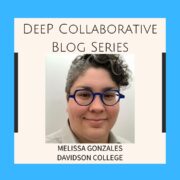
Deliberation across Disciplines: Lessons from a Course in Gender and Sexuality Studies

June 9, 2022 by Melissa Gonzales Leave a Comment

The Deliberative Pedagogy (DeeP) Faculty Collaborative consists of 15 faculty from Davidson College and five other Associated Colleges of the South institutions who are committed to learning and implementing new ways to improve and deepen the quality of their class discussions. Throughout the 2021-22 academic year, these faculty, who come from a wide array of disciplines, studied and discussed different deliberative pedagogy methods, shared their ideas and questions with one another, and worked to embed deliberation in their classrooms. In this special blog series, members of the Collaborative describe and reflect on their experiences developing and teaching their deliberation-involved courses.

The most important thing I learned from intentionally incorporating deliberation in my class (Introduction to Gender & Sexuality Studies) is that deliberative practices can be closely aligned with feminist pedagogy. Based on what I understood, at the time, about the primary domains of deliberation in rhetoric, philosophy, and political science at the start of DeeP, I was not expecting to encounter a high level of alignment with the feminist pedagogy I have been engaged in for almost two decades.

Given that I am often engaged as a teacher-scholar with cultural and feminist studies that not only study the racialized impacts of nationalism (Bebout 2016), but that also critique the very foundation of commonplace notions of citizenship and democracy (Beltrán 2020, Brandzel 2016), I knew that I could not approach the idea that developing deliberation skills makes us better citizens in any straightforward way. I wondered if there would be enough common ground to bring deliberation into my gender and sexuality studies classroom in a highly productive way. So, I entered the group with my own baggage and biases, as we always do. And I did start there; namely by reflecting on how I could expand our learning about cognitive biases in a way that both set the stage for the development of deliberative dispositions and engaged feminist, anti-racist, and queer ways of knowing. 

Despite the fact that the DeeP readings from political science and philosophy did not engage feminist studies, I found from the first day that there was fertile ground for thinking through some of the common aims of deliberation and feminist pedagogy. First, the communal orientation and egalitarianism were clearly compatible with feminist pedagogy. For my course, the communal orientation of setting up shared guidelines for deliberation dovetailed with my existing practice of collectively reviewing and revising shared agreements for our discussions with all students in the course, with the aim of establishing guidelines for discussion that are as inclusive as possible. I expanded the amount of time spent on gathering student input about what harms they had previously experienced, in classrooms that had shut down the sharing of ideas. This allowed us sufficient time to reflect on, revise, and commit to the shared agreements that would govern our class discussions and deliberations. I collected student experiences anonymously, using slido.com, and I also used this tool multiple times throughout the semester to foster a safer, more inclusive way of observing our own community’s range of experiences and perspectives on controversial issues, such as abortion. 

As DeeP progressed, I thought about how the broader definition of citizenship deployed by the DCI, alongside its focus on engagement with public life, was largely compatible with the forms of activism we study and analyze in Introduction to Gender & Sexuality Studies. Reflecting on this overlap inspired me to alter the Theory to Praxis assignment used in class. Instead of a proposal for a grant to effect change (a previous iteration of the assignment), students workshopped, drafted, peer-reviewed and produced a final version of a Deliberation Guide, using previous DCI guides as models. Workshopping and peer-reviewing the Deliberation Guide required them to collaborate intellectually across their differences, as did many mini-deliberations in class. Repeatedly, students observed that they were encountering previously unknown perspectives on different aspects of the human experience, which is expected in this course, and they engaged these with curiosity and respect for difference. I observed that intentionally incorporating deliberation in the class allowed for more metacognitive engagement with the benefits of active listening and shaping questions that invite more divergent than convergent answers. 

What inspired me to get involved in DeeP was knowing that, whenever and wherever teacher-scholars get together to share their strategies and stories about the classroom, magic happens. This proved true. I was also pleasantly surprised to discover the ways that intentionally and explicitly featuring and studying deliberation enhanced the inclusivity of the classroom and extended the reach of my feminist pedagogy. I believe that next semester, I can use my reflections on my own biases and engagement across difference to help students better understand the aims and outcomes of deliberation. 


Works Cited

Bebout, Lee. Whiteness on the Border: Mapping the US Racial Imagination in Brown and White. NYU Press: 2016.

Beltrán, Cristina. Cruelty as Citizenship: How Migrant Suffering Sustains White Democracy. Minnesota UP: 2020.

Brandzel, Amy L. Against Citizenship: The Violence of the Normative. University of Illinois Press: 2016.

Filed Under: Blog Posts, Faculty Posts

  • « Go to Previous Page
  • Page 1
  • Interim pages omitted …
  • Page 62
  • Page 63
  • Page 64
  • Page 65
  • Page 66
  • Interim pages omitted …
  • Page 75
  • Go to Next Page »

Footer

Blog Post Categories

  • Announcements
  • Blog Posts
  • DCI Posts
  • Events
  • Faculty Posts
  • Fellow Posts
Image of a compass superimposed by the text "Deliberative Citizenship Initiative" and "Davidson College." Clicking on this image leads to the Initiative page.

Recent DCI Blog Posts

  • We Tried to Fix Jubilee’s “Middle Ground” – Here’s How It Went
  • A Case for Deliberation in the Natural Sciences
  • Welcoming New Staff to the DCI and DCN
  • Facebook
  • Twitter
  • Instagram
  • LinkedIn


Copyright © 2026 · Infinity Pro on Genesis Framework · WordPress · Log in