• Skip to main content
  • Skip to footer

Deliberative Citizenship Initiative

Building Democracy One Conversation at a Time

  • The Initiative
    • Programs
      • Deliberation Across the Curriculum
      • Deliberation on Campus
      • Deliberation in the Community
      • Research on Deliberation
    • Motivations
      • Why Deliberative Citizenship?
      • Why Davidson? Why Now?
    • Who’s Involved?
      • DCI Fellows Cohorts
        • 2025-2026 Fellows
        • 2024-2025 Fellows
        • 2023-2024 Fellows
        • 2022-2023 Fellows
        • 2021-2022 Fellows
        • 2020-2021 Fellows
      • DeeP Collaborative Cohorts
        • 2024-2025 DeeP Collaborative Faculty
        • 2023-2024 DeeP Collaborative Faculty
      • Advisory Council
    • History
      • What Sparked the Initiative?
    • Key Deliberative Dispositions
    • Frequently Asked Questions (FAQ)
    • Annual Report
  • Get Involved!
    • Participate in a Forum
    • Join a D Team
    • Become a Fellow
    • Take Courses
    • Get Training
    • Come to Guest Lectures
  • Events
    • Upcoming Events
      • 250th Anniversary Deliberative Forum Series on American Values
    • Past Events
  • Connections
    • The Deliberative Citizen: The DCI’s Monthly Newsletter
    • Efforts on Campus
    • Efforts in the Community
    • Efforts Elsewhere
    • Readings and Resources
      • DCI-Published Guides
      • DCI Guide to One-on-One Conversations
      • How to Disagree
      • Demonstration of Facilitation Styles
      • Deliberative Pedagogy Mini-Course
    • How We Can Help: DCI’s LET’S DELIBERATE! Partnership Opportunities
    • DCI in the News
  • DCI Blog Posts
    • Recent Blog Posts
    • All Blog Posts

The DCI Blog

DCI in the News: Notre Dame’s Good Work Series

August 1, 2023 by Sara Copic

Good Work: examining institutions cover image.

By Sara Copic, DCI Assistant Director

Virtues and Vocations: Higher Education for Human Flourishing is a magazine of the Virtues and Vocations initiative at the University of Notre Dame’s Center for Social Concerns. This year, the DCI was featured as part of the magazine’s Good Work series. To read the original article, click here: https://socialconcerns.nd.edu/virtues/newsletter-post/davidson-college-deliberative-citizenship-initiative/ 

The article does a nice job of summarizing the work of the DCI and its core mission programs. 

The DCI was founded in 2020 with the goal of combating unproductive, polarized political and social discourse by replacing it with deliberative citizenship. Dr. Graham Bullock, Associate Professor of Political Science and Faculty Director of the DCI at Davidson College, was one of the founding co-conveners of the DCI. In the Virtues and Vocations article, Dr. Bullock elaborates on the notion of citizenship that is at the heart of the DCI:

“Citizenship has become equated with what passport you hold, a kind of national identity, but this is not the only way to think about citizenship. We’ve tried to think about a broader sense of citizenship as the work that we do together to engage the problems we face in society.”

And he elaborates on what deliberation is:

“Deliberation is sort of an antidote to the very harsh, toxic public discourse that we experience in the mainstream and social media contexts – talking past each other, not really engaging with one another’s reasons, sometimes not even providing reasons for why we hold the positions we do. We see deliberation as a form of discourse that is in good faith, trying to understand one another and then come up with new ideas that might often transcend where we started from.”

The article goes on to explain the history of the DCI and its early events, which started at the beginning of the COVID-19 pandemic. Rather than allowing COVID to block their progress, its leadership saw the pandemic as an opportunity to host virtual events that could draw not only a local and regional but also a national audience to the DCI. As a result, we have been able to host many kinds of deliberative discussions, both online and in-person. 

The DCI’s programming includes small-scale discussions between members of deliberative groups, or D Teams, and larger scale events like our speaker series and public forums. All of our deliberations are facilitated by the DCI Fellows, who are Davidson students trained in best practices for leading productive and meaningful deliberations between people from all walks of life and from many ideological backgrounds. 

As we look ahead to the coming academic year, we hope to see you at our speaker series and public forums, to meet you in one of our D Teams or during one of our deliberation facilitator training workshops. Become a member below to keep up with our activity, and follow us on your favorite social media site. 
Filed Under: Announcements, Blog Posts, DCI Posts

Talking Religion and Politics: How Deliberation Can Help Students Navigate Difficult Conversations

July 26, 2023 by Jason Blum

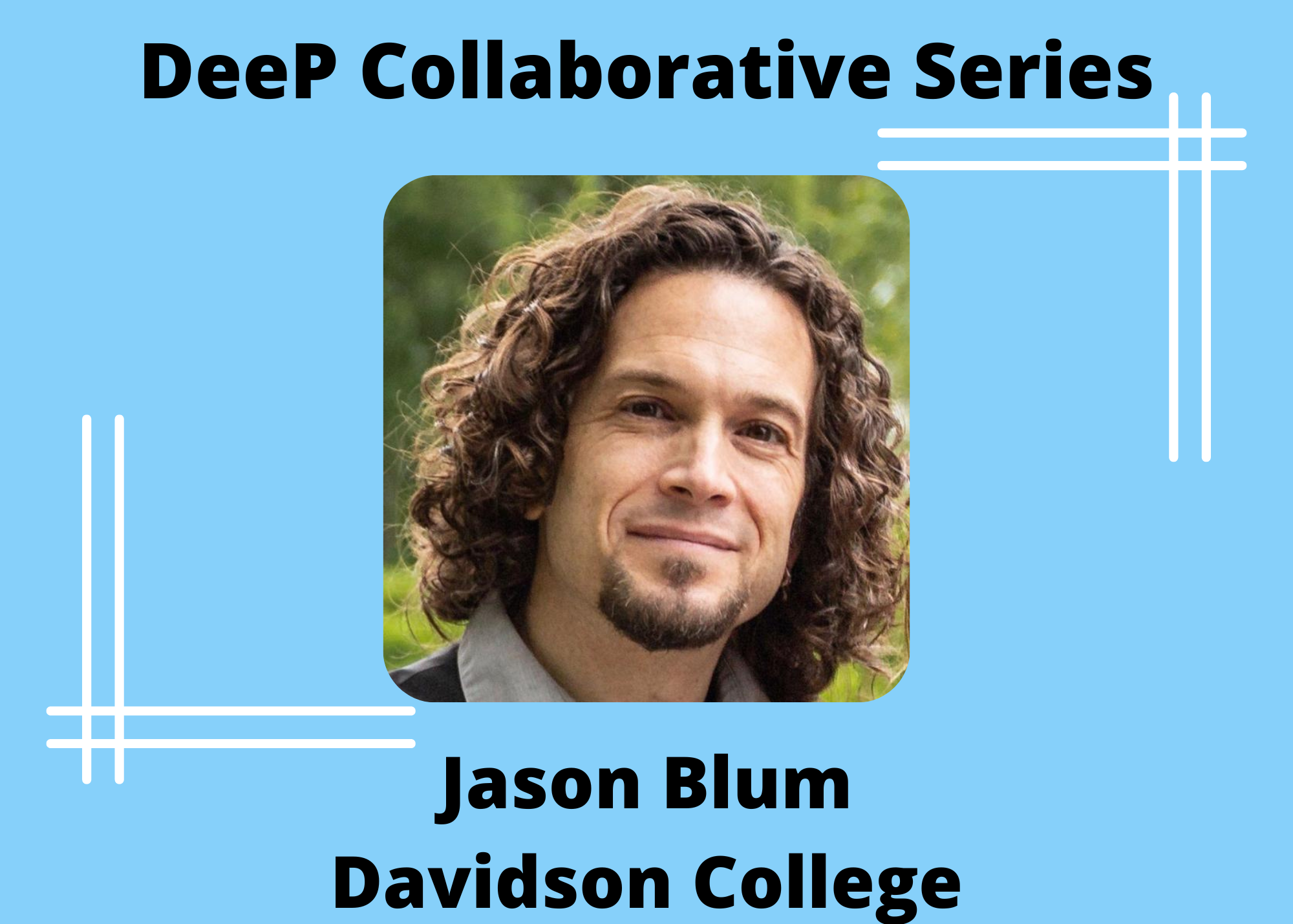
DeeP Collaborative Series Introductory Image for Jason Blum.

By Jason Blum (Assistant Professor of the Practice in Writing, Davidson College, DeeP Collaborative Member)

The Deliberative Pedagogy (DeeP) Faculty Collaborative consists of 20+ faculty from Davidson College and five other Associated Colleges of the South institutions who are committed to learning and implementing new ways to improve and deepen the quality of their class discussions. These faculty come from a wide array of disciplines and backgrounds. They come together to study and discuss different deliberative pedagogy methods, share their ideas and questions with one another, and work to embed deliberation in their classrooms. In this special blog series, members of the Collaborative describe and reflect on their experiences developing and teaching their deliberation-involved courses.

Please note that Professor Blum’s course was taught and the below blog post was written before the U.S. Supreme Court ruled in case of 303 Creative LLC et al. v. Elenis et al.

The case of 303 Creative LLC v. Elenis, which was argued before the Supreme Court in December of 2022,was a natural choice for the central deliberation exercise I staged in my course during the Spring 2023 semester. I incorporated it into my writing course, a seminar-style class designed specifically for first-year students. Although the primary goal of the course is to hone students’ writing skills, I fashion my writing courses around provocative and timely topics that challenge students to engage with other authors’ (often competing) perspectives and to produce arguments that explain and defend their own positions in response to those texts. This semester, the topic around which my writing course was built was religion in the public square. 

Much of the course centers on two texts, one of which argues for a more prominent role of religion in public life, and the other of which contends that religion is undeserving of the legal accommodations and special cultural status that it enjoys in the United States. The casewas well-suited to emphasize the deliberative skills and sensibilities that I sought to foster throughout the semester. It involves a Colorado-based web designer who plans to expand her business into creating websites for weddings. For religious reasons, she objects to same-sex marriage and intends to post a disclaimer stating that she will not design websites for same-sex weddings. Because Colorado law forbids discrimination against gay people, the disclaimer she wants to post would be illegal.

For our deliberation, students were organized in teams of three and provided with a brief New York Times article that describes the basic details of the case. I then asked each team to devise arguments supporting the plaintiff, and then to devise arguments supporting the defendant. After considering the case from each perspective, teams then attempted to reach consensus on how the case should be decided. I explicitly prompted students to draw on our course readings in approaching the exercise. Finally, the class reconvened as a whole to compare decisions and discuss the deliberations that led to their decisions.

I never opined on the case. My pedagogical strategy is to withhold my own positions to avoid the possibility of influencing my students and make them more comfortable expressing a range of opinions. I also explain to students why I do this, and many of them have commented that they appreciate this technique and my purpose in using it.

The case was appropriate for my course primarily because it concerns contrasting values that the majority of students would likely see as positive: on the one hand, religious liberty and freedom of speech, and on the other hand, antidiscrimination.[1] As one of our authors puts it, the case was therefore one in which “the clash is not of wrongs but of rights.”[2] Students were therefore tasked with making a difficult call. Reflecting the divergent texts that we read, there are viable and potentially compelling arguments to be made on both sides. It is the kind of complex and challenging question over which intelligent, well-meaning people can disagree – a “wicked problem,” in the lingo of deliberation – and therefore one that would force students to practice the kind of careful reflection that makes not only for good writing but for good thinking. 

This was perhaps the central intellectual sensibility that I sought to foster in my course: the ability to engage honestly and even generously with competing perspectives over an issue that is complex and unlikely to be easily or cleanly resolved. Tasking student teams with the responsibility of coming to a determination in the 303 Creative case was also beneficial in that it provided a concrete case in which these competing concerns were acutely crystallized. I scheduled the deliberation late in the semester, once students were familiar with the general outlines of the two primary texts we read. They were therefore well-positioned to apply the general principles they had learned in a way that was specific, and which clarified for them both the stakes involved and the sometimes abstract concepts we had discussed. By this point in the semester, the class had also developed a sufficient rapport with each other (and me) that we were able to discuss this controversial issue with an attitude of mutual trust and collaboration.

At least one student commented to me that the exercise forced her to change her thinking. The necessity of addressing a real-world instance seemed to provide a kind of intellectual traction that deepened her thinking on the relevant questions that forced reconsideration of her prior assumptions and values. Other students echoed the sentiment that applying course concepts to a real-world scenario was helpful, as well as “fun.” More than one student suggested that future iterations of the course could benefit from more exercises like this. Incorporating deliberation into my course underscored intellectual skills – such as honest attention to contrary perspectives, generosity of interpretation, acknowledgement of complexity, and willingness to reconsider one’s own positions – that are also central to effective writing and good thinking.


[1] The Supreme Court has stipulated that it will limit its review of the case to the question of whether the Colorado law violates First Amendment protections of freedom of speech. For our deliberation, I instructed students to proceed as though the question of free exercise of religion was still on the table, since that was an essential dimension of the course. 

[2] Stephen Carter, The Culture of Disbelief (New York: Anchor Books, 1993), 154.

Filed Under: Blog Posts, Faculty Posts

The Fusion of Nuclear Technologies and Policy in a First-Year Writing Course

July 25, 2023 by Anthony Kuchera

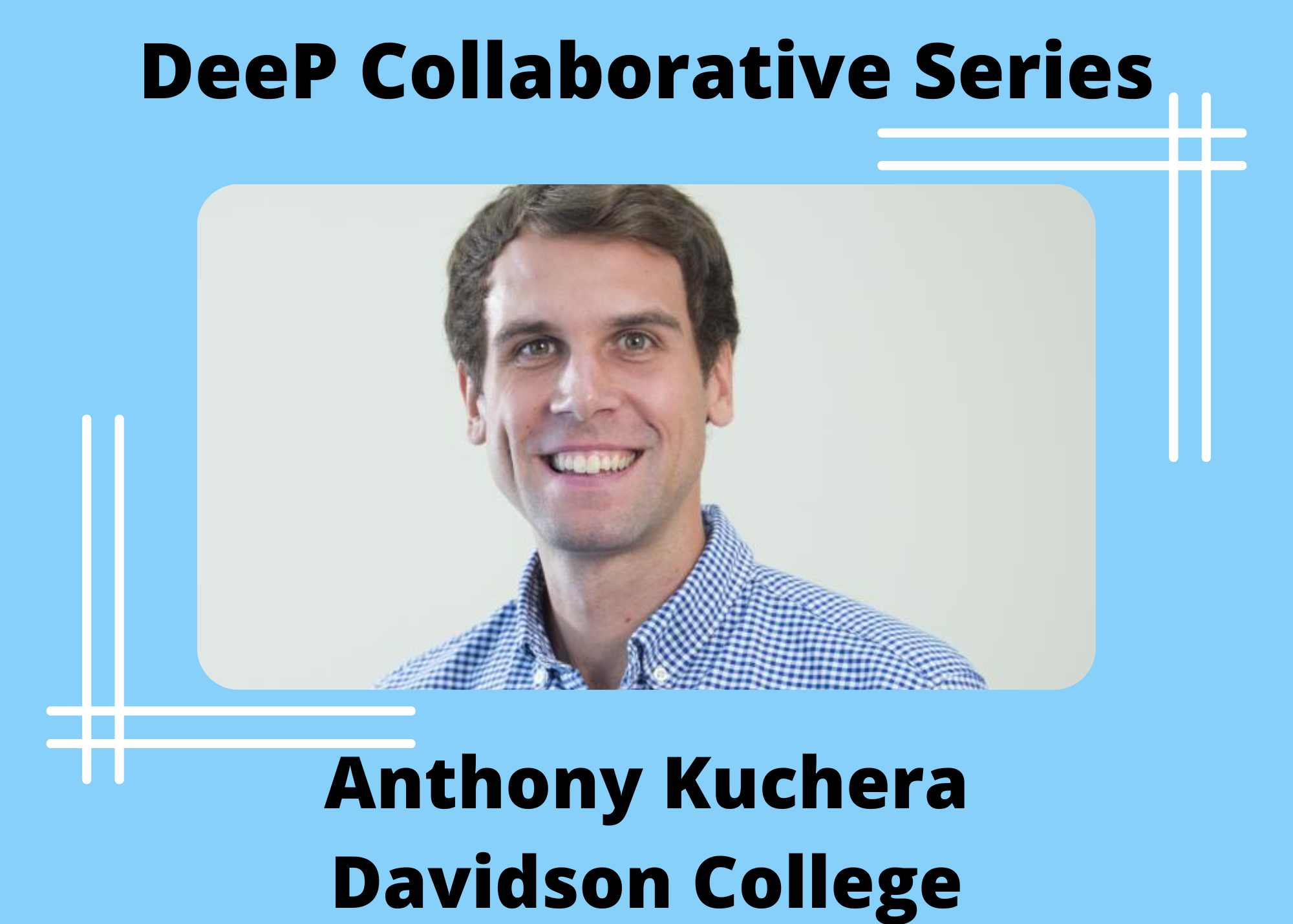
DeeP Collaborative Series Introductory Image for Anthony Kuchera.

By Anthony Kuchera (Assistant Professor of Physics at Davidson College, DeeP Collaborative Member)

The Deliberative Pedagogy (DeeP) Faculty Collaborative consists of 20+ faculty from Davidson College and five other Associated Colleges of the South institutions who are committed to learning and implementing new ways to improve and deepen the quality of their class discussions. These faculty come from a wide array of disciplines and backgrounds. They come together to study and discuss different deliberative pedagogy methods, share their ideas and questions with one another, and work to embed deliberation in their classrooms. In this special blog series, members of the Collaborative describe and reflect on their experiences developing and teaching their deliberation-involved courses.

As a nuclear physicist who primarily teaches upper-level physics courses, I was initially intimidated to teach a Writing 101 course at Davidson College. This is a required course for all first-year students that can be taught by faculty members across the college. With help and guidance from the former director of the Davidson College Writing Center, I gained confidence that the theme of my course, the intersections of nuclear science, technology, and policy, was worthy for a writing course and of interest to the Davidson students. In May 2023 I completed teaching the course for the third time. As a result of my participation in the Deliberative Citizenship Initiation (DCI) Deliberative Pedagogy (DeeP) Faculty Collaborative during the 2022-2023 academic year, I feel that it was the strongest yet. By participating in the readings, trainings, and interactions with other students and faculty, I found a significantly better way to approach discussions on difficult topics in the classroom.

In many physics courses, there is a focus on the scientific concepts, mathematical framework, and problem solving. Typically, there is not much discussion on contentious issues. In the WRI 101 course I teach, the idea is flipped. There is very little focus on the scientific details (but enough for students to understand generally what is going on) and a primary emphasis on analyzing the ways in which nuclear science and its applications are understood, perceived, regulated, and implemented to solve societal needs. I regularly emphasize to the students that the nucleus of the atom holds incredible potential for applications in energy, medicine, and other industries, but it comes with (often significant) risks. Because of this risk-reward situation, there is a broad spectrum of ideas on how nuclear technologies can and should be used.

In the first two iterations of this course, I found the in-class discussions to generally be less than satisfying with only a few eager students willing to engage and mostly responding just to me and not the other members of the class. I take the blame for this as I didn’t have a great strategy to facilitate these discussions. This lack of preparedness is what motived me to join the DCI DeeP Faculty Collaborative.

In Spring 2023, I updated my WRI 101 course to incorporate deliberations into my curriculum. The course is structured with four major topics: radiation and the public, development of nuclear weapons, nuclear power, and current political situations with nuclear technologies. Each topic has a major writing assignment. The deliberations were held about one week before the due date of the writing assignments. This was intentional, and gave students sufficient time to consider other perspectives to issue and the argument(s) they are making. In each writing assignment it was expected that students respond to viewpoints other than their own and the deliberation gives an opportunity to hear what those are and why others might have those perspectives. Each deliberation took place for about 35 minutes in class with 10 minutes at the end for the students to write a reflection on their experiences.

I was pleasantly surprised by the reactions and feedback from the twelve students in the class. They all seemed to thoroughly enjoy the deliberations. The deliberations provided a way for students to interact with each other and not just respond to me. I was fascinated to see students take initiative to ask fellow students questions about their perspectives. I also was grateful to see students engage respectfully when disagreeing with each other. Ultimately, this is what I wanted to see happen. I hoped students would discover what they believe and find out what leads to others having different perspectives. In holding these deliberations, I found a solution. Future iterations of this course will certainly continue to have deliberations and I am now trying to find ways to include some in other courses I teach.

Filed Under: Blog Posts, Faculty Posts

Deliberating About Ethics with Gen Z

July 20, 2023 by Erik Anderson

DeeP Collaborative Series Introductory Image for Erik A. Anderson.

By Erik A. Anderson (Chair and Associate Professor of Philosophy, Furman University, DeeP Collaborative Member)

The Deliberative Pedagogy (DeeP) Faculty Collaborative consists of 20+ faculty from Davidson College and five other Associated Colleges of the South institutions who are committed to learning and implementing new ways to improve and deepen the quality of their class discussions. These faculty come from a wide array of disciplines and backgrounds. They come together to study and discuss different deliberative pedagogy methods, share their ideas and questions with one another, and work to embed deliberation in their classrooms. In this special blog series, members of the Collaborative describe and reflect on their experiences developing and teaching their deliberation-involved courses.

This semester at Furman University, I incorporated deliberative pedagogy into my ethics course. We hear much about how polarized Americans are about moral issues, and there is a widespread impression that Gen Z students are too busy “cancelling” each other to discuss controversial questions. I wanted to investigate to what extent these assumptions were true of my students. I also wanted to do what I could to open them up to having difficult conversations and to help them develop the skills they need to do so effectively.

My course was organized around contemporary moral issues. We covered five broad topics: freedom of speech, animal rights, racism and sexism, environmental ethics, and abortion. My plan was to hold “deliberation days” on each of these topics in which students would reason together about competing policies. The students were told that on these days, we would pretend the class was a legislature and that our job was to debate and then vote on which policies to adopt. I described deliberative pedagogy on the syllabus as aiming “to improve our abilities as citizens to engage in democratic deliberation about pressing moral and political issues. […] The specific aim of the course in relation to deliberation is that you develop the ability to engage in respectful discussion with others who disagree with you about moral questions that matter deeply to you.” In order to introduce deliberation to the students, I assigned readings by Amy Gutmann and Dennis Thompson, Diana Hess and Paula McAvoy, and Scott Aikin and Robert Talisse. However, students primarily learned about deliberation by doing it.

Before the first deliberation day, I created “ten commandments,” in consultation with the class, that would govern our deliberations:

    (i) Judge ideas, not people.

    (ii) Be honest and respectful.

    (iii) Vegas rules: don’t post criticisms of your fellow students on social media.

    (iv) Commit to empathetic listening. Don’t listen just to find weaknesses in opposing views.

    (v) Try to understand competing perspectives and be fair to them.

    (vi) Disagree with curiosity, not hostility.

    (vii) Give other students the benefit of the doubt.

    (viii) Be brief so that everyone has the chance to participate.

    (ix) Monitor your body language: avoid eye rolls and other expressions of disdain.

    (x) Seek consensus, not victory.

In commenting on and explaining these rules, I connected them with some of the “deliberative virtues” developed in the literature as well as with the “deliberative dispositions” promoted by the Deliberative Citizenship Initiative. While it was largely up to the students to enforce the rules, there were, to my knowledge, no incidents in which students violated them.

I faced some practical challenges in organizing the deliberation days. Foremost among them was the lack of time (the class was only 50 minutes long) and the large size of the group (25 students). To make sure each student got to participate, I divided the class into groups of three and four students. I assigned students to the groups randomly and varied their membership each time in order to prevent students from only deliberating with friends or people they were likely to agree with. I also had the deliberation proceed through distinct stages. For each topic, I focused our attention on two competing policy proposals. In the first stage, students were instructed to present to their small group what they took to be the strongest arguments and the most serious objections to each of the competing proposals. The point was for students to articulate arguments for and against different policies without yet defending a position of their own. I hoped this would encourage them to be even-handed. Only after they laid out considerations for and against each proposal did I ask them, in the second stage, to state what position they supported and why. At this stage, they engaged in deliberation proper. They sought to persuade the members of their small group that their favored proposal was the better one. I circulated around the room so I could get a sense of how things were going, but I remained hands-off because I didn’t want to inhibit or influence their conversations.

After about 25 minutes in their small groups, we moved to a third stage in which each small group reported to the whole class about how their deliberations had gone. Was there any consensus about the best proposal? Was one of the proposals more widely accepted than the other? What were the reasons for and against each proposal articulated in the deliberation? Then, in a fourth stage, I posed the question again for the whole class to consider: which of the two proposals should we, as a class, adopt? My thinking was that individuals who offered arguments addressed to the whole class would have had their understanding of the issue and their arguments refined through their small group deliberations. In the whole group deliberation, students explained why they found the arguments favoring one of the proposals to be more compelling than those supporting the alternative. When one person defended a particular view, I would ask for rebuttals from the other side. While it was very tempting for me give my own input, I tried to stay in a facilitative role and to leave the deliberation up to the students themselves.

In a final stage, after about 15 minutes of whole-group deliberation, we took a vote. Students voted anonymously on Zoom, which instantly tallied the results. As the vote happened right at the end of our 50-minute class, I had to wait for the following class to debrief the exercise. Students had to write a “deliberation report” in which they summarized the arguments for and against the two proposals, defended their own view, reflected on the process of deliberation (for example, I asked them whether at any point they had changed their minds), and had the opportunity to devise their own alternative proposals.

One thing I didn’t anticipate was how difficult it was to come up with proposals for the students to discuss that were clearly distinct and yet both had initial plausibility. On free speech, for example, I decided to focus on the limits on what kinds of controversial materials professors could teach in class. There was consensus that professors and students shouldn’t use hate speech (e.g. slurs, verbal attacks) and that it was permissible for professors to assign materials that contained examples of hate speech as long as there were legitimate academic reasons for doing so. But students disagreed about material containing academic arguments in support of (what they took to be) racist, sexist, homophobic, or transphobic conclusions. I wanted the class to deliberate about a proposal that was relatively permissive — giving professors more leeway to assign controversial materials — and one that was more restrictive. But the more plausible I tried to make the two proposals, the more qualified and nuanced they became, the more they started to blur into one another. On the other hand, the more distinct I tried to make them, the more “extreme” they became, which threatened to make them nonstarters for the students. The proposals I ended up with were somewhat vague and ambiguous, saying things like “professors may assign materials that present sexist, racist, or other objectionable ideas as long as doing so serves a legitimate academic purpose” and “professors should not assign materials that marginalize, exclude, or denigrate students on the basis of their race, sex, gender identity, etc.” Students interpreted a number of the key phrases in these proposals differently, which meant that they weren’t always assigning the same meanings to the competing alternatives.

Despite this (unresolved) problem, students reported that they enjoyed the activity of deliberation and found it useful. There were no heated conflicts and it didn’t seem to me that students felt the need to censor themselves (though it’s hard to know for sure — in hindsight, I should have asked them about self-censorship on their deliberation reports). I do have to mention one caveat, however. The whole semester we were building toward a deliberation day on the most controversial issue by far, abortion. Unfortunately, I came down with COVID after spring break and had to cancel a number of classes. As a result, we were not able to have a final deliberation on abortion. That issue would have been an important test case for how proficient the students had become at deliberation. I can say, though, that the discussions we had on the readings about abortion were civil and productive even when we discussed pro-life views, which conflicted with the views held by most students. One student who said early in the semester that “men are not entitled to have an opinion about abortion” had by the end of the term come around to seeing the importance of listening to diverse perspectives on the issue.

As a first-time experiment, my attempt to teach ethics deliberatively wasn’t entirely successful, but it was successful enough to be worth working on and improving in the future. I was especially impressed by how seriously the students took our deliberation days — as if the members of Gen Z were hungry for the kinds of respectful moral and political conversations that are so lacking in America today.

Filed Under: Blog Posts, Faculty Posts

The Explorer Mindset: Can It Be a Possibility?

July 17, 2023 by Divin Dushimimana

Image of the painting Wanderer of the Sea Fog

Divin Dushimimana ‘26 (DCI Fellow)

We’re in a world with many polarizing ideas. At some point it feels like it’s one idea against all other ideas and their owners do everything in their capacity to transmit their ideas. Without going too far from where our present location, let’s start with the US and the country’s political systems. We mostly have Republicans vs Democrats. These political ideologies differ in many ways, starting with their perspective on taxes to minimum wage to healthcare policy to the military and to many other things in the country. Statistics show that the number of Americans in each party with a negative view of the other party has doubled since 19941https://www.pewresearch.org/politics/2014/06/12/political-polarization-in-the-american-public/. It’s as if members of one political party wants to convert people in the other party to their beliefs.

By zooming out, we can see that the western political and economic ideology of democracy and capitalism has been fighting head-to-head with the political and economic ideologies of socialism and communism for a long time. Having been present in a conversation between an American and a Chinese that encapsulated this conflict, it’s hard for me to envision a situation where an explorer-mindset as a deliberative disposition can be applicable in a normal conversation. In this conversation about capitalism and communism that I witnessed, it was about one person proving why one of the systems is better than the other.  Now that I think about it, neither were looking for a common ground in the debate, and I feel like this is how many conversations are in this world.

When looking back to my primary school memories, I reminisce about debates we used to have like fire vs water, food vs water, or even who is better between mother and father. As I remember, none of us in these conversations were ready to apply the explorer-mindset to understand where other people’s opinions originate. As we grow up, this character trait – a stubborn commitment to our currently held beliefs, right or wrong – gets ingrained in us and we become resistant to accepting and learning from other people’s perspectives. When I look back, I think polarization is a concept that we were taught since we were young and we grow up to apply it in our daily lives.

That’s why the explorer mindset is a concept I had never seen applied by anyone before reading and learning about the Deliberative Citizenship Initiative. My conversations were so debate-focused before joining DCI. Ever since I learned about this concept, I’ve been trying to put it into practice because I realized it’s a way to practice intellectual humility by understanding that there could be multiple truths to a certain topic. Conversations should shift from being focused on persuading another person of your perspective or opinion to finding common ground and actually learning why people think the way they think. This is because people’s backgrounds and experiences do really influence their opinions on certain topics.

However, with little exposure to this concept, it’s unlikely that people are going to put it into practice or that the number of people willing to practice intellectual humility will increase. Instead, we see the number of people without intellectual humility increase day by the day and this is a concerning trend. Unless DCI and other similar initiatives become accessible to more students, people, and institutions around the world, the explorer-mindset is unlikely to spread widely, despite our desperate need for it amidst today’s hyper-polarization. For this reason, I hope that more of us will join the DCI and participate in its activities, so we can all explore different perspectives together, in our search of solutions to our common problems.  

Filed Under: Blog Posts, Fellow Posts

  • « Go to Previous Page
  • Page 1
  • Interim pages omitted …
  • Page 50
  • Page 51
  • Page 52
  • Page 53
  • Page 54
  • Interim pages omitted …
  • Page 75
  • Go to Next Page »

Footer

Blog Post Categories

  • Announcements
  • Blog Posts
  • DCI Posts
  • Events
  • Faculty Posts
  • Fellow Posts
Image of a compass superimposed by the text "Deliberative Citizenship Initiative" and "Davidson College." Clicking on this image leads to the Initiative page.

Recent DCI Blog Posts

  • We Tried to Fix Jubilee’s “Middle Ground” – Here’s How It Went
  • A Case for Deliberation in the Natural Sciences
  • Welcoming New Staff to the DCI and DCN
  • Facebook
  • Twitter
  • Instagram
  • LinkedIn


Copyright © 2026 · Infinity Pro on Genesis Framework · WordPress · Log in