• Skip to main content
  • Skip to footer

Deliberative Citizenship Initiative

Building Democracy One Conversation at a Time

  • The Initiative
    • Programs
      • Deliberation Across the Curriculum
      • Deliberation on Campus
      • Deliberation in the Community
      • Research on Deliberation
    • Motivations
      • Why Deliberative Citizenship?
      • Why Davidson? Why Now?
    • Who’s Involved?
      • DCI Fellows Cohorts
        • 2025-2026 Fellows
        • 2024-2025 Fellows
        • 2023-2024 Fellows
        • 2022-2023 Fellows
        • 2021-2022 Fellows
        • 2020-2021 Fellows
      • DeeP Collaborative Cohorts
        • 2024-2025 DeeP Collaborative Faculty
        • 2023-2024 DeeP Collaborative Faculty
      • Advisory Council
    • History
      • What Sparked the Initiative?
    • Key Deliberative Dispositions
    • Frequently Asked Questions (FAQ)
    • Annual Report
  • Get Involved!
    • Participate in a Forum
    • Join a D Team
    • Become a Fellow
    • Take Courses
    • Get Training
    • Come to Guest Lectures
  • Events
    • Upcoming Events
      • 250th Anniversary Deliberative Forum Series on American Values
    • Past Events
  • Connections
    • The Deliberative Citizen: The DCI’s Monthly Newsletter
    • Efforts on Campus
    • Efforts in the Community
    • Efforts Elsewhere
    • Readings and Resources
      • DCI-Published Guides
      • DCI Guide to One-on-One Conversations
      • How to Disagree
      • Demonstration of Facilitation Styles
      • Deliberative Pedagogy Mini-Course
    • How We Can Help: DCI’s LET’S DELIBERATE! Partnership Opportunities
    • DCI in the News
  • DCI Blog Posts
    • Recent Blog Posts
    • All Blog Posts

The DCI Blog

DCI in the News: Support Expands Impact of the DCI

August 18, 2023 by Sara Copic

DCI in the News

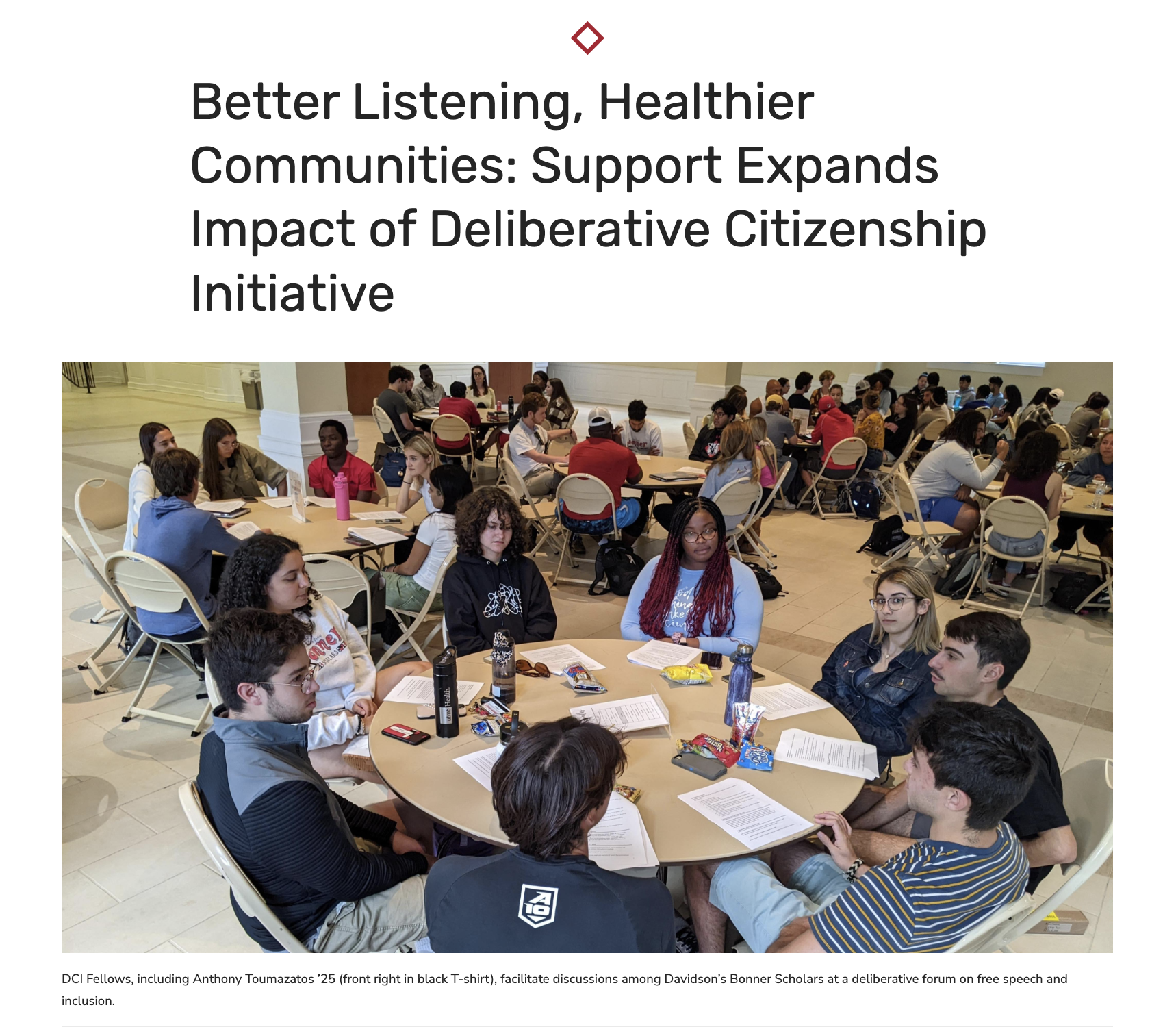
An article was published last week on the Davidson College website featuring stories from Davidson students, faculty, staff, community members, and alumni about how the DCI has enabled them to engage in and facilitate more productive discussions about difficult topics. The article includes some great insights from Anthony Toumazatos ’25 (DCI Fellow), David Barnard ’79 (Davidson alum and DCI D Team participant), Pam Dykstra (Davidson community member and DCI Advisory Council member), Jayme Sponsel (Assistant Director For Research, Learning, and Outreach in Davidson’s Library and a Co-Convener of the DCI), and Melissa González (Davidson’s interim Chief Equity and Inclusion Officer and DeeP Collaborative member).

It also highlights two recent gifts that will help the DCI continue to build and expand the deliberative opportunities it is offering. These include a generous gift from Amy ’98 and Steven Wacaster and a major grant from the Arthur Vining Davis Foundations. We encourage you to check out the article as soon as you have the chance. It provides a wonderful window into the impact that the DCI has been having – and promises to have in the years to come.

If you want to join in on the action right away, you can sign up for a Fall D Team here and register for our annual Deliberation Facilitator Training Program here. And stay tuned for more announcements soon about our other fall programs that are in the works!
Filed Under: Announcements, Blog Posts

Year in Review: Highlights from Our 2022-23 Annual Report

August 18, 2023 by Sara Copic

DCI 2022-2023 Annual Report Cover

The DCI has wrapped up its third year of deliberative programs and has just published its third Annual Report! As we prepare for another academic year full of Deliberative Forums, Speakers, D Teams, and Training Programs for our Fellows, Deliberation Facilitators, and Deliberative Pedagogy (DeeP) Collaborative Faculty Members, we want to share some highlights from this report. We hope that you find something that inspires you to join the DCI and engage with others on the pressing issues facing our society.

Quick tip: If you already know you’d like to get involved in the DCI this year, click here to learn more about our Fall 2023 D Teams and here for more about our upcoming Deliberation Facilitator Training Program!

We started off the 2022 year with our first-ever Semester Kickoff Party, where students, faculty, staff, and community members gathered to learn more about the DCI’s mission and programs, which was followed by our Deliberation Facilitator Training Program, where we trained 44 new facilitators, including our ’22-’23 DCI Fellows and DeeP Collaborative cohorts. The DCI Fellows went on to facilitate conversations among our D Team members, Forum participants, and—in the course of completing their own deliberation projects—other groups on campus and in the wider community. All told, over 850 people participated in last year’s DCI programs.

Last year, the DCI expanded its reach within the Davidson campus community. Our Fellows organized and facilitated a friendly deliberative competition about the greatest actors, athletes, and musicians of all time at our Deliberating GOATs event. Fellows also hosted Commons Conversations, informal lunchtime discussions with Davidson students about a wide range of salient topics. Fellows also held office hours at the E.H. Little Library, where the DCI’s newly curated capsule collection of resources and reading materials is on display. The collection is always being updated, so stop by the library to check it out!

We collaborated with academic departments, co-curricular programs, and community partners throughout the year. For example, we co-hosted a forum with the Bonner Scholars Program during which DCI Fellows facilitated conversations among Bonner scholars about free speech and inclusion. And we hosted our second year of the Deliberative Pedagogy (DeeP) Collaborative for faculty from both Davidson and Associated Colleges of the South (ACS) institutions.

Visit this page to read our newly published 2022-2023 Annual Report, where you can find out all about our goals, programs, and growth over the three years we’ve been hosting deliberations and building our capacity to engage with one another on challenging topics.

Filed Under: Announcements, Blog Posts

The DCI is Hosting its Fifth Deliberation Facilitator Training Program!

August 9, 2023 by Sara Copic

2023-Flyer-DRAFT-1

How should we engage in meaningful, productive disagreement, discussion, and problem-solving with others, especially when the issue at hand is highly contentious and politicized? This is the fundamental question the DCI has been working to answer, and we believe there is a way to do it well. We can disagree respectfully, we can discover the truth in spite of—and indeed, because of—our differences, and we can solve pressing issues democratically using the tools of deliberative democracy.

Deliberation, as we see it at the DCI, is a method of discussion that enables citizens—broadly construed so as not to limit this notion to persons with one particular legal status—to state their views and the presuppositions behind them, reconstruct the arguments for their positions, and to make progress toward solutions to problems where there is entrenched disagreement.

Although this can sometimes happen organically in conversation or in the political sphere, the DCI came about in part because this is so difficult to achieve. After all, we cannot claim to be immune from falling into echo chambers, falling prey to motivated reasoning, relying on fallacious reasoning, or even from failing to be able to articulate the main reasons for the views we hold in the face of criticism from another.

On the other hand, we can also be so uncomfortable in the face of disagreement that we would rather not engage—and we either decide to simply agree to disagree or to shut each other out. But living together requires making decisions together and coming to a shared understanding of difficult problems, at least to some extent.

Our experience, and the experienc of similar programs around the world, has found that well-trained and intentional facilitators can help participants overcome these obstacles and engage in meaningful and productive deliberation, even when they disagree deeply. This is why the DCI is hosting its fifth Deliberation Facilitator Training Program this year. The training will take place over two sessions from 1:30 pm to 5:30 pm, one on Sunday, Sept. 10th and the other on Saturday, Sept. 16th. The sessions complement each other are required components of the training. Virtual and in-person options are available, but space is limited so sign up soon if you are interested. 

his hands-on and interactive program enables participants to lead deliberation sessions in their community, with colleagues, with their families, or in their classrooms, and to facilitate DCI-hosted forums on matters of public interest. The DCI supports facilitators with learning materials we send out before the training days, and participants get a chance to practice facilitating a mock deliberation.

Do you feel your community, your family, your students, or your colleagues would benefit from deliberating about an issue with the help of a trained facilitator? Learn more and sign up here by Tuesday, Sept. 5th!

Filed Under: Announcements, Blog Posts, Events

Introducing Our Fall 2023 D Teams

August 9, 2023 by Sara Copic

D-Teams-2023-Flyer-1-2

The DCI is hosting its fourth year of D Teams starting this fall, and we are excited to share this fall’s theme and topics with you. This year, we also invite you to participate in our new Invite a Friend Program, which will help us increase the range of perspectives represented in D Team discussions.

The DCI’s D Teams provide the opportunity for groups of 6-10 people to meet three times per semester and to discuss a series of contentious topics of public concern together. D Teams present a unique opportunity because they can get you into meaningful conversation with people socially, generationally, or ideologically different from you. They build community among participants empower them to have more productive conversations about topics that typically are difficult to talk about.

When we conducted our Topics Survey earlier this summer—where we gathered responses from previous D Team participants, Davidson students, and community members via our social media channels—and when we considered the suggestions for topics from our 2022-2023 cohort of DCI Fellows, we found that there was significant interest in topics that seemed to touch on the value of autonomy. These topics were: (i) speech, harm, and offense, (ii) abortion, and (iii) book censorship.

Our goal this year is to pay attention to the different problems presented by each topic while also investigating different ways of balancing our autonomy rights with one another’s so that everyone’s autonomy can be properly respected. We will also explore how our commitment to autonomy should be weighed when it comes into conflict with other values. To learn more about our topics for this year and our theme, see our Fall 2023 D Teams webpage. You can also read more about the purpose and structure of our D Teams here.

Since D Teams are about building community and building democracy, we very much would like you to participate in our Invite a Friend Program. This program allows you to indicate a preference to be on a D Team with someone you know when you register. They could be a friend, family member, colleague, neighbor, or someone you know from another context. You may want to invite someone who is ideologically different from you, in order to increase our D Teams’ ability to engage with different perspectives. Or, in case you are feeling hesitant about joining a team, you may want to invite someone with whom you share something in common. In either case, we welcome you and a friend (or multiple friends!) to join us this year as we deliberate about the problems we find both pressing and challenging for us to solve today.

Sign up for a D Team – and invite a friend – by September 7, 2023.

Filed Under: Announcements, Blog Posts, Events

How Do We Deliberate in the Arts?

August 2, 2023 by Robert Vander Poppen Leave a Comment

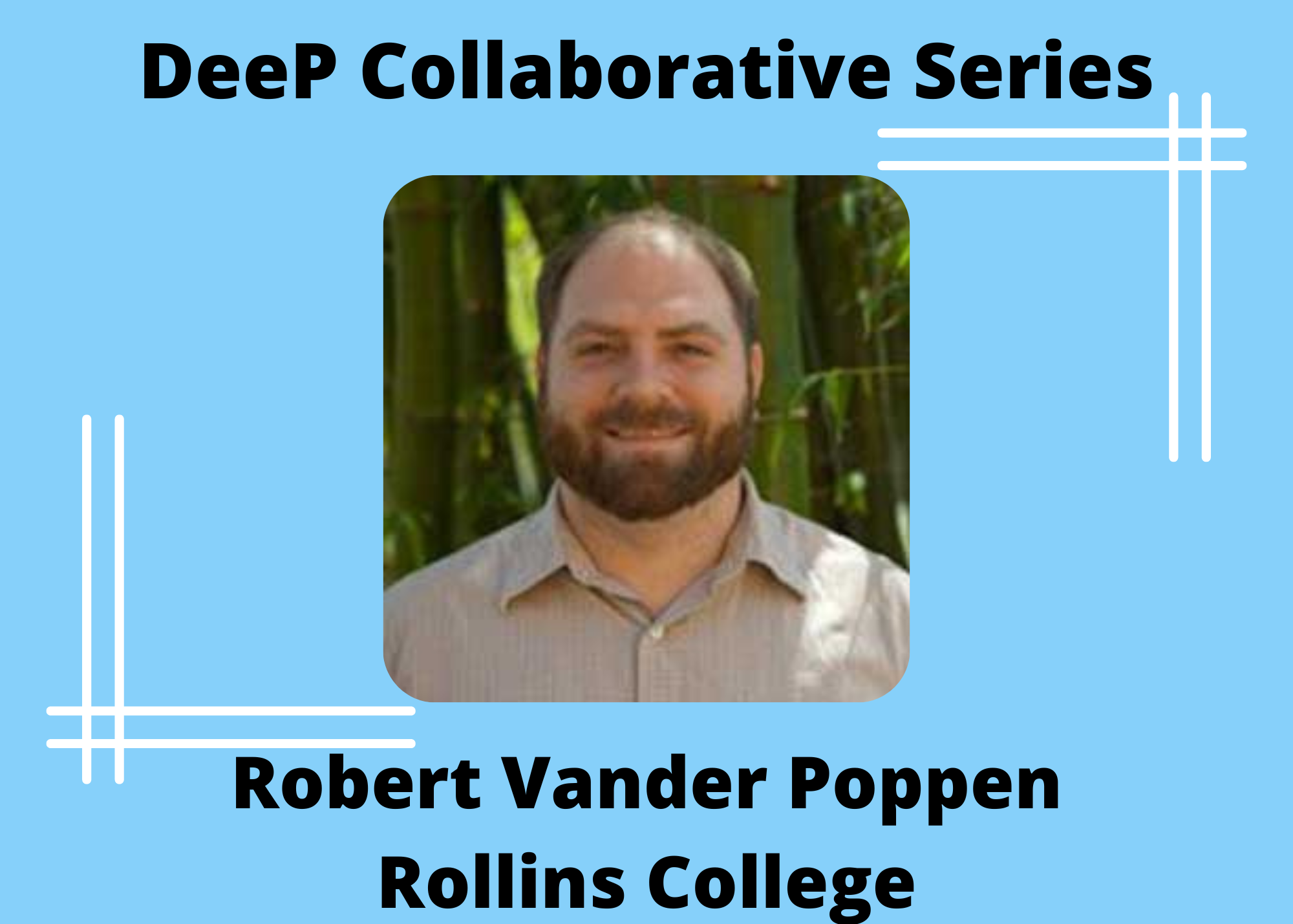
Robert Vander Poppen, Rollins College

By Robert Vander Poppen (Associate Professor of Classical Art & Archaeology at Rollins College, DeeP Collaborative Member)

The Deliberative Pedagogy (DeeP) Faculty Collaborative consists of 20+ faculty from Davidson College and five other Associated Colleges of the South institutions who are committed to learning and implementing new ways to improve and deepen the quality of their class discussions. These faculty come from a wide array of disciplines and backgrounds. They come together to study and discuss different deliberative pedagogy methods, share their ideas and questions with one another, and work to embed deliberation in their classrooms. In this special blog series, members of the Collaborative describe and reflect on their experiences developing and teaching their deliberation-involved courses.

In Spring 2023, 25 students at Rollins College in Winter Park, FL walked into ARH 215 – Art and Archaeology of the Greek World. Few of them were expecting the class to be anchored in the pedagogy of deliberation. Art History, on its surface, doesn’t seem to be a field that would lend itself to the kind of debates that easily arise in other disciplines. After all, what is there to debate about art and artifacts that are 2,500 years old? 

In truth, the deliberative process is at the heart of what we as Archaeologists and Art Historians do in our scholarship. Archaeological and Art Historical research is aimed at deciphering meaning from visual objects based on their internal formal characteristics (what they look like and what is depicted on them) and interpreting them by analyzing them in their cultural, historical, and physical contexts. Not surprisingly, it is rare, especially with regard to ancient art, to be able to construct such context in its entirety. Much relevant information that would aid in the interpretation of images and objects is unknown, and much Art Historical and Archaeological scholarship is an exercise in the explanation of incomplete data. 

This phenomenon of missing context is especially prevalent when one moves beyond the cannon of well-known masterpieces and into attempting to understand the decisions that went into creating (and using) more mundane sites and artifacts such as the dinner dishes, or a private house, or a craftsman’s workshop. As a result, Archaeologists and Art Historians constantly engage in the exercise of deliberation and reason giving based on visual evidence.

The reason-giving found in Art History and Archaeology classes may look a bit different than that found in other deliberation-involved courses. Whereas in a Philosophy or Ethics class students might be developing their arguments based on the rules of formal logic, the system of argument in Art History and Archaeology is predicated on the logic of visual analysis. Students in ARH 215 spent the semester honing their skills in this specialized type of argumentation that they then used to inform their deliberations. Students worked in small deliberation groups to determine where an artifact fits in a stylistic sequence, what constitute the salient features of a typology, and which amongst a suite of possible readings of an artifact or interpretations of an archaeological site should be preferred.

All of these skills are important to the discipline as a whole, but there is also a second area of focused deliberation within the fields of Art History and Archaeology. Although artists create meaning when they produce an artifact and contemporary viewers add a second layer through the use of the object in its original context, a final layer of meaning is imparted to an object through its display. That is to say that the modern deposition of objects in museum collections is a function of a series of political, cultural, and historical trends that often lead to ethical debates. Museums are not neutral. They are active participants in the creation of narrative surrounding the artifacts that they display and the choice of text, as well as the very ownership of objects have contemporary political implications.

One of the primary concerns surrounding artifacts from antiquity is the question of ownership. Starting in the 1970s museums, universities, and cultural institutions began to wrestle with legacies of colonialism that underpinned the system of foreign excavations and the movement of objects away from their places of excavation via the art market. Since the UNESCO Convention on Cultural Heritage was adopted, the entities mentioned above have had to wrestle with the implications of possessing the physical and material culture of someone else’s past. Within ARH 215, students engaged in debates surrounding issues of repatriation and exportation of cultural patrimony. Such issues are rarely clear-cut. Often several competing claims on objects exist and what is right is not always determined strictly by the law. In other words, just because it might be legal for an institution to keep an object or artifact, it doesn’t mean that it is ethical. Throughout the course, students familiarized themselves with international cultural heritage law, the codes of ethics of relevant professional organizations, as well as key scholars including museum professionals as they attempt to frame such debates. 

The cornerstone of the course was a series of class-long debates on several controversial issues related to ancient Greek Art. Students placed themselves in the role of a museum curator and decided whether they would buy the Getty Kouros. They adopted the role of trustees of the British Museum and members of the Greek Government and decided what to do with the Parthenon Marbles. 

The debate surrounding the disposition of the Parthenon Marbles was the most intense and the most productive. Students were asked to consider the problem through a variety of lenses. At first, students researched the historical context of the removal of the marbles and the current state of museum infrastructure in both Greece and the United Kingdom. Based on recent solutions to other cultural property disputes, the students developed several practical and workable proposals for moving the controversy forward and building trust between the institutions involved. As a second phase of the deliberations, students were asked to familiarize themselves with the legal implications of the major treaties on cultural property, as well as the state of British law with regard to the marbles. After this research, many of the students were surprised to note that many of the solutions that they had proposed for moving the discussion surrounding the Parthenon marbles forward in an equitable way could not be accomplished due to the current legal framework.

Their observations were that a group of reasonable people willing to commit to a genuine deliberation could solve the controversy in a satisfactory way, but the current political and legal framework was operating to prevent these conversations from happening in a meaningful way.

Filed Under: Blog Posts, Faculty Posts

  • « Go to Previous Page
  • Page 1
  • Interim pages omitted …
  • Page 49
  • Page 50
  • Page 51
  • Page 52
  • Page 53
  • Interim pages omitted …
  • Page 75
  • Go to Next Page »

Footer

Blog Post Categories

  • Announcements
  • Blog Posts
  • DCI Posts
  • Events
  • Faculty Posts
  • Fellow Posts
Image of a compass superimposed by the text "Deliberative Citizenship Initiative" and "Davidson College." Clicking on this image leads to the Initiative page.

Recent DCI Blog Posts

  • We Tried to Fix Jubilee’s “Middle Ground” – Here’s How It Went
  • A Case for Deliberation in the Natural Sciences
  • Welcoming New Staff to the DCI and DCN
  • Facebook
  • Twitter
  • Instagram
  • LinkedIn


Copyright © 2026 · Infinity Pro on Genesis Framework · WordPress · Log in