• Skip to main content
  • Skip to footer

Deliberative Citizenship Initiative

Building Democracy One Conversation at a Time

  • The Initiative
    • Programs
      • Deliberation Across the Curriculum
      • Deliberation on Campus
      • Deliberation in the Community
      • Research on Deliberation
    • Motivations
      • Why Deliberative Citizenship?
      • Why Davidson? Why Now?
    • Who’s Involved?
      • DCI Fellows Cohorts
        • 2025-2026 Fellows
        • 2024-2025 Fellows
        • 2023-2024 Fellows
        • 2022-2023 Fellows
        • 2021-2022 Fellows
        • 2020-2021 Fellows
      • DeeP Collaborative Cohorts
        • 2024-2025 DeeP Collaborative Faculty
        • 2023-2024 DeeP Collaborative Faculty
      • Advisory Council
    • History
      • What Sparked the Initiative?
    • Key Deliberative Dispositions
    • Frequently Asked Questions (FAQ)
    • Annual Report
  • Get Involved!
    • Participate in a Forum
    • Join a D Team
    • Become a Fellow
    • Take Courses
    • Get Training
    • Come to Guest Lectures
  • Events
    • Upcoming Events
      • 250th Anniversary Deliberative Forum Series on American Values
    • Past Events
  • Connections
    • The Deliberative Citizen: The DCI’s Monthly Newsletter
    • Efforts on Campus
    • Efforts in the Community
    • Efforts Elsewhere
    • Readings and Resources
      • DCI-Published Guides
      • DCI Guide to One-on-One Conversations
      • How to Disagree
      • Demonstration of Facilitation Styles
      • Deliberative Pedagogy Mini-Course
    • How We Can Help: DCI’s LET’S DELIBERATE! Partnership Opportunities
    • DCI in the News
  • DCI Blog Posts
    • Recent Blog Posts
    • All Blog Posts

The DCI Blog

Public Lecture: Democracy and Freedom of Expression … Revitalizing Public Discourse on Campus and Beyond

March 7, 2022 by Carla Cole Leave a Comment

By Carla Cole, DCI Coordinator

The Deliberative Citizenship Initiative and Davidson College Writing Program are sponsoring a public lecture featuring Leila Brammer, Director of the Parrhesia Program for Public Discourse at the University of Chicago on March 22, 2022 at 7:30 pm. Guests may register here to attend the lecture in person at the 900 Room in the Alvarez College Union (capacity is limited) or via Zoom.

In her remarks, Dr. Brammer will address how freedom of expression in academic and civic environments recognizes the centrality of multiple perspectives, differences, and disagreements to test and develop the best thinking to address collective challenges. Public discourse today is often critiqued for divisiveness that fails to reflect these foundational practices and leaves many unwilling to enter into essential conversations that should animate a healthy democracy. Dr. Brammer will explore how the lens of discourse theory exposes the limits of our current modes of discourse and suggests important ways to reimagine and transform how we engage with one another on campuses and in our communities.

Following the lecture, guests are welcomed to ask questions.

This lecture is part of Davidson College’s “Freedom of Expression Week 2022: Speak. Listen. Learn. Do.”

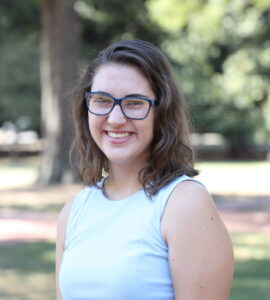
Leila Brammer is the Director of the Parrhesia Program for Public Discourse at the University of Chicago. Rooted in the Chicago Principles of Freedom of Expression, the Parrhesia Program curricula, programming, and outreach seek to foster the capacity for vigorous, inclusive, and productive discourse in the classroom, campus, and civic life. Building on the history and theory of freedom of expression and rhetoric, the curriculum and programming promote and model academic and civic practices of dialogue, deliberation, and advocacy. Outreach efforts include workshops and seminars for college/university and high school faculty and students to explore and embed both the principles and practices of open discourse in curricula, campus life, and surrounding communities.

Previously, Dr. Brammer developed a civic engagement curriculum and public deliberation and dialogue program at Gustavus Adolphus College that were recognized nationally by the American Association of Colleges and Universities and the National Communication Association. In her work in public deliberation and dialogue, Dr. Brammer builds and facilitates frameworks in which community members come to understand problems from multiple perspectives and work together to develop evidence-based approaches to address challenging civic issues.
Filed Under: Blog Posts, Events

DCI Fellow Shares Impact of Deliberation

February 4, 2022 by Carla Cole Leave a Comment

Photo of Cadie McNaboe

By Carla Cole, DCI Coordinator

Cadie McNaboe, 2020-2021 Deliberative Citizenship Initiative Fellow and Co-Convener and Davison ‘22 political science major, shares the impact deliberation has had on her life in the Davidson Journal Magazine article, “Moving From the Loudest Voice to Listener, From Debate to Deliberation.” Cadie discusses how her training and experiences as a Fellow with the DCI helped her in her classes and personal relationships. Cadie notes the importance of active listening and how her use of conversation maps helped her to become more engaged in her classes and other conversations.

Regarding her experience facilitating DCI discussions for forums and D Teams, Cadie states, “As a facilitator in the deliberations, my role wasn’t to amplify my own thoughts. Instead my goal was to create space for all participants to share, and then guide them in seeing how their different perspectives overlapped. Going from a mindset that highlights the importance of your opinion to a model where all voices are meant to be equal, was a fundamental shift.”

Cadie embraced this shift and implemented it into various aspects of her life, including family dinners where potentially divisive conversations took place. Cadie was able to facilitate a family conversation about contentious political issues and find areas of common ground rather than chaos. Cadie says she isn’t sure whether deliberation can transform our democracy, but says, “what I do know for certain is that deliberation has fundamentally transformed me.” You can read the full article here.

Filed Under: Announcements, Blog Posts, DCI Posts Tagged With: facilitation

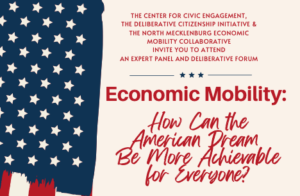
Economic Mobility: How Can the American Dream Be More Achievable for Everyone?

January 20, 2022 by Carla Cole Leave a Comment

By Carla Cole, DCI Coordinator

Davidson’s Deliberative Citizenship Initiative, Davidson’s Center for Civic Engagement, and the North Mecklenburg Economic Mobility Collaborative invite you to attend an online deliberative forum February 15th from 7 to 9 pm. The forum will begin with a talk from three expert panelists followed by small breakout group facilitated deliberations. Panelists represent a variety of perspectives and include Sheri Chisolm, Executive Director of Leading on Opportunity, Kieth Cockrell, President of Bank of America Charlotte, and Patrick Garry, author and Professor at the University of South Dakota’s School of Law and Director of the Hagemann Center for Legal & Public Policy Research.

Nationally, people across the United States are beginning to question the concept of the American dream as income inequality rises, poverty deepens, and access to education and healthcare opportunities appear unequally distributed.  If the American dream does exist, how might we begin to understand this abstract concept? In our everyday lives, how do we define this idea of economic mobility, and what different ideas have been proposed to make it more achievable for everyone? This forum will address the challenges of economic mobility and possible strategies for making the American dream more accessible to everyone.

The forum will enable participants to explore important questions, learn from experts, listen to the perspectives of others, and share ideas about economic mobility. We request that all registrants plan to attend both the panel and small group discussions, as they are designed to complement one another.

Due to the limited number of DCI trained facilitators, registration is limited, so please sign up today! This event is free and open to the public.

Filed Under: Events

Parenting, Deliberating, and Advancing Democracy

December 16, 2021 by Elaine Hall Leave a Comment

By Elaine Hall, DCI Fellow

When I applied to be a DCI fellow, part of my pitch was that I have extensive practice at navigating discussions in which there is difference and disagreement. I am raising two boys. As human beings, they often find themselves at odds with themselves, each other, me, and the world in general. Simple decisions about whether to eat at Chick-Fil-A or Cookout, whether to watch MythBusters or Great British Baking Show, whether to play Hearts or Rummikub, can and regularly do turn into pitched logical and emotional battles for the upper hand. Certainly, the skills of fostering family unity while also negotiating detailed who-chooses-the-entertainment agreements have crossover benefits for facilitating deliberations on matters of broader concern, right?

In my daily life, I often have to call a pause, remind folks to listen, restate the ground rules, and dial down the heat in order to problem-solve one situation or another. It turns out that what I’m doing constantly and informally, the DCI is defining and practicing in more formal and documented fashion. DCI has identified several key deliberative dispositions such as humility and charity that map closely to “I’m listening to your brother now, then it will be your turn,” and “  Learning to lean into these dispositions is the work of a lifetime, and it helps us thrive as individuals.

Whenever we engage conflict, or potential conflict, in the human family, there are particular skills that can help that go more smoothly. These skills are not easy. They often go against our initial inclination to storm out or declare “that’s not fair.” But they can be learned, taught, and practiced. As parents, teachers, and community leaders, we can take responsibility for building these skills in ourselves and fostering them in our people.

I have learned a lot from the work of Brenè Brown about how I can be attentive to my own experiences of vulnerability and shame, and thus show up in healthy ways when things get tough. The Gifts of Imperfection was a helpful guide to manage my own stuff as a new parent. She offered specific language and ideas for disentangling myself from judgment and perfectionism, allowing me to treat myself and others with kindness and respect. Within the DCI, we know that deliberators who can maintain kindness and respect are far more likely to be successful.

Dr. John Gottman has written on emotional health and emotional intelligence in families. His book, Raising an Emotionally Healthy Child, gives helpful guidance for teaching children. He says that the key elements are recognizing emotion, responding with connection, listening to understand and empathize, naming emotions clearly, and dealing with emotion in healthy, problem-solving ways. The same suggestions have been very helpful for my own growth. When we have the skills to recognize and move through our own emotions and discomforts, we are much better prepared to participate effectively in the hard work of deliberation.

Deliberation goes best when we practice nuanced skills for  speech and deep listening. The interconnected skills that foster strong understanding and collaborative problem solving are the work of a lifetime, yet we can practice them early and often. Whenever we practice stating our own needs and desires clearly and listening to others attentively, we are taking steps towards healthier selves, relationships, communities, and maybe even democracy.

Filed Under: Blog Posts, Fellow Posts

Finding Balance

December 9, 2021 by Meggie Lasher Leave a Comment

By Meggie Lesher, DCI Fellow

As a research librarian at Davidson, I regularly run into controversy, whether it is cutting edge yet contested scientific findings or problematic interpretations of historical events. I am often reminded that “a truly great library has something in it to offend everyone,” a quote from fellow librarian Jo Goodwin that circulates widely during Banned Books Week or when censorship issues fire up on social media.[1] Libraries have a long tradition of navigating a delicate balance between being public spaces for all and the need to regulate these spaces.

For example, most public libraries allow community groups to use meeting rooms and similar spaces within the library building. Not long ago, the American Library Association (ALA) revisited the Library Bill of Rights as it pertained to meeting room policies. A white supremacist group booked a public library meeting room, which sparked controversy over who can use library spaces. The ALA’s Intellectual Freedom Committee proposed the following language about library meeting rooms:

“Public libraries are bound by the First Amendment and the associated law governing access to a designated public forum. A publicly funded library is not obligated to provide meeting room space to the public, but if it chooses to do so, it cannot discriminate or deny access based upon the viewpoint of speakers or the content of their speech. This encompasses religious, political, and hate speech.

“If a library allows charities, non-profits, and sports organizations to discuss their activities in library meeting rooms, then the library cannot exclude religious, social, civic, partisan political, or hate groups from discussing their activities in the same facilities.”[2]

This language was adopted by the ALA in June 2018, and this decision did not go over well; library staff took to Twitter to share #NoHateALA and demonstrated their disagreement with the inclusion of hate groups in the guidance. The ALA subsequently voted to rescind this interpretation and return to the original language of the Library Bill of Rights released in 1991, included below:

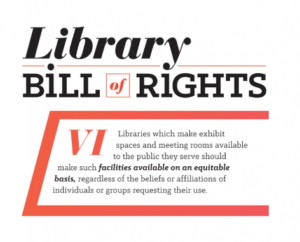
“VI. Libraries which make exhibit spaces and meeting rooms available to the public they serve should make such facilities available on an equitable basis, regardless of the beliefs or affiliations of individuals or groups requesting their use.”[3]

Concerned parties, both from the public and library staff, wanted the ALA to go further and affirm that hate speech and hate groups did not belong in the library. Returning to an older version of the Library Bill of Rights seemed like a step in the wrong direction to many critics of the decision. Yet, libraries have the responsibility to maintain access to information and public spaces no matter the affiliation or activities of the groups desiring to use the space. Libraries must call on agreements, such as the Library Bill of Rights, to ensure fairness. While affirming its commitment to intellectual freedom, the ALA has also encouraged libraries to “adopt and enforce user behavior policies that protect library users and staff from harassment.”[4]

The balance between fairness and regulation reminds me of the figurative space we enter together when preparing to deliberate. Just like libraries, there is a real need to regulate such spaces. For those new to DCI, we begin each deliberation with our conversation agreements. These agreements cover the ground rules for how we treat each other as well as guidelines about how to approach the discussion. Essentially, they hold us together while keeping us accountable. Regulation may seem like too strong of a word for our conversation agreements, yet we completed plenty of training about how to create an environment conducive to reaching a deliberative state— another type of delicate balance! We foster a shared understanding when we follow our conversation agreements and participate in difficult conversations together. Without at least some regulation, the deliberative space seems untenable and difficult to maintain. Let’s consider those agreements below.

Conversation Agreements

Each of these agreements suggests both norms to follow in the conversation as well as behaviors to avoid. For example, “be an attentive and active listener” suggests showing clearly – e.g., through your body language and your responsiveness to what others say — that you are listening to other members of the group. This agreement also suggests that being an inattentive and passive listener – playing with your phone, getting distracted, interrupting, not acknowledging others’ views – is not appropriate behavior in a deliberative context. Most of the time these agreements are internalized and followed without any problem, but sometimes the group or the facilitator may need to intervene to remind everyone of them (and in rare occasions enforce them).

Another way to consider the need for coordination and agreement in deliberative spaces is to reflect on what debate looks like in our daily lives. “Debate” is often acrimonious, combative, and rarely conclusive or inspiring. It’s more for entertainment on TV rather than an opportunity to learn from each other as we grapple with difficult questions. This style of TV debate lacks the regulation that we employ in deliberation. I see the parallels with the ALA issues on meeting spaces; without regulation, we are not nearly as democratic as we can be. Even though everyone may not agree with the ALA’s current guidance related to library spaces, the decision reflects the necessary structures that encourage democracy, just as the structures within deliberation allow us to fully participate together. As we honor structures like the conversation agreements, we are better able to enter deliberative spaces with as much equity, access, and shared respect as possible.

Image Link: https://www.oif.ala.org/oif/wp-content/uploads/2018/07/OIF-post-meeting-rooms-e1531248052538-730×589.png


[1] Learn more about censorship on this podcast episode from Brooklyn Public Library’s Borrowed Podcast.
https://www.bklynlibrary.org/podcasts/something-offend-everyone

[2] Yorio, Lisa Peet & Kara. “ALA Rolls Back Inclusion of Hate Groups in Bill of Rights Revision.” Library Journal. Accessed November 06, 2021. https://www.libraryjournal.com?detailStory=free-speech-debate-erupts-with-alas-inclusion-of-hate-groups-in-revision-of-bill-of-rights-interpretation.

Image: LaRue, Jamie. “Library Meeting Rooms for All.” Intellectual Freedom Blog (blog), July 10, 2018. https://www.oif.ala.org/oif/?p=14997.

[3] American Library Association. “Library Bill of Rights.” https://www.ala.org/advocacy/intfreedom/librarybill

[4] American Library Association. “Meeting Rooms: An Interpretation of the Library Bill of Rights.” https://www.ala.org/advocacy/intfreedom/librarybill/interpretations/meetingrooms


Filed Under: Blog Posts, Fellow Posts

  • « Go to Previous Page
  • Page 1
  • Interim pages omitted …
  • Page 65
  • Page 66
  • Page 67
  • Page 68
  • Page 69
  • Interim pages omitted …
  • Page 75
  • Go to Next Page »

Footer

Blog Post Categories

  • Announcements
  • Blog Posts
  • DCI Posts
  • Events
  • Faculty Posts
  • Fellow Posts
Image of a compass superimposed by the text "Deliberative Citizenship Initiative" and "Davidson College." Clicking on this image leads to the Initiative page.

Recent DCI Blog Posts

  • We Tried to Fix Jubilee’s “Middle Ground” – Here’s How It Went
  • A Case for Deliberation in the Natural Sciences
  • Welcoming New Staff to the DCI and DCN
  • Facebook
  • Twitter
  • Instagram
  • LinkedIn


Copyright © 2026 · Infinity Pro on Genesis Framework · WordPress · Log in