• Skip to main content
  • Skip to footer

Deliberative Citizenship Initiative

Building Democracy One Conversation at a Time

  • The Initiative
    • Programs
      • Deliberation Across the Curriculum
      • Deliberation on Campus
      • Deliberation in the Community
      • Research on Deliberation
    • Motivations
      • Why Deliberative Citizenship?
      • Why Davidson? Why Now?
    • Who’s Involved?
      • DCI Fellows Cohorts
        • 2025-2026 Fellows
        • 2024-2025 Fellows
        • 2023-2024 Fellows
        • 2022-2023 Fellows
        • 2021-2022 Fellows
        • 2020-2021 Fellows
      • DeeP Collaborative Cohorts
        • 2024-2025 DeeP Collaborative Faculty
        • 2023-2024 DeeP Collaborative Faculty
      • Advisory Council
    • History
      • What Sparked the Initiative?
    • Key Deliberative Dispositions
    • Frequently Asked Questions (FAQ)
    • Annual Report
  • Get Involved!
    • Participate in a Forum
    • Join a D Team
    • Become a Fellow
    • Take Courses
    • Get Training
    • Come to Guest Lectures
  • Events
    • Upcoming Events
      • 250th Anniversary Deliberative Forum Series on American Values
    • Past Events
  • Connections
    • The Deliberative Citizen: The DCI’s Monthly Newsletter
    • Efforts on Campus
    • Efforts in the Community
    • Efforts Elsewhere
    • Readings and Resources
      • DCI-Published Guides
      • DCI Guide to One-on-One Conversations
      • How to Disagree
      • Demonstration of Facilitation Styles
      • Deliberative Pedagogy Mini-Course
    • How We Can Help: DCI’s LET’S DELIBERATE! Partnership Opportunities
    • DCI in the News
  • DCI Blog Posts
    • Recent Blog Posts
    • All Blog Posts

The DCI Blog

Diversity and Deliberation: Making the Connection

February 22, 2023 by Kayleigh Davies

Many hands holding pieces to a puzzle in the center.

By Kayleigh Davies ’25 (DCI Fellow)

Diversity is the practice of including and involving people from a range of different backgrounds, be they social, ethnic, socioeconomic, or cultural. It drives creativity and enhances innovation; this is not a foreign concept to us. Allowing people to learn directly from each other ensures that a functioning community is established, wherein differences can coexist and standard stereotypes are dispelled.

Davidson College as an institution is not exempt from this line of thinking. Its commitment to diversity is explained through a series of statements on its website: “Davidson College believes fundamentally in the dignity and worth of every human being, and we are committed to assisting students in developing humane instincts and disciplined and creative minds for lives of leadership and service. Cultivating a broadly diverse community is crucial to our educational mission and purpose.”

Davidson College is home to a student body representing 50 states and 46 countries. Of the 1,973 students enrolled, 28% are domestic students of color, and 8% are international students. However, it is not enough to simply create a space where a diverse population exists, especially one as large as 2,000 people. In order for diversity to have the desired effect, we must ensure that measures are being taken to encourage the exposure of differences.

Similarity/attraction theory states that humans are more attracted to those they view as similar to themselves, rather than dissimilar. Such an attraction is not an inherently negative trait, but there are indisputable drawbacks to this natural inclination. There is a limit to what one can learn from someone similar to themselves.

It is undeniable that Davidson College’s community sometimes suffers from the downsides of our tendency to be attracted to those similar to ourselves. So while the college is brimming with educated students eager to deliberate on a variety of contentious issues, the productivity of the conversations are hindered by the similarities shared between the groups students find themselves in.

DCI makes a space on this campus where the diversity present is made visible. I was excited to be presented with the opportunity of becoming a DCI Fellow, but surprised when I recognized only a handful of names on the list of other student fellows. I had lived in the same building as some of these students, studied in the same places, made conversation with their roommates, all with their existence unbeknownst to me. As a group of students, we all applied to become DCI Fellows because we were attracted to the idea of deliberation, but every one of us has a different understanding of that term.

Something I have learned during the progression of our D Teams is that differences are what drive our conversations. No two people can hold a discussion if the premise is eternal agreement; the hesitation to disagree feeds awkward silences like no other. Breaking down our viewpoints to the specific components that create them often reveals even minor differences that fuel discourse, and thus amplify the productivity of our conversations.

Filed Under: Blog Posts, Fellow Posts Tagged With: D Teams

Intellectual Humility and the Power of Questions

February 20, 2023 by Heidi Meyer

Photo of zipper

Heidi Meyer ’23 (DCI Fellow)

“Do you know how a zipper works?” “Yes,” I quickly answered confidently on the survey, reflecting that I’ve used zippers my whole life on clothing, my shoes, backpacks, and more. My confidence slowed when the next question came: “Please explain in the writing response below how a zipper works.” I paused. After a bit of thinking, I wrote “I realize now I do not know how a zipper works.” 

This example was a successful lesson for me in intellectual humility. This Perspectives module, which was a part of my DCI training, had totally convinced me to completely change my viewpoint and I wasn’t angry or defensive, but rather astonished and impressed with how much my view had changed so quickly. 

The first takeaway for me was that I don’t know as much as I think I know. While there are many topics that I could give a stance on or may have learned about in the past through a class or personal research, I often forget details or don’t look deeply into topics before taking a stance. 

The beauty of intellectual humility is that it is positive. There is always more anyone can learn on any subject. Therefore everyone should be open to learning more information and with new information, changes in beliefs or stances may come. If society can learn to embrace intellectual humility and a growth mindset around learning, it would help combat polarization. People would be more willing to engage with someone who holds a different viewpoint, as every conversation would pose an opportunity to learn and grow. This doesn’t mean that everyone will change their core beliefs after one conversation, but it does mean that you can learn about someone, humanize them, and sympathize with why they might hold a different view than you do. 

The second lesson for me was the power of questions. The efficacy of a question to diplomatically disarm someone is powerful and can not only help someone change their mind but can also help protect a relationship from being harmed by a disagreement. Most people become defensive when their views and especially core beliefs are challenged. But asking genuine questions to understand where someone is coming from, however, can help you learn about their reasoning and simultaneously encourage them to reflect on their reasoning. This self-reflection is often more effective in getting someone to realize their mistake than telling someone why they are wrong. In the zipper example, I was completely convinced to change my mind to a completely different perspective due to one question asking me to explain my stance. 

While zippers are a niche topic, the lesson applies to other subjects such as politics, workplaces, and personal relationships. Asking people to explain their positions is an effective way to help them think through their position and defend it. The answers can help you understand where someone is coming from or help that individual consider other perspectives if they realize they aren’t as sure as they thought they were about why they held such a stance. 

In today’s modern polarized society, questions are a simple but effective way to come together, whether through learning about the other side or encouraging people to be more curious and openminded. When asking questions, be mindful to also ask yourself why you hold the views you do and to remain intellectually humble even if you have answers to your own questions.  There is always more you can learn that may change the way you think and feel.

Filed Under: Blog Posts, Fellow Posts Tagged With: D Teams, facilitation

Citizen University CEO Eric Liu Visits Davidson Monday – RSVP Today!

February 2, 2023 by Graham Bullock

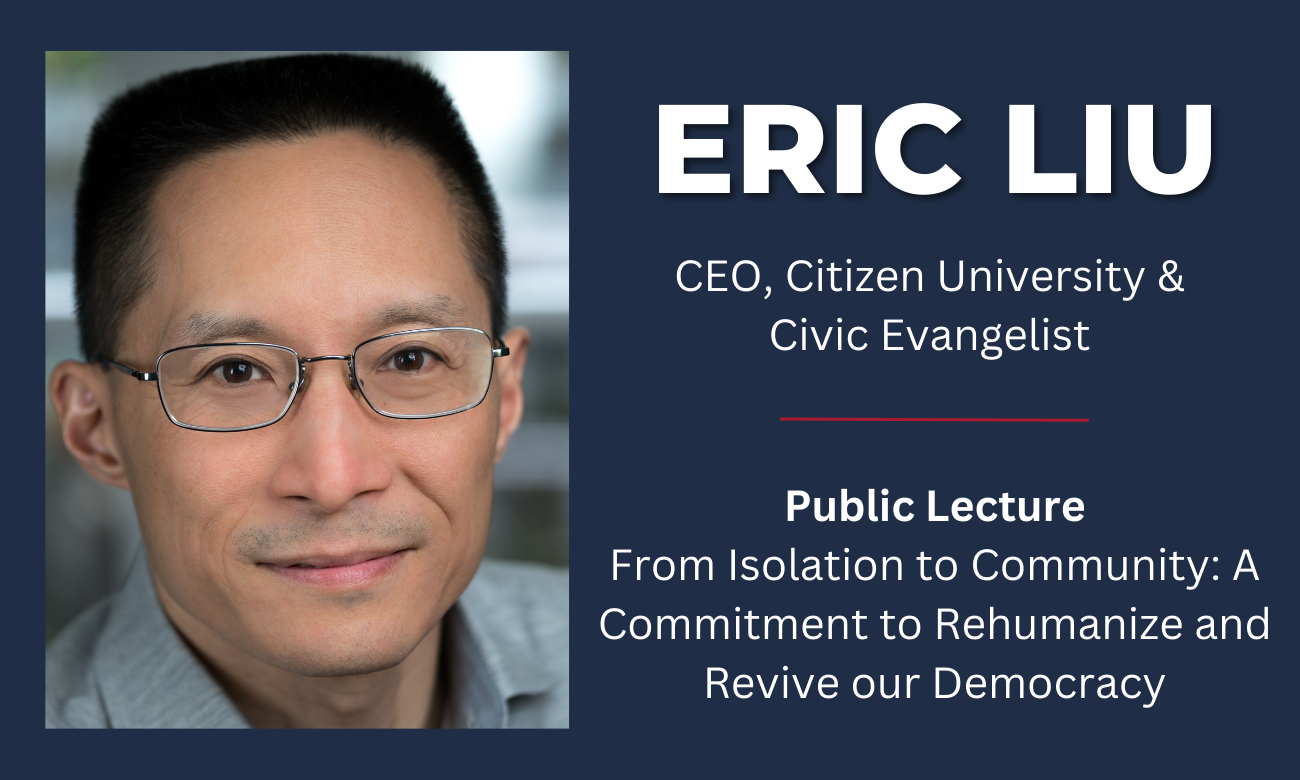
Introductory Slide for Eric Liu.

We are excited to share some information about two upcoming events co-sponsored by the Bonner Scholars Program and the Deliberative Citizenship Initiative featuring Citizen University CEO Eric Liu. The first is a public lecture by Mr. Liu this coming Monday evening (2/6) from 5 pm to 6:30 pm in the Lilly Gallery. The theme of his talk is “From Isolation to Community: A Commitment to Rehumanize and Revive our Democracy.” More information is below and attached; the event is free to attend in person but an RSVP is required on WildCatSync (there will also be a livestreaming option).

After his keynote address, Liu will lead a smaller interactive conversation exploring the key insights from the Better Arguments Project, a national civic initiative that he helped create to “bridge divides – not by papering over those divides but by helping people have better arguments.” Learn more below and RSVP on WildCatSync. The event is in-person and dinner is included for all participants, but seating is limited so RSVP as soon as possible if you are interested in joining.

Eric-Liu-Flyer-for-Email

PUBLIC LECTURE:

From Isolation to Community: A Commitment to Rehumanize and Revive our Democracy

Monday, February 6th, 5 pm to 6:30 pm

Is it possible to escape our culture of hyperindividualism, digital isolation, and status anxiety? What does it mean to be an engaged citizen in today’s divisive and divided political landscape? How can we come together to restore hope, find joy and purpose, revive democracy, and feel part of a connected community? Citizen University CEO Eric Liu confronts these questions, celebrates the shared values and beliefs that unite us, and provides an action plan for powerful citizenship. Drawing from his hit TED talk and the “Civic Saturdays” phenomenon his organization sparked, Liu will challenge us to rehumanize our politics and rekindle a spirit of love and responsibility in civic life. Not just for the good we will do for society, but for the powerful good that we will do for ourselves. To RSVP for this free event co-hosted by the Bonner Scholars Program and the Deliberative Citizenship Initiative, click here (in-person and streaming options available).

The Better Arguments Project:

AN INTERACTIVE CONVERSATION AND DINNER

Monday, February 6th, 7 pm to 8:30 pm

After his keynote address, Citizen University CEO Eric Liu will lead a smaller interactive conversation exploring the key insights from the Better Arguments Project, a national civic initiative that Liu helped create “to help bridge divides – not by papering over those divides but by helping people have better arguments.” Designed as a practical approach to enable individuals and groups with diverse perspectives to engage with one another (without rushing prematurely towards reconciliation), the Better Arguments Project focuses on incorporating historical context, emotional intelligence, and a recognition of power dynamics into these efforts. It is also based on five key principles for better arguments, which Liu will introduce and help participants actively consider how they can incorporate into their future conversations across differences. Dinner is included for all participants, but seating is limited so RSVP as soon as possible if you are interested in joining.           

Eric Liu, Citizen University CEO and Co-Founder

SPEAKER BACKGROUND

“Democracy works only when enough of us believe democracy works,” says Eric Liu. How do we rekindle that belief? How do we, as individuals, organizations, communities, corporations — even professions — reinvigorate the meaning and spirit of citizenship in America? These are the questions civic evangelist Eric Liu explores in his compelling, acclaimed talks – talks that celebrate our shared values and challenge Americans to live up to them. Liu is one of the country’s most sought-after speakers on citizen power, civic health, the future of democracy, and American identity. His inspirational 2019 main stage TED Talk, based on his work at Citizen University, received a standing ovation and more than topped one million views in less than a month. His two previous TED Talks, on power and on voting, have been viewed three million times. Recently, Liu has been elected to membership in the American Academy of the Arts and selected to be a 2020 Ashoka Fellow. In both cases he was recognized by colleagues and was championed by friends.

Liu, son of Chinese immigrants and former White House speechwriter, is the CEO of Citizen University, a nonprofit working to foster a culture of powerful, responsible citizenship. He also directs the Aspen Institute’s Citizenship & American Identity Program and is a correspondent at TheAtlantic.com. His eight books include You’re More Powerful Than You Think: A Citizen’s Guide to Making Change Happen, and the national best-sellers The Gardens of Democracy and True Patriot. His first book, The Accidental Asian, Notes of a Native Speaker was a New York Times Notable Book featured in the PBS documentary, “Matters of Race.” Liu’s latest book is Become America: Civic Sermons on Love, Responsibility and Democracy, which grows out of the Civic Saturday phenomenon that Liu and his team pioneered and has now spread nationwide. Liu served as a White House speechwriter for President Bill Clinton and later as the President’s deputy domestic policy adviser. He has also served as a board member of the Corporation for National and Community Service, the Washington State Board of Education and the Seattle Public Library and is co-founder of the Alliance for Gun Responsibility. He is a graduate of Yale College and Harvard Law School.

Reviewed as “phenomenal,” “amazing,” “motivating,” “moving” and “empowering” by audiences ranging from university leaders and K-12 educators to innovators in corporate citizenship, health care, and architecture, Liu’s talks are unforgettable experiences. With passion, magnetism, a grounding in history, and a sense of humor, Liu touches people from all walks of life and across the political spectrum. He ignites and unites. And he leaves his audiences inspired to take action, with a renewed spirit of common purpose and a deeper sense of civic responsibility.

Filed Under: Events

Don’t Expect It, but Persuasion is Possible

January 31, 2023 by Brody Bassett

Stock Image of multiple headshots making the shape of a lightbulb.

By Brody Bassett ’25 (DCI Fellow)

Going into my first semester as a facilitator with the Deliberative Citizenship Initiative, I was excited to hopefully help people hear different opinions. I hoped to help facilitate discussion to break people out of potential “echo chambers,” so there could be more understanding between opposing viewpoints on and off Davidson’s campus. 

After my first week of facilitations, I was pleased with the development of the deliberations. The members of my group were openly conversing about their opinions and viewpoints. During the first session, I was able to see the different perspectives within the groups. These different perspectives led to differing political beliefs which were talked about during the discussion. I was happy to see that my deliberation team engaged with each other despite their differences in opinion.

One of the first deliberation topics of my session brought about a specific voting option: mail-in voting. People certainly had different opinions about this option and its effects on the overall electoral process.  Specifically, one person voiced the opinion that mail-in voting leads to a potential for less integrity within the voting system. Another individual from the deliberation voiced their own belief that mail-in voting allows more accessibility for working-class Americans. The two then began to weigh the pros and cons of the mail-in voting system, each expressing their own opinions. I was happy to facilitate this discussion, and both parties productively expressed their opinions while other members began to weigh in as well, leading to a fruitful exchange of ideas. My first facilitation lived up to my expectations as people shared different viewpoints, exposing each other to different opinions. In my next facilitation, however, the conversation did not follow my expectations.

As stated above, I was committed to being a facilitator of deliberation groups to hopefully show people different perspectives on politically contentious topics. I frankly did not realize the potential of deliberation groups to change people’s opinions on political topics. As facilitators, we don’t expect our group’s participants to necessarily alter their views on these topics; we are more focused on encouraging listening, sharing, and exploring new ideas together.  So my expectations were broken when I was pleasantly surprised that one of my D Team members humbly started our time by admitting that they conceded their viewpoint from the last deliberation. The member recounted specific details from the opposing point of view, leading them to the conclusion that they might be wrong. They shared this revelation with the group and thanked everyone for the discussion that helped change their viewpoint.

Following my second meeting with my D Team, I was impressed by the humility and the bravery the individual took to let go of their views and acknowledge to a group their change in opinion. This interaction showed me that deliberation groups were more than just tools to break people from their “echo chambers,” and that deliberations could bring people to accept new ideas. While not all the members of D Teams will come forward to share their change in opinion, the environment of a deliberation group does allow for the change of opinions in a healthy space. We shouldn’t expect it but it does happen and I was very pleased to see it firsthand.

Filed Under: Blog Posts, Fellow Posts Tagged With: D Teams, facilitation

Spring 2023 D Teams are Here! Register Today!

January 10, 2023 by Graham Bullock

D-Teams-Poster_Spring-2023

Following our successful fall deliberations about elections, this spring the Deliberative Citizenship Initiative (DCI) is hosting two tracks of discussions on important issues facing our society. The first single-topic track will take a deep dive on pressing issues relating to climate change, while the second multi-topic track will explore questions related to three key policy areas – climate change, immigration, and college admission policies. These were the highest priority issues identified in surveys of previous D Team members and discussions among the DCI Fellows and Co-Conveners. When registering, you will be able to indicate which is your preference (if you have one).

Climate Change (Single-Topic Track)

The last year witnessed record temperatures in North America, Europe and elsewhere, as well as record floods around the world, including in Kentucky, Pakistan, and Australia. Large majorities of scientists, policymakers, business leaders, and citizens now generally agree that climate change is occurring, but often differ on particular strategies to pursue and who should be responsible for implementing them. Over the course of three sessions, participants in this D Team track will take a deep dive into the topic of climate change, tackling three key questions:

  1. Climate Choices (Part I): What climate strategies, if any, should we pursue? Should we focus more on reducing carbon emissions, protecting communities from the impacts of climate change, or accelerating the development of innovations that can make it easier to do both?
  2. Climate Responsibilities (Part II): Who, if anyone, should be responsible for paying for these strategies? Should everyone pay an equal share, should polluters pay more, or should those with greater capacity pay more?
  3. Climate Responsibilities (Part III): Who, if anyone, should be responsible for implementing these strategies? Should governments, businesses, or consumers take the greatest responsibility for taking action on climate change?

    Immigration, College Admission Policies, and Climate Change (Multi-Topic Track)

    The DCI’s second track will also discuss our climate choices along with two other topics – immigration and college admissions policies.

    1. Immigration Choices: In 2022, there were a record number of migrant border crossing into the United States. Who should we welcome? What should we do? Should we welcome all immigrants and be a beacon for freedom, enforce the law and be fair to those who follow the rules, or slow down and re-build our common bonds? 
    2. College Admission Choices: In 2023, the Supreme Court will rule on two highly consequential cases related to the use of race in college admissions. How should applicants’ backgrounds be taken into account, if at all? To what extent should race, athletic performance, legacy status, gender, socio-economic status, and/or merit be used in the admission process?
    3. Climate Choices: What climate strategies, if any, should we pursue? Should we focus more on reducing carbon emissions, protecting communities from the impacts of climate change, or accelerating the development of innovations that can make it easier to do both?

      Registration

      Spring 2023 D Team Registration — CLICK HERE

      • To register for a spring D Team, click on the link above. The registration deadline is Monday, January 23rd.
      • You can choose from several dates and times. Please have your calendar ready and updated when you register and indicate all time slots that you will be available.
      • In consideration of others in your group, you are expected to attend all three sessions.
      • Group assignments, along with the date, time and the DCI Fellow leading your D Team will be emailed to you by Monday, January 30th.
      • We encourage you to invite someone who has different perspectives on the issues than you to join a D Team as well. Please this information with a colleague, friend, neighbor, or family member who you think might be interested. Everyone is welcome and encouraged to join!

      Dates

      • Registration deadline – Monday, January 23
      • D Team Assignments sent to participants – Monday, January 30
      • D Team Session 1 – Week of Monday, February 20th
      • D Team Session 2 – Week of Monday, March 20th
      • D Team Session 3 – Week of Monday, April 10th

      More Information

      See below for some comments from recent D Team participants (over 160 people participated on 19 different teams this past fall):

      “My D Team experience allowed me to have rich discussions with a mix of students, staff, and alumni. I particularly enjoyed the diversity in our ages and backgrounds. The written guides and our facilitator helped me feel prepared to participate in topics I had little experience in discussing, especially outside of my own friend group.”

      “The DCI experience is one of the rare opportunities in these contentious times that cross-generational and cross-political perspectives can be shared and engaged within a respectful discussion.”

      Click here to learn more and watch a short video about the D Team experience. You can also find out about the difference between SkillBuilder and BridgeBuilder Teams and read more testimonials from past participants.

      Filed Under: Announcements Tagged With: D Teams

      • « Go to Previous Page
      • Page 1
      • Interim pages omitted …
      • Page 55
      • Page 56
      • Page 57
      • Page 58
      • Page 59
      • Interim pages omitted …
      • Page 75
      • Go to Next Page »

      Footer

      Blog Post Categories

      • Announcements
      • Blog Posts
      • DCI Posts
      • Events
      • Faculty Posts
      • Fellow Posts
      Image of a compass superimposed by the text "Deliberative Citizenship Initiative" and "Davidson College." Clicking on this image leads to the Initiative page.

      Recent DCI Blog Posts

      • We Tried to Fix Jubilee’s “Middle Ground” – Here’s How It Went
      • A Case for Deliberation in the Natural Sciences
      • Welcoming New Staff to the DCI and DCN
      • Facebook
      • Twitter
      • Instagram
      • LinkedIn


      Copyright © 2026 · Infinity Pro on Genesis Framework · WordPress · Log in