• Skip to main content
  • Skip to footer

Deliberative Citizenship Initiative

Building Democracy One Conversation at a Time

  • The Initiative
    • Programs
      • Deliberation Across the Curriculum
      • Deliberation on Campus
      • Deliberation in the Community
      • Research on Deliberation
    • Motivations
      • Why Deliberative Citizenship?
      • Why Davidson? Why Now?
    • Who’s Involved?
      • DCI Fellows Cohorts
        • 2025-2026 Fellows
        • 2024-2025 Fellows
        • 2023-2024 Fellows
        • 2022-2023 Fellows
        • 2021-2022 Fellows
        • 2020-2021 Fellows
      • DeeP Collaborative Cohorts
        • 2024-2025 DeeP Collaborative Faculty
        • 2023-2024 DeeP Collaborative Faculty
      • Advisory Council
    • History
      • What Sparked the Initiative?
    • Key Deliberative Dispositions
    • Frequently Asked Questions (FAQ)
    • Annual Report
  • Get Involved!
    • Participate in a Forum
    • Join a D Team
    • Become a Fellow
    • Take Courses
    • Get Training
    • Come to Guest Lectures
  • Events
    • Upcoming Events
      • 250th Anniversary Deliberative Forum Series on American Values
    • Past Events
  • Connections
    • The Deliberative Citizen: The DCI’s Monthly Newsletter
    • Efforts on Campus
    • Efforts in the Community
    • Efforts Elsewhere
    • Readings and Resources
      • DCI-Published Guides
      • DCI Guide to One-on-One Conversations
      • How to Disagree
      • Demonstration of Facilitation Styles
      • Deliberative Pedagogy Mini-Course
    • How We Can Help: DCI’s LET’S DELIBERATE! Partnership Opportunities
    • DCI in the News
  • DCI Blog Posts
    • Recent Blog Posts
    • All Blog Posts

The DCI Blog

Polarization and Deliberation on College Campuses

April 24, 2023 by Miles Charles

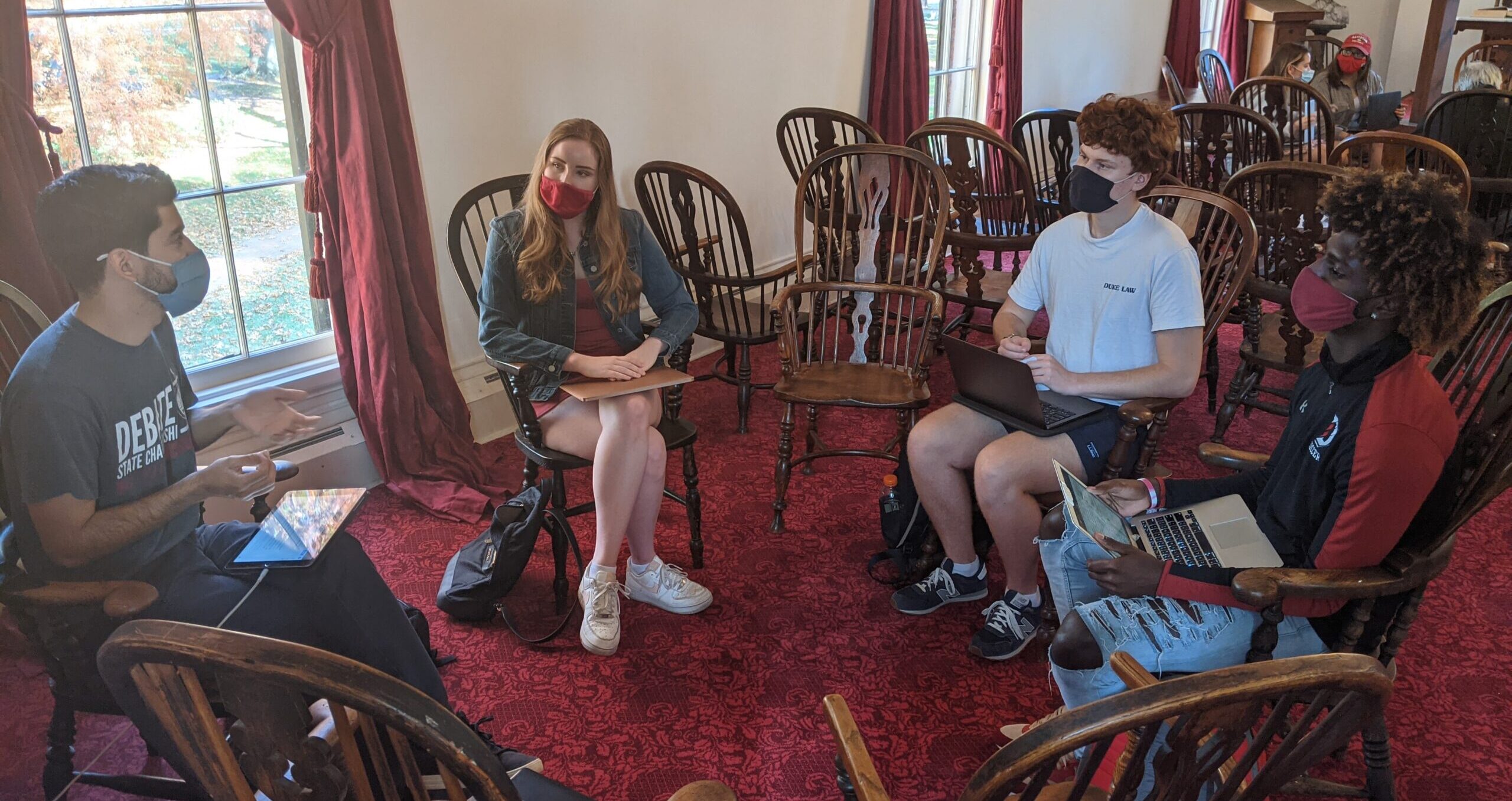
Group of Students talking in a circle.

By Miles Charles ’25 (DCI Fellow)

College campuses are often microcosms of society at large, with students from a wide range of backgrounds and experiences coming together in one place. However, these diverse communities are not immune to the challenges of polarization and division that are currently plaguing our society. Whether it’s disagreements over politics, social issues, or campus policies, tensions can run high on college campuses. But there is hope: deliberation can be a powerful tool for bringing together a divided college campus.

Deliberation involves the careful consideration and discussion of issues, with an emphasis on active listening, respectful communication, and a willingness to engage with others in good faith. When applied to the context of a college campus, Davidson College for example, deliberation opens the opportunity to foster a deeper sense of community past simply being a wildcat and promote a culture of constructive dialogue.

One way to incorporate deliberation on a college campus, as DCI has done at Davidson, is through the implementation of deliberative groups and forums. These groups are facilitated and led by trained Davidson Students to better encourage student participation. As a student facilitator, I have seen and experienced firsthand how student led deliberations create a space in which all voices are heard and respected, regardless of political affiliation, background, or personal beliefs.

Another innovative approach is to incorporate deliberation into the curriculum itself. Various colleges and universities have already begun to do so, incorporating courses on topics such as civil discourse, conflict resolution, and intergroup dialogue. Within the Davidson context, deliberation is being incorporated in courses across the curriculum by faculty participants in the DCI’s Deliberative Pedagogy Collaborative. Expanding these efforts will expose students to different perspectives and teach them skills needed to engage in productive class discussions, dialogues, and promote a more inclusive community.

Deliberation can also be effective in addressing specific issues or conflicts on a college campus. For example, as a student, a controversial issue is the limited number of parking spots on campus. By employing the deliberative process, the various stakeholders such as administration, students, employees, visitors, and more can be brought together to engage in constructive dialogue. This can help to identify common ground and find solutions that are acceptable to all parties involved.

In order for deliberation to be effective, it is important to create a culture that values respectful communication and open-mindedness. This can be achieved through workshops, trainings, and other educational initiatives that teach students and staff the skills necessary to engage in productive dialogue. It is also important to ensure that all voices are represented and that everyone feels comfortable participating in the process.

In conclusion, deliberation is a powerful tool for bringing together a divided college campus. By creating spaces for respectful and constructive dialogue, incorporating deliberative approaches into the curriculum, and addressing specific issues through a deliberative process, colleges and universities can foster a more inclusive and welcoming campus community.

*Photo above is from students participating in a deliberation designed and facilitated by students in a course on ethics and policymaking in the fall of 2021. Over a dozen such deliberation-involved courses have been taught by faculty participants in the DCI’s Deliberative Pedagogy (DeeP) Collaborative.

Filed Under: Blog Posts, Fellow Posts

Building Coalitions Through Deliberation

April 18, 2023 by Daniel Lee

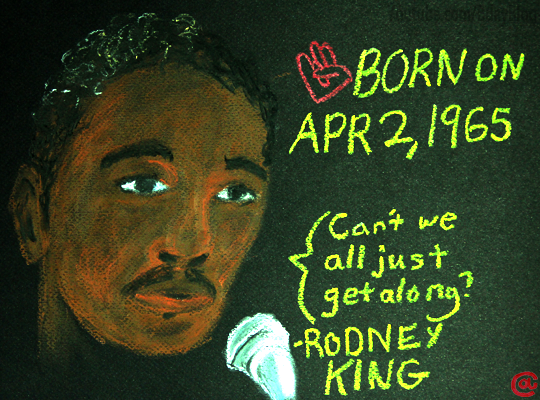
Painting of Rodney King with quote "Can't we all just get along?" and "Born on April 2, 1965."

Daniel Lee ’26 (DCI Fellow)

April 30th, 1992. Fire blazed through the streets of Koreatown and South Central in Los Angeles. Korean Americans frantically ran about, attempting without much success to prevent looters from stealing from vandalized buildings. The police were nowhere to be seen—the people were on their own, helpless except for a few handguns and the presence of one another.

March 3rd, 1991. Rodney King, a Black construction worker, enjoyed a few drinks with his friends and drove down Interstate 210. A few officers noticed him speeding and pursued his vehicle. Determined to avoid being convicted and thus violating parole for a previous robbery, King led the police on a high-speed chase through Los Angeles. He was eventually arrested and beaten mercilessly by a swarm of officers.

The act of police brutality was recorded and distributed through the media, enraging Black communities. When King’s case was taken to court, the resulting verdict only furthered the brewing anger by favoring the position of the white officers. Infuriated, Blacks violently protested in the streets of Koreatown and South Central, destroying and burning property. The police dared not intervene, leaving residents to fend for themselves. Ultimately, an estimated 2,300 privately-owned businesses run by Korean Americans were harmed, measuring up to approximately $400 million in damages.

On its face, the 1992 LA Riots tell a story of police brutality and white supremacy. But in close examination, it also tells a story of the dysfunctional relationship between Black and Korean American communities. Cultural misunderstanding and prejudice directed at one another create unnecessary division among marginalized communities and make it difficult to develop meaningful coalitions to fight against greater structural problems. Often, this dysfunctional dynamic arises from differences in cultural etiquettes (e.g., norms surrounding eye contact and merchant-customer interaction) and faulty stereotypes that instill unreasonable fear and hatred in people’s minds. Without this unfortunate misperception, it seems unlikely that the 1992 LA Riots would have manifested in the way they did.

In this light, it is my sincere hope to break down existing cultural misunderstandings and work towards building productive coalitions between the AAPI community and other marginalized communities. Instead of being held at an impasse over our differences, we must work hand-in-hand to fight against the greater evil—structural racism and prejudice that weigh down our communities. This starts with intentional education that dissolves toxic stereotypes and respectful deliberations that allow communities to find common ground and see each other in a truer light.

Through the skills and life experiences I develop as a DCI Fellow, I hope to use deliberation to lead successful coalition-building between marginalized communities. The empowerment of future generations to create a more perfect society founded upon values of justice and inclusion starts with everyday conversations grounded in intellectual humility and genuine respect. Instead of being in conflict with each other, I dream of people from all different cultures and backgrounds standing together, hope dancing with our every heartbeat as we march on toward a brighter future.

Image by Cass Anaya used under Creative Commons License

Filed Under: Blog Posts, Fellow Posts Tagged With: facilitation, politics

The Importance of Notetaking

April 12, 2023 by Brody Bassett

Stock Image of Person notetaking

By Brody Bassett ’25 (DCI Fellow)

Going into my second semester of being a DCI facilitator, I was very excited to host my first D-Team of the new year! Before my D-Team, I made sure to look over my suggested self-improvements from last semester. Amidst the comments of stop fidgeting, sit up straight, and smile was buried the comment: “take notes.” While the comment seemed simple at first, I realized it held a lot of value. Notetaking allows the facilitator to record important ideas to follow up on and allows the facilitator to fade into the background.

In my previous DCI facilitator events, I always took notes but did not give them much attention. Notetaking was simply an extension of my memory, and from my notes, I was able to pull relevant questions and pose them to my group. The exercise of taking notes was helpful to me because while my brain was busy making sure DCI agreements were followed and monitoring everyone’s speaking time, I could simply write down important points brought up to the deliberation. This allowed me to put my main focus on the fluidity of the deliberation. When the time came, I had an abundance of questions to choose from to continue the conversation.

Simply, notetaking acts as an extension of the brain, so the facilitator can solely focus on maintaining the agreements and learning environment of the deliberation.

Secondly, the practice of taking notes allows the facilitator to fade into the background of the deliberation. By notetaking, the facilitator starts to resemble a scribe. A member of the group talks about their thoughts on a specific topic, and the facilitator diligently records the central point for comparison with other people’s ideas. It is important to state, however, that the facilitator must be careful not to become a scribe and remember that they are in charge of maintaining a good environment for deliberation. So the difference between a scribe and a facilitator is that the facilitator interjects comments in the deliberation to keep it on track and oriented towards the expected outcomes.

Keeping that thought in mind, the act of notetaking helps put the facilitator more at the same level as the members of the deliberation. The deliberators respect the facilitator’s advice and direction of the conversation while the facilitator respectfully records the main comments from the discussion to provide important points to return to later in the deliberation. This reinforces the idea that the facilitator is present not to simply direct and lead the conversation but to facilitate listening and sharing among the group, and will fade into and out of the conversation as needed to do so. Notetaking helps the facilitator remind the group of questions and ideas to consider.

At the time of writing this blog, my D Team has just finished the meeting, and I used my notetaking tactic. By notetaking, I was able to focus on maintaining a productive deliberation environment, and I found myself able to produce relevant questions for my group members to continue the conversation. Overall, I think notetaking is a valuable tool for a facilitator to use during their deliberations.

Filed Under: Blog Posts, Fellow Posts Tagged With: D Teams

Registration for Upcoming Deliberative Forum on Social Media is Open!

March 15, 2023 by Graham Bullock

Image of Social Media: How should we engage and/or regulate it, if at all.

With Elon Musk’s recent acquisition of Twitter, the Supreme Court’s upcoming rulings on two cases (Gonzalez v. Google and Twitter v. Taameh) related to online content, and continuing concerns about the effects of online interactions on the mental health of teenagers in the news, questions about the role of social media in our lives have never been more salient. These questions exist at both the micro-level of personal decisions and interactions and the macro-level of society, politics, and democracy. Should we be on social media? Should we regulate it? If so, how and to what extent? Some argue that social media is generally positive for both individuals and society, while others assert that its harms far outweigh its benefits – at least as it currently operates.

To explore these questions, Davidson College’s Deliberative Citizenship Initiative, Digital Studies, Political Science, and Psychology Departments, and Jay Hurt Hub for Innovation and Entrepreneurship invite you to join us for a Deliberative Forum on “Social Media: How Should We Engage and/or Regulate it, If at All?” This Deliberative Forum will enable participants to actively engage with this important issue, first by hearing from an online panel of experts with diverse perspectives on the topic, and then by actively deliberating with one another in facilitated small group discussions (either in person or virtually) on how best to engage with and regulate social media (if at all). This is a fantastic opportunity to learn from experts, listen to the viewpoints of others, and share your own ideas about this challenging and complex topic.

The event is free but registration is required. We request that all registrants plan to attend both the panel and the small group discussions, which are designed to complement each other. Participants may join both in-person and online. Spaces are limited due to the number of trained DCI facilitators we have available to moderate the small group discussions. You may be placed on a waitlist if our capacity is reached; we will let you know if spaces open up. We will do our best to accommodate as many people as we can so please don’t hesitate to get on the waitlist. The Zoom link will be sent to online participants after they register.

Register on EventBrite
Social-Media-Forum-Poster_4.5.23

Panelist Bios:

Emily Dreyfuss is a journalist who covers the impacts of technology on society, with a focus on social media and information systems. She was a 2018 Nieman Berkman Klein fellow, a senior editor at WIRED and CNET, and a founding editor of the tech news website Protocol. Ms. Dreyfuss is currently Senior Editor and Research Fellow at the Harvard Kennedy School’s Technology and Social Change Project, where she co-leads the Harvard Shorenstein News Leaders Program and edits the Media Manipulation Casebook, a research platform that advances knowledge of misinformation and its threats to democracy, public health, and security. Ms. Dreyfuss is also a co-author of the 2022 book, Meme Wars: The Untold Story of the Online Battles Upending Democracy in America.

Melissa Hunt is the Associate Director of Clinical Training in the Department of Psychology at the University of Pennsylvania, where she also earned her PhD in psychology. Dr. Hunt conducts ongoing research on the cognitive and affective bases of depression, anxiety, and chronic gastrointestinal disorders, and has published two books on these topics for both patients and clinicians. In 2018, Dr. Hunt published the first experimental study on Facebook, Snapchat, and Instagram use, and found a causal link between time spent on these platforms and increased loneliness and depression. The study, “No More FOMO: Limiting Social Media Decreases Loneliness and Depression,” was published in the Journal of Social and Clinical Psychology and has been cited over 700 times.

Darius Kazemi is an internet artist and researcher who has been working on federated, decentralized social media since his Mozilla Open Web Fellowship in 2018. He maintains several federated social media software projects including Hometown, and published Run Your Own Social, a guide to hosting a small social media site for your friends. He is a Senior Software Engineer at Meedan where he works on Check, a software tool for content moderators and fact-checkers. He has been interviewed by The Wall Street Journal and The New York Times about the difficulty of identifying bot accounts on social media, and The Boston Globe has described him as “one of the most closely watched and pioneering figures at the intersection of technology, cultural commentary, and what feels to many like a new kind of Web-native art.”

Jacob Mchangama is CEO of the think tank Justitia and directs the organization´s Future of Free Speech Project. Jacob has written and commented extensively on free speech and human rights in international media outlets, including the Economist, L.A. Times, Washington Post, BBC, CBS News, NPR, CNN, Foreign Affairs, Foreign Policy, The Wall Street Journal, and Politico as well as top-tier academic and peer-reviewed journals. Jacob frequently appears on international TV and radio providing expert commentary on issues related to free speech, tech and human rights. Jacob is the producer and narrator of the podcast “Clear and Present” Danger: A History of Free Speech and author of the critically acclaimed book Free Speech: A History From Socrates to Social Media, published by Basic Books in 2022.

Mark Sample, Chair and Professor of Digital Studies at Davidson College, will serve as the moderator of the panel.

Filed Under: Events

10 Minutes a Day!

March 1, 2023 by Mae Corley

calendar stock image

Mae Corley ’25 (DCI Fellow)

As a DCI Fellow this year, I have learned the power of a great facilitator to drive a conversation, play devil’s advocate, and dig deeper within a discussion. Yet, I’ve become much more aware of the informal deliberations that occur right in front of me every day. In those scenarios, an official facilitator is rarely present and conversation management must be controlled and determined by the parties engaged in the deliberation. These conversations may be complex or simple or anywhere in between but deliberation norms are still as important as ever. This sounds straightforward, but these conversations are much more difficult than they seem.

I can vividly remember the most powerful conversations I’ve had with friends, family, and teachers. All of them include a surrender of ego and acceptance that learning is done by listening. These powerful conversations require honesty on a level that can be intimidating. Deliberations like this take hard work and effort. It is difficult to be this vulnerable with people you do not feel comfortable with, and I find myself relying on several friends who have a natural ability to make me feel heard and valued. I strive to be a person who can invite these types of conversations with people I do not know extremely well. DCI has taught me the importance of this skill (which can be developed and practiced) to seek intentional conversations and practice thinking through my actions when engaging with people with other views.

On Davidson’s campus, I often hear students express a desire to have deliberative conversations, but I think many people are forgetting an important step. They are forgetting to first practice deliberative skills that would allow them to have successful informal deliberations every day. They are unaware of how important it is to intentionally manage conversations to keep both parties comfortable and willing to engage respectfully.

So, what should be done? Where is the magical solution which will create incredible deliberative conversations everywhere we turn at Davidson? Well, I think it’s simpler than you would think. I’ve often heard the idea of small acts of kindness. The purpose is to encourage each individual to complete one small act of kindness each day and, compounded together with the actions of the larger community, a huge impact will be felt. I propose the same method for deliberative skills and conversations. If we can challenge our Davidson community to practice deliberation and community engagement similarly then imagine the impact.

Each person can challenge themselves to seek out one intentional, deliberative conversation each day. It could be short – ten minutes (or perhaps longer!) – but engagement with deliberative skills each day makes these conversations and skills easier over time. Ten minutes of practicing intellectual humility, active listening, and thoughtful discussion with another person can encourage the entire campus to pick up these important skills.

Perhaps I’ve oversimplified, but I think the point remains. Informal deliberation is extremely important, but it’s a difficult pursuit. It takes more effort and intentionality than one would expect. Davidson stands to benefit greatly from a community that chooses to engage with each other in deliberative ways and seeks to learn from others. It isn’t easy, but it is extremely important for growth and learning in our Davidson community. It can start with just a few minutes every day!

Filed Under: Blog Posts, Fellow Posts Tagged With: D Teams

  • « Go to Previous Page
  • Page 1
  • Interim pages omitted …
  • Page 54
  • Page 55
  • Page 56
  • Page 57
  • Page 58
  • Interim pages omitted …
  • Page 75
  • Go to Next Page »

Footer

Blog Post Categories

  • Announcements
  • Blog Posts
  • DCI Posts
  • Events
  • Faculty Posts
  • Fellow Posts
Image of a compass superimposed by the text "Deliberative Citizenship Initiative" and "Davidson College." Clicking on this image leads to the Initiative page.

Recent DCI Blog Posts

  • We Tried to Fix Jubilee’s “Middle Ground” – Here’s How It Went
  • A Case for Deliberation in the Natural Sciences
  • Welcoming New Staff to the DCI and DCN
  • Facebook
  • Twitter
  • Instagram
  • LinkedIn


Copyright © 2026 · Infinity Pro on Genesis Framework · WordPress · Log in