• Skip to main content
  • Skip to footer

Deliberative Citizenship Initiative

Building Democracy One Conversation at a Time

  • The Initiative
    • Programs
      • Deliberation Across the Curriculum
      • Deliberation on Campus
      • Deliberation in the Community
      • Research on Deliberation
    • Motivations
      • Why Deliberative Citizenship?
      • Why Davidson? Why Now?
    • Who’s Involved?
      • DCI Fellows Cohorts
        • 2025-2026 Fellows
        • 2024-2025 Fellows
        • 2023-2024 Fellows
        • 2022-2023 Fellows
        • 2021-2022 Fellows
        • 2020-2021 Fellows
      • DeeP Collaborative Cohorts
        • 2024-2025 DeeP Collaborative Faculty
        • 2023-2024 DeeP Collaborative Faculty
      • Advisory Council
    • History
      • What Sparked the Initiative?
    • Key Deliberative Dispositions
    • Frequently Asked Questions (FAQ)
    • Annual Report
  • Get Involved!
    • Participate in a Forum
    • Join a D Team
    • Become a Fellow
    • Take Courses
    • Get Training
    • Come to Guest Lectures
  • Events
    • Upcoming Events
      • 250th Anniversary Deliberative Forum Series on American Values
    • Past Events
  • Connections
    • The Deliberative Citizen: The DCI’s Monthly Newsletter
    • Efforts on Campus
    • Efforts in the Community
    • Efforts Elsewhere
    • Readings and Resources
      • DCI-Published Guides
      • DCI Guide to One-on-One Conversations
      • How to Disagree
      • Demonstration of Facilitation Styles
      • Deliberative Pedagogy Mini-Course
    • How We Can Help: DCI’s LET’S DELIBERATE! Partnership Opportunities
    • DCI in the News
  • DCI Blog Posts
    • Recent Blog Posts
    • All Blog Posts

The DCI Blog

A Look Back: The DCI’s Spring Forum on Social Media

December 4, 2023 by Graham Bullock Leave a Comment

Image of Social Media: How should we engage and/or regulate it, if at all.

In the Spring of 2023, Davidson College’s Deliberative Citizenship Initiative, Digital Studies, Political Science, and Psychology Departments, and Jay Hurt Hub for Innovation and Entrepreneurship hosted a Deliberative Forum on “Social Media: How Should We Engage and/or Regulate it, If at All?” This Deliberative Forum enabled participants to actively engage with this important issue, first by hearing from an online panel of experts with diverse perspectives on the topic, and then by actively deliberating with one another in facilitated small group discussions (either in person or virtually) on how best to engage with and regulate social media (if at all). We have just released the recording of the panel portion of the forum and you can view it now below. Also included below are the event’s deliberation guide and flyer for your reference. Enjoy!

Social-Media-Forum-Poster_4.5.23

DCI-Social-Media-Deliberation-Guide
Filed Under: Announcements, Events

Thanksgiving With a Side of Politics

November 22, 2023 by Sara Copic

Pumpkins and squashes at harvest time

By Sara Copic, DCI Assistant Director

It’s a commonplace saying in American culture that we shouldn’t talk about politics at family gatherings. And though American political polarization is nothing new, recent Israeli military raids in Gaza in response to the October 7th Hamas attack in Israel have the potential to deepen our political divides and leave us feeling more emotionally reactive, more prone to blaming one another, and potentially less willing to spend time together at Thanksgiving. Recent landmark Supreme Court rulings, former President Donald Trump’s ongoing trials, and an upcoming presidential election make the political stakes feel even higher.

What practices or intentions might help us have a Thanksgiving that connects us with our families, communities, and friends—and what should we leave at the door? One thing we have control over and that can help us connect is the practice of approaching a disagreement with genuine curiosity.

All too often, when we get into a discussion about a social or political problem, we fall into a debate—you have your reasons, I have mine, now let’s figure out who’s right and who’s wrong. But if we’re gathering to connect, as we hope to do at Thanksgiving, debate is likely not the right tool for the occasion. Instead, asking how someone came to hold their beliefs and why those beliefs are so important to them with openness and curiosity can better aid connection.

There’s a fine line between asking “why do you think that?” in the spirit of debate and in the spirit of curiosity. But asking questions that aim toward understanding rather than adversarial debate can show someone you really care, rather than that you’re looking for a fight. One way to show genuine curiosity is not to follow up on those questions right away with opposing positions and arguments, but to sit with where the other person is coming from. Making space for their beliefs without arguing against them can be a way of showing acceptance for someone as a person, even if you ultimately disagree with her worldview.

An objector might ask, “But what if I find my family members’ views morally problematic? What if what they advocate is, in my opinion, unjust?” The idea here may be that we must—perhaps for reasons of moral integrity, or for the sake of doing the right thing—disabuse our family and friends of the problematic views they hold. Indeed, we shouldn’t simply let a disagreement lie indefinitely or condone a serious injustice where we see it. But might it be possible and even preferable to leave the business of moral and political argumentation aside in some contexts so that we may foster a mutual care for each other, and lay the foundation for more productive disagreements in the future? By approaching our deep disagreements with curiosity first, we may be able to build the trust needed in order to have the hard conversations we would like to have together.

If this approach resonates with you, or you would like to learn more about it, check out some of our programming from this semester in which Christy Vines explains the idea of empathic intelligence and how to harness it to connect across our lines of difference.

Want more Thanksgiving inspiration? Check out posts by Carla Cole and Dalton Landon for more perspectives about how to approach holiday connection and conversation.

Filed Under: Blog Posts, DCI Posts, Faculty Posts

The Subjectivity Trap

November 20, 2023 by Arshiya Husain

Arshi Husain facilitating a deliberation

Arshiya Shirin Husain ’26 (DCI Fellow)

“Subjective,” I’ve noticed, is a word that gets thrown around a lot in today’s day and age—not only in colloquial conversations, but also in mainstream media and politics.

I often hear people use subjectivity as a means to settle debates: “Oh, but morality is subjective,” one might say in order to resolve an argument on abortion or gun violence. While I can see how this is a reasonable defense, for reasons I’ve never been able to articulate well enough, it’s always bothered me.

The issue with the “subjectivity argument” (as I call it), in my opinion, is that it leaves no room for healthy debate, dialogue, or discussion.

My time so far as a DCI Fellow has taught me that there is an important distinction between respecting different opinions and understanding different opinions. Perhaps our world is too quick to do the former without paying any heed to the latter. In other words, in our attempt to become “respectful individuals,” we stop asking questions that are often difficult, yet necessary, to ask. In an ideal world, we want respect to go hand-in-hand with understanding.

As an example, I might not agree with somebody who proposes that the United States should have stricter immigration laws. But asking questions such as, “What makes you say that?” or, “Can you tell me more about why you think this?” will help me discover what the other person values and how their own life experiences come into play. Hearing the other side of the story might not change my own political views, but it will ignite a conversation that will allow me to humanize the people on the “other side.” Whereas in a world where I never asked the aforementioned questions, I would continue to feel disconnected from those with different opinions than mine. In the long run, this could lead to issues such as internal resentment being built up on either side.

As a DCI Fellow, I completed a series of lessons by the Constructive Dialogue Institute (CDI) titled Perspectives. One thing that struck me was the idea of how the same values can lie at the core of different opinions. For instance, you might value protecting all forms of life. Perhaps, for Person A, this could mean that they identify as a Republican and take a pro-life stance in the debate on abortion. For Person B, it could mean that they identify as a Democrat and advocate for stricter gun-control in America.

The point here is that disagreements will always exist, as will the subjective nature of most opinions and beliefs. Does this mean that there’s simply no point in arguing or deliberating? Certainly not. If anything, continued disagreement should push societies to engage in even more dialogue to try and see how people might see the world through different lenses.

Additionally, despite degrees of subjectivity, we might often find ourselves surprised to discover the similarities that lie at the hearts of supposedly different arguments. While our beliefs may differ, it is likely that our values do not.

A preconceived notion many have regarding deliberation is that all parties have to reach an agreement, since it is easy to think about deliberation as being only applicable when we are trying to come to a decision about something practical. The DCI taught me that this might be an underlying reason for why we may be afraid to engage in discussions in the first place. But if we all came into conversations with the goal to simply understand, rather than to convince, the world would be a better place.

This concept is further explored in Chapter 2 of Why We Argue (And How We Should): A Guide to Political Disagreement in an Age of Unreason by Scott Aikin and Robert Talisse. Aikin and Talisse emphasize the importance of developing a sense of cognitive command, a concept that focuses on controlled thinking and making active decisions rather than passive ones.

What good does it do anybody to move through the world not knowing why people think the way they do, or act the way they do? Sure, morality and beliefs may be subjective. But should we also not try to unearth the mysteries that lie beneath the surface? Should we not try to investigate the root causes of this subjectivity? If for no other reason than to solidify our own beliefs, as individuals.

Society has led us to believe that respecting different opinions and questioning different opinions is mutually exclusive. But this is simply a logical fallacy that, in the long run, only creates further divide and polarization. Look beyond the false dichotomy and you’re likely to find that we become more tolerant of others’ opinions when we can appreciate the reasoning behind them. After all, empathy is closely tied with the ability to understand others.

Filed Under: Blog Posts, Fellow Posts

The Mediums of Deliberation: How Does Each Create Meaningful Conversation and Promote Community? 

November 14, 2023 by Logan Jain

AI image of people deliberating at a table

Logan Jain ’26 (DCI Fellow)

Like so many of my peers, interacting in the Zoom space is nothing new to me. While the necessary constraints of the COVID-19 pandemic provided the initial introduction, I still regularly find myself on Zoom for a variety of reasons. Frequently, I’m thankful for the technological impact of Zoom, allowing me access to people and information that I might not otherwise be privy to.  

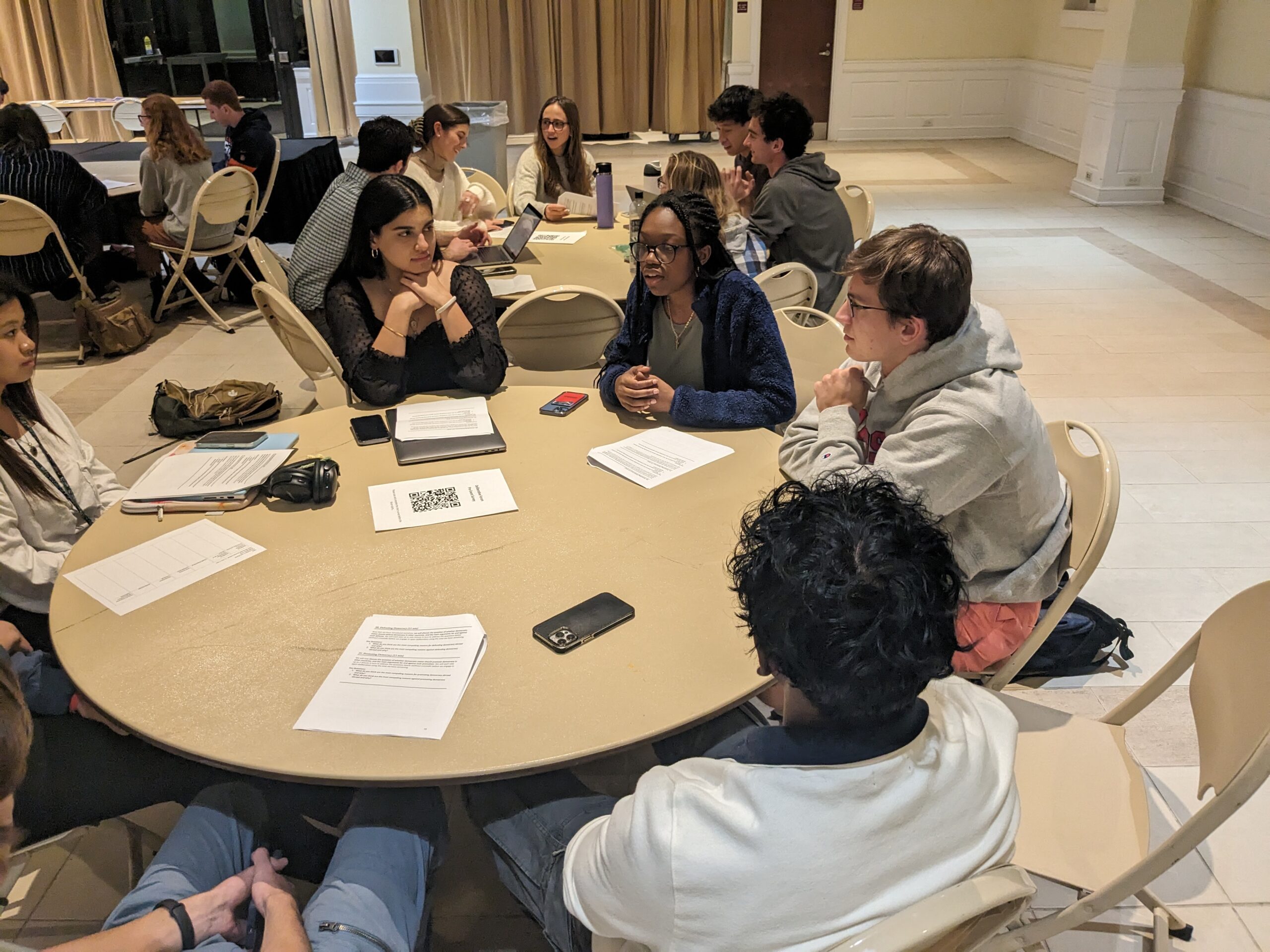
This was the case a few weeks ago when sickness prevented me from physically attending the DCI’s first facilitator training session of the year, but a well-integrated virtual option allowed me to still take part. A week later, no longer ill, I attended the second training session in-person. Each session featured a mock deliberation, and comparing my experience in this activity across the two mediums allowed me to think about the benefits and drawbacks of each as a conduit for constructive and meaningful deliberation.  

One of the stated goals of the DCI is to build community via deliberation. When we hear the word community, there can be an inclination to view it as rooted in a physical location (college community, neighborhood community, etc.). However, digital platforms disrupt this notion, allowing deliberative communities to form that transcend physical location.  

My deliberative group on Zoom was geographically diverse, and also more diverse along racial and generational lines than my in-person group.   

This was certainly no coincidence; the town of Davidson is over 85% white compared to a national average of 60%. And because of the College, most of my in-person group was composed of fellow students. Meaningful deliberation requires a diversity of viewpoints, and one way to increase that diversity is through participation from individuals with different life experiences, demographic backgrounds, and identities. The geographic segregation of America makes this difficult, but virtual engagement makes it more possible, allowing individuals to join the collective act of deliberation regardless of their location.   

Community-building also relies on the quality and authenticity of interaction. During my in-person mock deliberation, I found nuanced elements of human interaction, such as eye contact and body language, to be a critical part of this process. The conversation flowed in a manner that I hadn’t experienced on Zoom, and I left feeling a deeper connection to the individuals whom I deliberated with. 

Perhaps this was also a product of my concentration. On Zoom, I found it more challenging to feel actively engaged in the conversation as the effects of staring at a computer screen sapped my focus. Face-to-face, I was invigorated by the emotions of those around me and felt like it took far less effort to maintain a necessary level of engagement.  

Ultimately, rather than determine that one medium is unequivocally better than the other for deliberation, I came to the conclusion that each has its own strengths and weaknesses and has an important role in furthering the DCI’s mission. Some elements of the in-person experience that aid in building community are lost over Zoom. However, Zoom increases the accessibility of deliberation, exposing individuals to viewpoints that they might not otherwise encounter in their daily lives.  

From a pessimistic perspective, one could argue that something is lost in each medium. However, I prefer a more optimistic stance, appreciating each medium for the unique deliberative experience it has to offer. 

Note: The image above was generated by ChatGPT4.

Filed Under: Blog Posts, Fellow Posts Tagged With: deliberation, facilitation

“Let’s Deliberate!” The DCI’s Partnership Program

November 13, 2023 by Graham Bullock

weaving

Is there a difficult or contentious issue of public concern that your organization, program, department, office, or business would like to have a conversation about, but you are hesitant because you don’t know how it would go? Do you see the value of such a discussion but are not sure how to organize it effectively?

If so, the Deliberative Citizenship Initiative (DCI) may be able to help through its Deliberation Partnership Program, Let’s Deliberate! Every year, the DCI’s Fellows organize their own deliberation projects on topics that are of interest to them and others in our community. They could assist you in designing and facilitating a conversation on a topic that members of your group are interested in discussing. These Fellows are Davidson students who have gone through intensive deliberation facilitation training and have served as facilitators of the DCI’s Deliberative “D” Teams and Deliberative Forums.

If you are interested in exploring this option with one of our Fellows or other collaboration opportunities, please email dci@davidson.edu with your ideas. You are welcome to share some information about your group or organization and what topic of public concern that you would like to discuss. While we cannot guarantee that we will be able to match you with one of our Fellows, we will make our best efforts to do so.

To learn more about the DCI’s LET’S DELIBERATE Deliberative Citizenship Partnership opportunities, check out this page.

Filed Under: Announcements, DCI Posts

  • « Go to Previous Page
  • Page 1
  • Interim pages omitted …
  • Page 46
  • Page 47
  • Page 48
  • Page 49
  • Page 50
  • Interim pages omitted …
  • Page 75
  • Go to Next Page »

Footer

Blog Post Categories

  • Announcements
  • Blog Posts
  • DCI Posts
  • Events
  • Faculty Posts
  • Fellow Posts
Image of a compass superimposed by the text "Deliberative Citizenship Initiative" and "Davidson College." Clicking on this image leads to the Initiative page.

Recent DCI Blog Posts

  • We Tried to Fix Jubilee’s “Middle Ground” – Here’s How It Went
  • A Case for Deliberation in the Natural Sciences
  • Welcoming New Staff to the DCI and DCN
  • Facebook
  • Twitter
  • Instagram
  • LinkedIn


Copyright © 2026 · Infinity Pro on Genesis Framework · WordPress · Log in