Ziziphus jujuba – Indian jujube
Horticulture
Common kind is hardy as far north as southern New England, but is best suited for regions of long, hot, dry summers. It does well even in decidedly alkaline soil. The Texas jujube requires similar climatic conditions. The Indian jujube thrives in Florida and elsewhere in a variety of soils. Mountains, hills, sunny dry slopes, plains, also widely cultivated. Late fall or early winter. Tolerates poor soil. Fruits inn late fall or early winter. Medium water. Not suitable for containers. Easily grown in average, medium moisture, well-drained soils in full sun. Best in hot and somewhat dry climates in full sun. Plants tolerate alkaline soils. Mature plants have some tolerance for drought, but perform best with regular and consistent moisture. Avoid heavy, poorly drained soils. Plants will sucker from the roots. Other than pruning to keep them shapely, no special care is needed. Propagation is by seed, which should be removed from the stones before sowing.
Nomenclature/History
This plant is sometimes called Ziziphus zizyphus.
Botany
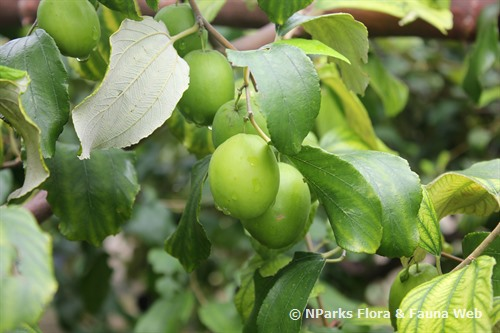
Trees small, rarely shrubs, deciduous, to 10 m tall, spinose or unarmed. Bark brown or gray-brown, with long reduced branches, without buds; branchlets (new branches) purple-red or gray-brown, flexuose, smooth, with 2 stipular spines or not; long spines erect, to 3 cm, stout; short spines recurved, developed from old branches; annual branchlets pendulous, green, solitary or 2-7-fascicled on short shoots. Stipular spines slender, caducous; petiole 1-6 mm, or to 1 cm on long shoots, glabrous or sparsely puberulent; leaf blade abaxially pale green, adaxially dark green, ovate, ovate-elliptic, or elliptic-oblong, 3-7 × 1.5-4 cm, papery, abaxially ± puberulent on major veins or glabrous, adaxially glabrous, 3-veined from base, base slightly asymmetric, subrounded, margin crenate-serrate, apex obtuse or rounded, rarely acute, mucronulate. Flowers yellow-green, bisexual, 5-merous, glabrous, solitary or 2-8 crowded in axillary cymes, shortly pedunculate. Pedicel 2-3 mm. Sepals ovate-triangular, adaxially distinctly keeled. Petals obovate, ca. as long as stamens, clawed at base. Disk orbicular, thick, fleshy, 5-lobed. Ovary basally slightly immersed in disk; style 2-cleft to half. Drupe red at maturity, turning red-purple, oblong or narrowly ovoid, 2-3.5 cm, (0.5-)1.5-2 cm in diam.; mesocarp fleshy, thick, sweet- or sour-tasting; stone acute or obtuse at both ends, 2-loculed, 1- or 2-seeded; fruiting pedicel 2-5 mm or longer. Seeds compressed-orbicular, ca. 1 × 0.8 cm, Fl. May-Jul, fr. Aug-Oct. 2n = 24*, 36*, 48*.
Plant Uses
Seeds used for relieving muscle spasms, as a tranquilizer, or to treat insomnia, neurasthenia and night sweats.)
