By Liam Mann ’27 (DCI Fellow)
Last year, DCI Fellow Declan O’Donoghue wrote a blog post about Jubilee Media’s “Middle Ground” and “Spectrum” series on YouTube. Middle Ground groups together people from opposing sides (examples: minimum wage workers and millionaires, ex-felons and cops, fit men and fat men), while Spectrum groups people from the same background (teen moms, high schoolers, men) to engage in discussions about their differences in thought, as well as find common ground. These series include some of the most-watched videos of their kind available on YouTube.
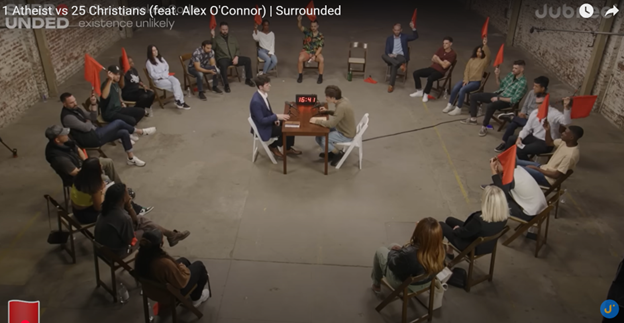
Recently, Jubilee has started a new series called “Surrounded.” In these videos, 20 people from one side of the political spectrum sit in a circle around 1 person from the other side who is an established politician or debater with extensive experience explaining their viewpoints. A claim that the central person makes is stated to the audience, and a timer ticks down. Once the timer beeps, a clock starts, and the most motivated of participants rush to the center seat to debate the claim. While the person who reaches the seat first explains their viewpoint, participants not involved in the debate can raise red flags to signal that they want the participant seated to be replaced. When more than half of the participants have raised flags, the participant is removed. This continues until the clock runs out of time, where the central debater then makes a new claim and the cycle repeats. After the claims (5 total) have been exhausted, the person at the center chooses a member from the circle to deliberate a topic of the circle member’s choosing for a 10-minute period.
The “Surrounded” series offers a new and innovative mode of discourse to a wide audience. However, I believe that its structure is less constructive and less deliberative than either “Middle Ground” or “Spectrum.” It is more of a series of mini debates in which participants try to attack each other’s arguments rather than explore the topic in a more deliberative fashion. Why is this the case? First, the red flag policy is not conducive to a productive exchange of ideas. If circle participants feel like their person is “losing” the argument, they will likely vote that person out. This may prevent significant points and ideas from being made. The red flag policy may also make it more difficult to advance conversations and for participants to change their minds. Participants may also have been more likely to engage in anti-deliberative practices, such as interruption and snide comments, to maximize their time debating.
Secondly, the 20-person structure led to great inequality of speaking time. Because participants had to rush to the middle chair to get their voice heard, the most motivated deliberators got much more time to talk than others. In fact, there were many deliberators in the videos that never spoke at all. This led to less diversity of opinion, as many people came up to the middle chair multiple times with the same logic and lines of reasoning (although they could not come up multiple times in the same question).
Third, the structure lacks a facilitator and guidelines that encourage participants to adopt more deliberative dispositions and engage in a respectful exchange of ideas. Rather than encouraging everyone to be open-minded and listen to learn from each other, the model opens the door for personal attacks and creates a more adversarial “win-or-lose” atmosphere focused on listening to re-load and respond.
I thought the best part of the video structure was the 10 minute debate that concludes each session. The central deliberator in both videos chose people that had engaged in challenging conversation and brought up good points. In addition, the prevention of red flag removal in this stage led to the continuation of idea-changing conversation instead of sudden interruption.
“Surrounded” offers a quite entertaining viewing experience, and many clips have gone viral across various social media sites. While “Surrounded” has many issues that limits the quality and amount of productive engagement that occurs, there were bright spots in the videos. Ultimately, Jubilee can hopefully continue to make videos that promote better public discourse to a wider audience and have a role in positively shaping our nation’s political climate.