This was the moment: After all the training, mock deliberations, and facilitations within the Fellows group, it was finally time to conduct my own D-Team. I had reviewed my facilitator’s guide and toolkit before arriving to make sure I was fully prepared.
About an hour into the meeting, there was a lull in the conversation, so I chose to ask a prompting question that would hopefully encourage more discussion. As I thought about what to say, though, I realized that one thing I hadn’t really thought about was how to ask a question neutrally without accidentally saying something that would show a preference for either side. Though I did eventually find something to say that was down the middle of the discussion, it led me to think about how the wording of questions can influence a discussion.
This topic doesn’t just apply to DCI’s deliberative teams or forums; we see the challenge of neutrally asking questions everywhere, from court cases to presidential debates. The problem with asking questions with a bias is that it can put people on the defensive, close down the conversation, or cause someone to go on the attack. When it feels like the facilitator is favoring one perspective over another, it can also leave participants feeling shut out of the conversation, which is the opposite of what a good deliberation should do.
It can also escalate a conversation from a discussion to a debate when it feels like the moderator is purposely trying to challenge your principles or values. For example, on the topic of the DCI’s forum on economic inequality, a question beginning with the statement, “If we all agree that equal opportunity is a good place to start… ” may shut some out of the discussion when not all members of the group have agreed on that assumption.
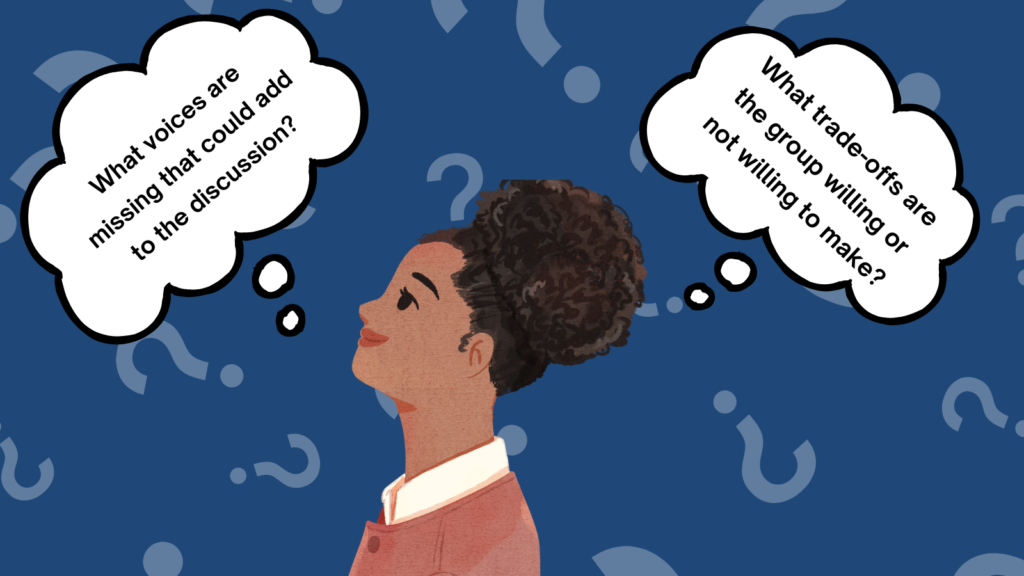
In addition to furthering a discussion, questions can also be used to understand participants’ beliefs. Because an important part of deliberation, in addition to being a neutral ground to discuss ideas, is to listen to other people’s perspectives and what motivates their values, asking questions of participants to hear more of their opinion is very important as well. If a participant expresses a viewpoint that has yet been unsaid in the group, the facilitator should not be afraid to ask about why they hold this view, as long as they do so in a non-confrontational and non-targeting way.
Another important way questions can be used by a facilitator is to bring out perspectives that are not included at the table. Sometimes D -Teams can hold more homogeneous viewpoints. In these cases, asking a question from someone else’s perspective can help to broaden the group’s area of discussion. To prevent the participants from believing that this is the facilitator’s viewpoint, the facilitator should always make sure to clarify when they are playing “devil’s advocate” or choosing to bring a new idea into the deliberation.
As a new facilitator, I’ve realized that there are many skills I’ve developed as I’ve gained more experience, such as when to step into a conversation or when to leave the floor more open. Additionally, I’ve been figuring out how to ask questions that are unbiased while still guiding the group farther into a discussion. Despite starting this post with a situation that may not apply to everyone, learning how to further a conversation with a neutral tone could be helpful in lots of different contexts. For example, when dealing with an argument with a friend, learning how to say what you want without attacking their thoughts could be very important to preserving that relationship. In addition, as deliberation becomes more and more important and hopefully widespread, the ability to ask unbiased questions can help moderators everywhere keep their conversations on track, framed in a neutral manner, and moving forward towards greater mutual understanding.